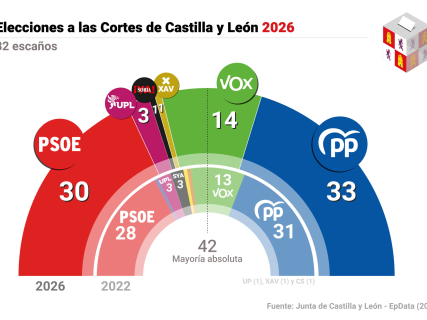

This is how the final distribution of seats in the Parliament of Castile and León stands
With 99.33% of the vote counted, the composition of the Castilian-Leonese Parliament is as follows:
In data
Result of the Castilla y León elections 2026:
PP: 33 procurators (35.47%)
PSOE: 30 procurators (30.74%)
Vox: 14 procurators (18.92%)
UPL: 3 procurators (4.35%)
XAV: 1 procurator (0.91%)
SY: 1 procurator (0.70%)
The absolute majority stands at 42 seats, which forces the PP to pact with Vox if it wants to form a Government.
Results of the elections of Castilla y León, municipality by municipality
The breakdown of the electoral results municipality by municipality in the regional elections of Castilla y León allows for a more precise analysis of voting behavior in the territory. This interactive graphic shows which political forces prevail in each locality, how support varies between urban and rural areas, and which municipalities concentrate the main changes compared to previous elections.
Number of deputies obtained in each province in the elections of Castile and León 2026
This graphic shows the distribution of procurators obtained by each party in the different provinces of Castilla y León after the 2026 regional elections. The visualization allows identifying which formations dominate in each territory and how parliamentary power is distributed within the community.
Evolution of the scrutiny of the Castilla y León 2026 elections
This graphic shows the evolution of the scrutiny of the regional elections of Castilla y León in 2026 as the votes from the different polling stations were incorporated. It allows observing how the electoral result has been configured in real time and how the position of each party changes throughout election night.
The distance between the last match with a seat and the next one
This interactive graphic analyzes one of the most relevant indicators of the electoral system: the distance in votes between the last party that achieves parliamentary representation and the first candidacy that is left out of the Cortes of Castilla y León. The comparison allows measuring electoral competitiveness and the impact of the seat distribution system in each constituency.
It also helps to understand how many votes have been necessary to enter the autonomous Parliament and which formations have remained closer to achieving representation.
Difference in votes in the elections of Castilla y León by provinces between 2022 and 2026
In this section, the results of the 2026 regional elections of Castilla y León are compared with those obtained in the previous elections of 2022. The analysis shows the difference in votes by provinces and allows identifying which parties have gained or lost electoral support in each territory.
Results: historical evolution of each party
This interactive graphic shows the historical evolution of the vote of the main political parties in Castilla y León from the first regional elections until the 2026 elections. The historical series allows observing the changes in the political balance of the community and the transformation of the party system.
In Castilla y León, the PP has dominated the political landscape for decades, exceeding 50% of the vote in elections such as those of 1995, 1999, or 2011. The PSOE has maintained more stable percentages, with a maximum of 37.7% in 2007 and 30.0% in 2026. For its part, Izquierda Unida achieved its best result in 1995 (9.5%), while Podemos burst onto the scene strongly in 2015 (12.1%) and fell to 5.1% in 2022. Both parties were left out of the regional Parliament in 2026. Vox went from being a residual force in 2015 (0.7%) to consolidating itself as the third political force after achieving 17.6% of the vote in 2022.
Seats obtained by the PP
This chart analyzes the evolution of the seats obtained by the Popular Party in Castilla y León throughout the different regional legislatures. It allows observing how the parliamentary weight of the PP has varied in the community and comparing its result in the 2026 Castilla y León elections with those obtained in previous elections.
Seats obtained by the PSOE in the regional elections
This chart analyzes the evolution of the seats obtained by the PSOE in Castilla y León throughout the different regional legislatures. It allows observing how the parliamentary weight of the socialist party in the community has changed and comparing its current result with that of previous elections.
Seats obtained by Vox
The evolution of Vox's vote and seats in Castile and Leon reflects the growth of this formation in the community during the last electoral cycles. The graph allows analyzing its consolidation as a third political force and its capacity to influence in the formation of parliamentary majorities.
Seats obtained by Podemos and United Left
This chart shows the historical evolution of Izquierda Unida and Podemos in Castilla y León, from their best results in the nineties until their loss of parliamentary representation in the last regional elections.
Seats obtained by the regionalists
The evolution of regionalist formations in Castilla y León shows the role that parties like UPL or Soria ¡Ya! have played in regional politics. The graphic allows observing their territorial impact and their influence in certain provinces.
Participation in the elections of Castilla y León 2026
Turnout figure in the 2026 regional elections
Turnout in the regional elections of Castilla y León in 2026 stood at 65.66%, which is 6.91 points more than in the 2022 elections. The increase in electoral mobilization reflects greater citizen interest in election day and a higher turnout than that recorded in the previous legislature.
Participation by provinces in Castile and Leon
This graphic breaks down electoral participation by provinces in the regional elections of Castilla y León in 2026. The visualization allows identifying territorial differences in voter mobilization within the community. The highest participation rate is registered in Valladolid (69.06%), while Zamora is the province where electoral mobilization grows the most compared to the 2022 elections, with an increase of 9.96 points.
Success of Demócrata's special on the Castilla y León 2026 elections
Democrat has launched this Sunday an interactive electoral special to follow live the results of the Castilla y León 2026 elections, with permanent data updates as the scrutiny advanced.
The special allows consulting results by province and municipality, with interactive maps and visualizations that show the evolution of the vote, the distribution of seats and the changes compared to previous elections and has been one of the great audience successes in number of views since the creation of this medium.
Readers can continue accessing the detailed results from this page:
Results by provinces: where to see the detail of the vote
The electoral special also includes direct access to all provinces of Castilla y León, allowing to see the electoral behavior in each territory.
You can click here to see the results of the elections in Castile and León by each province:
• Ávila
• Burgos
• León
• Palencia
• Salamanca
• Segovia
• Soria
• Valladolid
• Zamora
This territorial monitoring allows analyzing how the vote remains in each province and how the autonomous Parliament is distributed during election night.
Calendar: these are the deadlines to negotiate the investiture and form government
After the election night, Castilla y León now enters the decisive phase of the legislature: the negotiation for the investiture and the formation of the new autonomous Government. In the coming weeks, the institutional calendar will open, which includes the constitution of the Cortes, the election of the Bureau, and the investiture debate of the president of the Junta. From that moment on, the parties must finalize agreements that allow guaranteeing the governability of the community and defining the parliamentary majority that will support the next Executive.