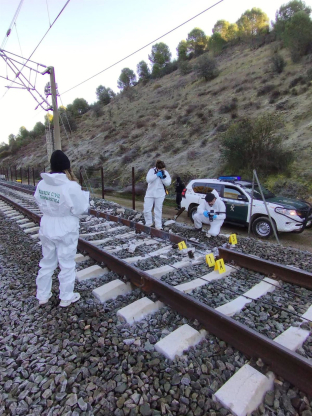

A report prepared by the Civil Guard and sent to the Court of First Instance of Montoro (Córdoba), square number 2, certifies that the track was already broken 22 hours before the derailment of the Iryo train which, in a matter of seconds, collided with the Alvia near Adamuz, causing on the afternoon of Sunday, January 18, the death of 46 people and more than 120 injured.
According to the document, to which Europa Press has had access, it is detailed that "the system only alerts of a break if the tension falls below the 'occupancy' threshold," so that "in the case of Adamuz, the Maintenance Support System (SAM) registered a sudden drop in tension on the night of January 17, but by remaining above the threshold, it did not generate any alarm to the interlocking or to the maintenance personnel" of Adif.
The agents conclude that "the SAM system passively registered an electrical alteration compatible with a break hours before the accident, but the signaling system was not configured to automatically alert of it due to the unreliability of the method in this railway infrastructure", and they add that "Adif, despite containing in its specifications that it must be designed to detect the fracture, did not demand it".
In the documentation also appears a technical report, still in draft phase, from the Railway Accident Investigation Commission (CIAF) about the Adamuz accident, which had already pointed out weeks ago a voltage drop compatible with the breaking of the track 22 hours before the derailment, all of this "based on the records of the electrical signals from the track circuits in the area, maintained by Hitachi", responsible for the signaling system.
(((There will be an expansion)))