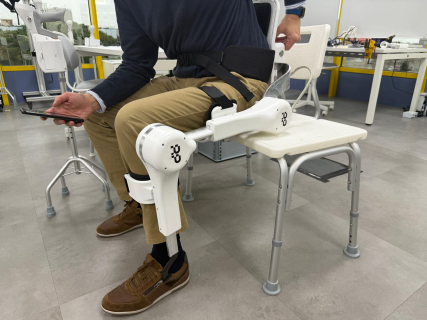
The Government has long aimed to develop technology applied to health, and has taken an important step in this regard with a new investment in the field of assisted mobility. The Spanish Society for Technological Transformation (SETT), dependent on the Ministry for Digital Transformation and Public Function, will allocate more than 600,000 euros to the Spanish company Robopedics to boost the development and commercialization of a bionic solution aimed at people with severe motor disability.
The operation is part of an agreement between both parties and aims to bring to market Awake, a device designed to robotize the leg affected by paralysis. Unlike other existing systems, which require support on both limbs, this technology acts only on the affected leg. The device weighs less than six kilograms —less than half that of other comparable equipment—, features a more compact and easy-to-place design, and reduces the final price by around 80%.
We invest more than €600,000 in @robopedics to boost bionic technology applied to mobility.
— Ministry of Digital Transformation Public Function (@mintradigital) March 24, 2026
The device incorporates AI algorithms that detect gait phase, weight transfer, and prevent falls, synchronizing assistance with the user's movement. pic.twitter.com/n6ItAhietZ
The system incorporates algorithms capable of detecting the gait phase, managing weight transfer, and preventing falls, which allows matching the assistance to the user's natural movement and improving safety. These algorithms are supported by an artificial intelligence model trained with data from six healthy subjects, including sitting posture patterns and falls, with the aim of facilitating a more fluid interaction between the machine and the user.
Robopedics, founded in Barcelona in 2021, develops bionic solutions aimed at recovering the ability to walk in patients with severe mobility problems, especially after having suffered a stroke. Specifically, the device is aimed at people with hemiplegia or hemiparesis who depend on a wheelchair. Globally, more than one hundred million people have survived a stroke, and more than twenty million use wheelchairs.
Public investment is part of a capital increase of 1.7 million euros for the company and is part of the public-private collaboration strategy promoted by the SETT. With it, the Executive seeks to accelerate the implementation of advanced technologies in the healthcare sector, with the aim of improving system efficiency and patients' quality of life.
The operation also has an impact on the scientific and industrial fabric, relying on collaborations with technology centers, universities and reference hospitals such as the Institute of Biomechanics of Valencia, LEITAT, Hospital Clínic, Institut Guttmann or Hospital del Mar. In addition, the project foresees the creation of nearly 200 qualified jobs between 2025 and 2032.
The investment is channeled through the Next Tech facility, driven by the Secretary of State for Digitalization and Artificial Intelligence and financed with funds from the Recovery, Transformation and Resilience Plan. This instrument is aimed at facilitating financing for technological startups and scale-ups.
Alongside this initiative, the SETT manages two other instruments aimed at strengthening the technological ecosystem: the PERTE Chip, focused on microelectronics and semiconductors, and the Spain Audiovisual Hub, focused on the digitalization of the audiovisual sector.