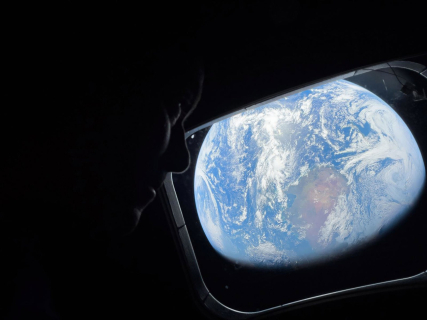

The mission Artemis II has entered its decisive phase after leaving Earth's orbit and heading for the Moon, in what represents the return of manned deep space exploration more than half a century after the Apollo program. The Orion spacecraft, with four astronauts on board, now faces the key moments of a mission that combines historical milestones with significant technical challenges.
Heading to the Moon after the translunar injection
The crew, formed by Reid Wiseman, Victor Glover, Christina Koch and Jeremy Hansen, has already completed the trans-lunar injection phase, a critical maneuver that propels the spacecraft towards an elliptical orbit in the direction of the satellite.
This step marks the halfway point of the mission and confirms the correct functioning of the Orion capsule's systems, designed to operate in conditions of deep space, beyond the protection of the Earth's magnetic field.
During these days, the astronauts are focused on verifying systems, preparing experiments, and planning observations, especially in view of one of the most anticipated moments: the flyby of the far side of the Moon.
The hidden face and a new space record
One of the most relevant milestones will take place on April 6, when the spacecraft reaches its maximum distance from Earth, exceeding 406,000 kilometers. With this, Artemis II will break the record set by Apollo 13, which until now held the record.
At that point, the crew will be able to observe and photograph areas of the far side of the Moon, becoming the first humans in decades to directly contemplate these regions.
However, this moment also implies an operational risk: the spacecraft will be incommunicado with Earth for between 30 and 50 minutes, as the Moon comes between Orion and the Deep Space Network. During that period, the astronauts must operate completely autonomously.
The return, the most critical phase
The final stage of the mission, scheduled between April 10 and 11, will be the most delicate. The return to Earth will require a series of high-precision technical maneuvers.
Before re-entry, the crew will perform manual piloting tests, critical systems tests, and radiation protection protocols, in addition to adjusting their equipment to withstand the return to Earth's gravity.
The key moment will arrive when the capsule separates from the service module and prepares to enter the atmosphere at a speed close to 40,000 kilometers per hour. At that instant, the heat shield must withstand extreme temperatures, in the most dangerous phase of the entire mission.
If everything goes as planned, the parachutes will deploy and the capsule will splash down in the Pacific Ocean, where NASA teams will proceed with the recovery of the crew.
A key mission for the lunar future
Artemis II does not include a moon landing, but it is a fundamental step within NASA's program to return to the Moon in a sustained manner and prepare future crewed missions, including Artemis III, which does foresee the return of humans to the lunar surface.
Beyond the symbolic component, the mission will serve to validate technologies, procedures and human capabilities in an environment that will be key for the next stage of space exploration.