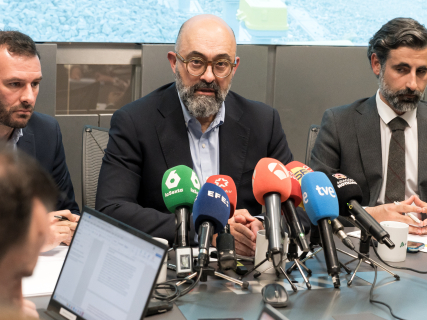
The president of Adif has downplayed this Monday the forcefulness of the latest report from the Civil Guard in the investigation of the railway accident in Adamuz (Córdoba) and has assured that, for the moment, “there is no certain proof” that allows concluding that there was a track breakage at the point of the accident.
The head of the public entity, Luis Pedro Marco de la Peña, has responded to the conclusions gathered in an official letter sent to the investigating judge, in which a possible fracture of the rail or the weld was pointed to hours before the train's derailment. In his appearance, he has insisted that those indications cannot yet be considered decisive.
“It is not a conclusive test”
Marco de la Peña has argued that the voltage drop recorded in the track circuit at the point of the accident cannot be interpreted as direct evidence of a break. As he explained, these systems are designed for track occupancy detection, but not for precisely identifying cracks or partial failures in the rail.
“The system cannot be considered a reliable mechanism for detecting breaks,” it pointed out, emphasizing that only a total fracture completely interrupts the electrical circuit. In that sense, it asked for caution when drawing conclusions while the expert reports continue.
Differences with the report of the Guardia Civil
The report of the Civil Guard indicated that a voltage drop registered in the system could be compatible with a break in the affected section of the Madrid-Seville high-speed line.
However, the president of Adif has maintained that that interpretation is not conclusive and that the behavior of the electrical circuit can be altered by multiple factors without that necessarily implying a rail fracture.
Call to wait for the expert reports
The head of the entity has insisted that the case remains open and that any hypothesis must be subject to the ongoing technical reports. He has also defended that the infrastructure complies with current security standards and that all elements involved in the affected section are being reviewed.
In parallel, it has assured that Adif collaborates with the investigation and that no relevant information has been hidden, at the same time that it has reiterated its willingness to assume responsibilities if any negligence were detected, although it has asked not to anticipate conclusions while the technical analyses do not conclude.