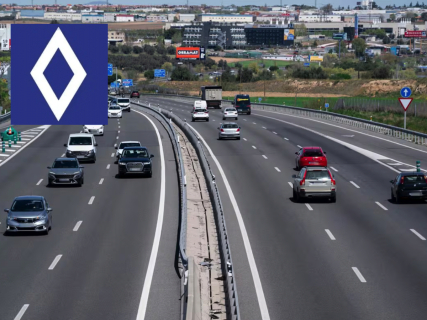

The sign with a white diamond on a blue background identifies a HOV lane, that is, a lane reserved for high-occupancy vehicles. It is not a simple recommendation nor a decorative mark on the road: it warns that this section has specific conditions of use and that not all cars can circulate on it freely.
In these lanes, the general rule in 2026 is to prioritize high vehicle occupancy over its environmental label. That means that passenger cars with a single occupant, even if they have a 0 emissions, ECO, C or B badge, can no longer use them automatically unless the variable signage of the section expressly allows it. The DGT introduced this change in the resolution of special traffic measures for 2026.
Who can use the VAO lane and who cannot
In general, vehicles that meet the minimum number of occupants set for that section, normally two people including the driver, as well as motorcycles, public transport, and other authorized vehicles according to the specific signage, can circulate in these lanes. That's why it's not enough to see the white diamond: you also have to look at the illuminated panels and the access regulation on each road.
This signage already affects several strategic points of the road network. The 2026 resolution includes HOV lanes on the A-6 and A-2 in Madrid, the V-21 in Valencia, the Ma-19 in Palma and several sections in Granada, Seville and Malaga, among others. That is to say, it is not an isolated change nor only from Madrid: it will appear more and more in metropolitan accesses and corridors with a lot of traffic.
The fine if you ignore this sign
Here is the data that really clicks and serves: using a VAO lane without meeting the conditions can result in a fine of 200 euros. That figure appears repeatedly in the information published about the new sections and in specialized explanations about the operation of these lanes in 2026.
Why the DGT has toughened the use of VAO lanes
The DGT explains that the objective is to recover the effectiveness of these lanes to improve traffic flow and favor public transport and carpooling. According to the Ministry of Interior and the DGT itself, the increase in passenger cars with a single occupant, including some electric ones, was reducing the usefulness of VAO lanes and generating recurrent traffic jams in them.
Put another way: the 2026 message is quite clear. Before, the focus was more on the type of car; now it is on how many people are inside. And that turns the white rhombus into a much more relevant signal than it seems at first glance.
What you should do if you see this sign on the road
If you see the white rhombus, do not enter by inertia. Check if your vehicle meets the lane conditions, review the required number of occupants and look at the variable signage of the access. In 2026 it will no longer be valid to assume that by having a 0 or ECO label you can always pass.