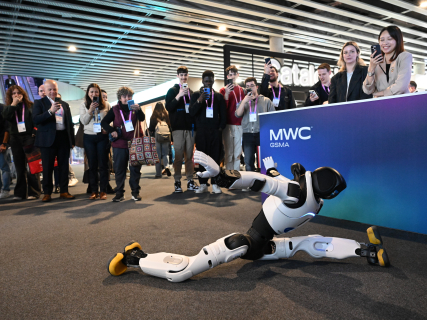

For four days, Barcelona once again became the epicenter of global technology. The Mobile World Congress (MWC26) gathered 105,000 attendees from 207 countries, nearly 2,900 exhibitors, and more than 1,700 speakers, confirming the event's weight as one of the main debate forums of the digital sector.
But beyond the announcements and technological demonstrations, this year's edition left a shared feeling among analysts and executives: the industry is advancing rapidly in technology, but is still looking for how to convert that advance into real growth.
Artificial intelligence drives the new phase of the industry
Artificial intelligence was, without discussion, the great protagonist of the congress. From linguistic models to robotics, AI was present in almost all panels and presentations. For the telecommunications sector, its application is already transforming network management, allowing processes to be automated, operational efficiency to be improved, and costs to be reduced.
But it also became clear that efficiency alone is not enough. During several sessions organized by the GSMA, experts insisted that the real challenge lies in transforming artificial intelligence into new revenue streams. As Peter Jarich, of GSMA Intelligence, summarized, “the industry needs to go beyond using AI solely to reduce costs and start demonstrating its value in revenue”. In other words: growth is not achieved by saving alone.
The dilemma of profitability and competitiveness
That debate connects directly with one of the sector's major concerns. After years of heavy investments in infrastructure —especially in the deployment of 5G— operators continue to face a profitability dilemma. Networks are increasingly advanced, but a good part of the economic value that circulates through them ends up in the hands of digital platforms and third-party services.
Therefore, the congress left a quite clear conclusion: operational efficiency is no longer enough to sustain the balance sheet of telcos. The debate has evolved from the technical capacity of networks towards the viability of the business model. Operators, historically responsible for digital infrastructure, are now looking for ways to avoid being relegated to simple connectivity providers.
In parallel, there was no shortage of voices from the sector that warned about the need to strengthen the technological competitiveness of Europe and guarantee a regulatory framework that incentivizes investment in digital infrastructures, increasingly considered as a strategic element for economic growth and the technological autonomy of the continent.
From the technology employers' association DigitalES they recall that “digitalization relies on a very tangible base: networks, data centers, infrastructures, and technological talent. If we want artificial intelligence and new digital services to generate growth and employment in Europe, we need an ecosystem that incentivizes investment in that critical infrastructure and that allows technological innovation to be transformed into economic and social prosperity”.
Social and security challenges
Artificial intelligence also opened other global-reaching debates. One of them was the AI linguistic gap. In a session held on the Turing stage, experts recalled that, of the more than 7,000 existing languages in the world, fewer than twenty currently have high-performance AI models. This poses the risk that billions of people will be left out of the economic and educational opportunities offered by this technology.
Robotics was another of the topics analyzed. Kate Darling, researcher and author specializing in the relationship between humans and machines, warned that expectations about robots are often excessive. As she explained, their real value is not in imitating people, but in complementing human capabilities through specific tasks in which machines can excel.
Alongside the technological debates, the congress also addressed an increasingly urgent problem for the digital ecosystem: online scams and fraud. With billions of dollars lost each year due to identity impersonations and social engineering attacks, experts agreed that it is a global threat that demands greater cooperation among operators, platforms, and authorities. As warned by the GSMA's Chief Technology Officer, Alex Sinclair, “fraud knows no international borders”.
The twentieth anniversary of the Mobile World Congress (MWC26) in Barcelona reflects the moment of transition the industry is experiencing. Never has there been so much technological capacity or such advanced networks, and the digital economy today has a much greater weight than two decades ago. However, the challenge remains the same: transforming that technological potential into a sustainable business model.