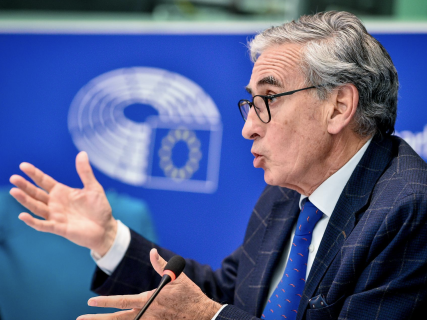


One of the national sports of Belgium could be meeting up to "have coffee". In that championship, the Café Belga, in Flagey square, would be its Olympic stadium. The setting is known for its cosmopolitan atmosphere; during the day it hosts endless gatherings. The daytime facet of the establishment is also witness to great alliances. There, in the symbol of the social life of the neighborhood of Ixelles, we meet someone who knows firsthand the workings of the community capital.
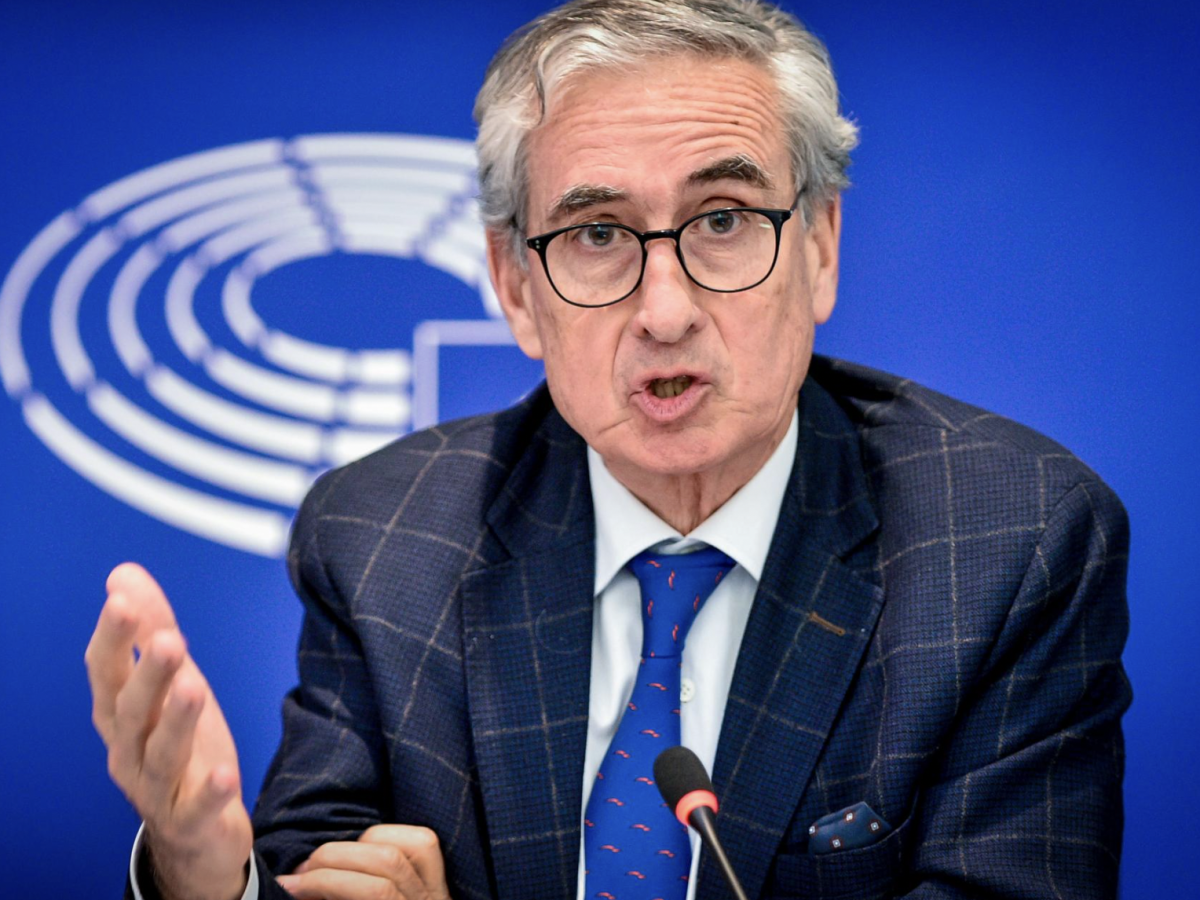
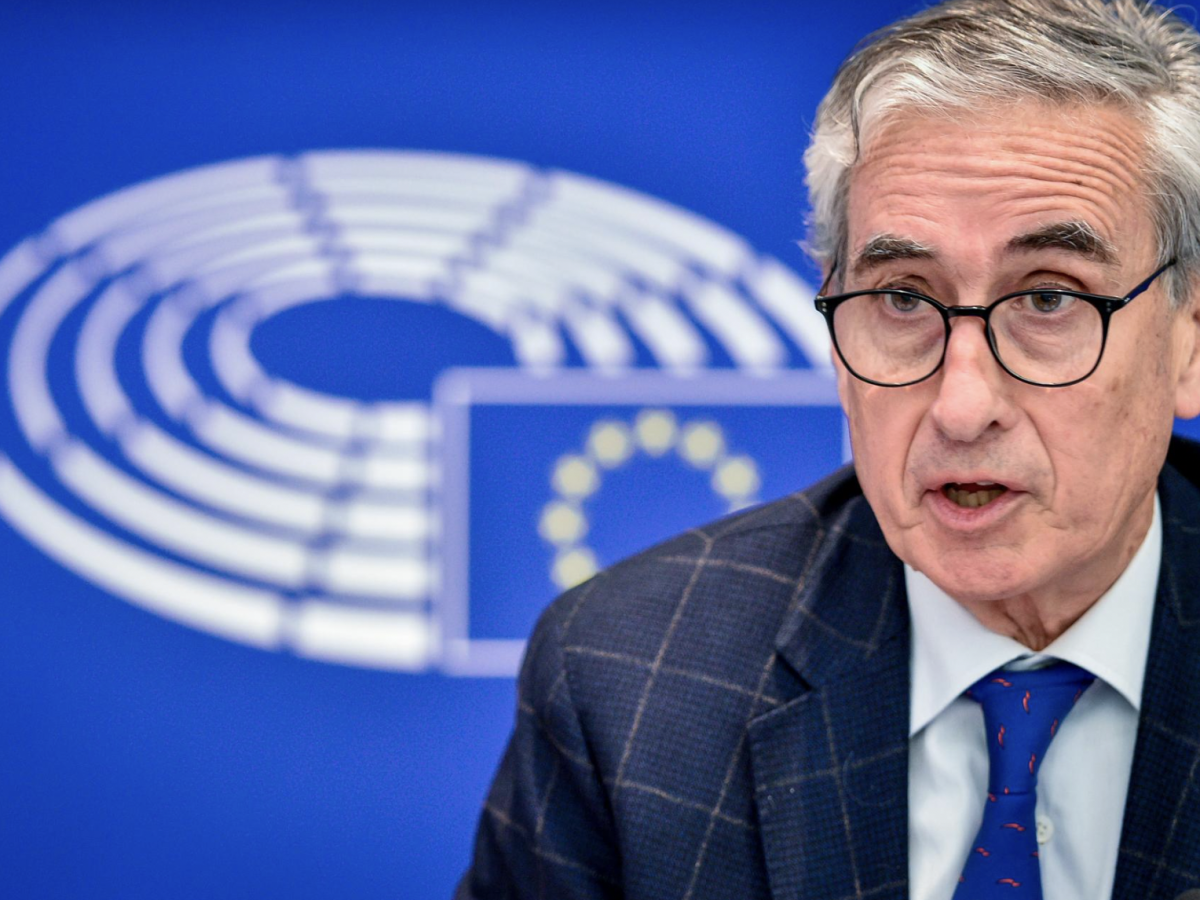
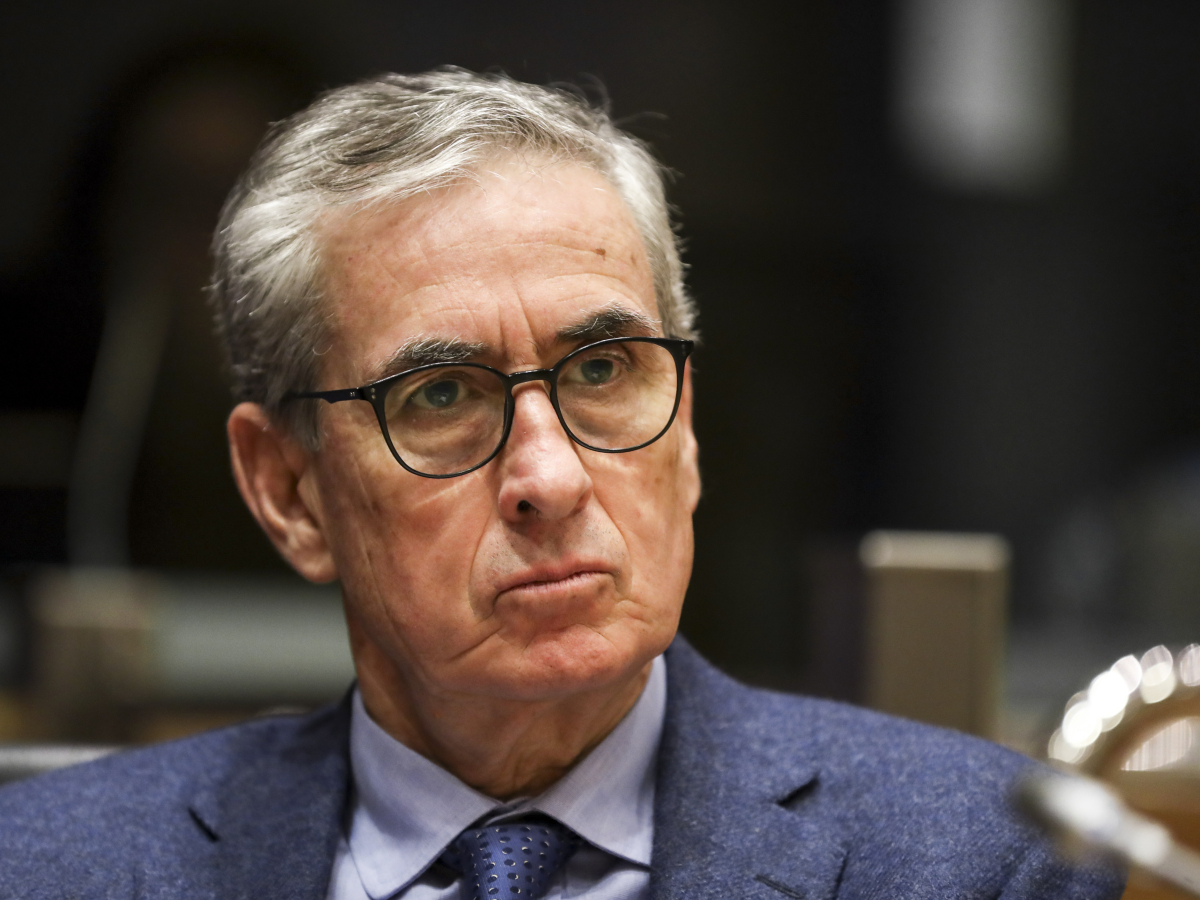
Ramón Jauregui (1948) arrives dodging the characteristic rain of the country. While waiting for his cup of decaffeinated coffee, he reflects on the latest events in national politics, including the Sánchez-González relationship, on the condition that they do not form part of the conversation that seeks to serve as a thermometer of the current situation of the continent. It has been one legislature since he left European institutions, thirty-five years since his time in the Basque Government and fifteen since his period in Moncloa under the command of José Luis Rodríguez Zapatero.
His/Her X-ray of the European context is that of someone who understands the community rhythm, its times, balances, but also its opposing interests. From a cafeteria surrounded by ponds and confidences, he/she opens the door for those currently on the political front line to open the debate on defense spending with foresight and responsibility, at a time when Europe is rewriting its own foundational principles.
Question: In these 40 years, how has Spain's journey been from '86 until now?
Answer: There is one thing I would like to convey to you, which is a somewhat nostalgic reflection from an anti-Francoist who lived on the border, which is somewhat my case.
Europe was for us the space of freedom and democracy to which we aspired in the anti-Franco struggle. For me, who lived next door, in San Sebastián, and crossed the border to buy books, to watch movies... It was like a bubble of freedom. That is a feeling I want you to have and to remember, because in my opinion it is capital.
There is even an anecdote. We had a bank in Hendaye called the Bank of Enchauste, to which money arrived from Swedish and German social democrats. I was Secretary of Treasury of the Socialist Youth and I crossed the border to collect that money. All the emotion of crossing with the money and not being stopped by the police, of buying books and not having them confiscated... All that emotion, that was Europe.
So, I would say that the entry into Europe, for our generation, was like finding Spain's place in the world. Deep down, the incorporation into the European Union —we talked about that 40 years ago— was finding a place, a company, a family, a route, a path for the future.
That was Europe for us.
Faced with that joke of the Falangists who said that Spain was a “unity of destiny in the universal”, that nonsense that almost became a common proverb, the answer is no: we are not a unity of destiny in the universal; we are a part of Europe for the world. That is the central idea of what that date and that incorporation were.
Ramón Jauregui: “We need a serious reflection from the European Parliament in favor of greater co-responsibility with the executive”
Q. Has Europe been as we imagined it would be when we entered?
A. It has been more. I believe everyone agrees that these have been the best 40 years in Spain's history. Not only because of having entered Europe, but without Europe it would not have been the same.
One must remember the moment. In the year 85 we had approximately 10 million jobs and almost 3 million unemployed. Today we have 22 and a half million employed and unemployment is around 9 or 10%.
We have multiplied our GDP by two. We have increased our life expectancy by ten or eleven years. We have reduced unemployment by half.
All that has happened in this time explains that Europe has helped Spain to build the best 40 years of its history. We came from a practically scrapped industry and we have modernized our economic and productive apparatus enormously. We are very competitive in many things.
I would say that a cultural change has occurred: opening of borders, educational levels, European mentality. Spain could not have been what it is if it had not entered the European Union 40 years ago.
Q. And also the other way around: how has Spain transformed Europe?
A. Spain has been shaping debates.
I believe it has always been at the core of the countries that wanted a closer, more intense union. Spain has been there if we remember its participation in the great treaties, from Maastricht to Amsterdam.
Spain's contributions have been important: for example, the impetus for the Erasmus program; the concept of European citizenship; Schengen; our positive political position in favor of German reunification; the defense of social cohesion; the architecture that gave rise to Next Generation, which is another gigantic step.
Spain has always been there. And that makes me proud, because that's where one has to be. Also, the opening towards Latin America must be highlighted. In the late 90s, Latin America did not exist on the radar of European foreign policy. Spain and Portugal opened that window to the other side of the Atlantic.
Q. In this debate where there is already talk of a two-speed Europe, something that is starting to be seen as feasible, do you see it as reasonable?
A. I don't like the idea of a two-speed Europe in the sense of concentric circles, because that has never worked well and has made internal life very complex.
I speak of a motor core. Traditionally that core was the Franco-German. Now that has broken and you have a different axis.
What I propose is something broader: that this core agrees —which will not be easy—, but it is the only instrument to advance in the roadmap that people like Draghi have marked or in the geopolitical challenges that Trump and the United States have posed to us, and the new world of powers that has been configured.
If there is no powerful hard core, Europe fragments and does not advance.
Q. But isn't there a risk of German predominance?
A. The problem is not Germany. The problem is fragmentation.
Within those countries, public opinions and parties are emerging that do not want that driving core. If in May 2027 Bardella were president of France and did not want to advance at that intense pace, the project would be blocked.
That Euroscepticism that does not deny the Union but accepts it as something that must be endured kills the project. Because what must be done now are gigantic steps:
unify the military industry, eliminate unanimity in foreign policy, become a power.
If the world is divided into three powers and the rest of us are vassals, the only way not to be one is to be a power.
Q. How are the North-South, East-West differences articulated?
A. Among a few initially and that the others gradually join in. There is no other remedy. If you want to agree with everyone, we won't be able to. It's already clear that there are objective difficulties.
The problem is that neonationalist public opinions are emerging that believe that problems are solved within one's own country. And there is a very strong internal problem: European public opinion does not accept immigration, and we need immigration like breathing.
There is an accumulation of anachronistic sovereigntism and anti-immigrant sentiment, especially anti-Islamic. That is the political configuration of today's Europe. And that is the real problem.
Ramón Jauregui: “Current politics requires gestures of authority, of power that wants to be so”
Q. What happens with the European Parliament?
A. I demand more power for the European Parliament, but I also demand co-responsibility from it with the executive.
In national democratic systems, a parliamentary majority supports the government. In the European Parliament, that culture of co-responsibility does not exist.
If Parliament blocks strategic decisions already negotiated by the Commission, the system fails. And Europe, which already has intrinsic difficulties due to being a sum of nations and not a federation, cannot afford that.
We need a serious reflection from the European Parliament in favor of greater co-responsibility with the executive.
Q. With Russia, should we pick up the phone?
A. To pick up the phone you have to be a power. If not, they won't pick it up for you.
In the world that is taking shape, you need strength. Money is one part, but it has limits. We have approved twenty packages of sanctions. But if you want to sit at the table you need military capability, strategic autonomy, and credibility.
We must create a European operational unit now, group national forces under a common organization and start setting that up. More complicated will be deciding where the European tank or the submarine is manufactured, but the operational unit is urgent. Current politics requires gestures of authority, of a power that wants to be one.
Q. In Spain it's hard to explain rearmament.
A. That is done by doing serious politics and raising the debate to public opinion in depth.
We need a great debate on defense. Because everything is connected. It is not just a distant city in the Baltic. It can be cyberattack, political manipulation, use of immigration as an instrument. If you are not part of the core that responds, you don't count. I know it is difficult in a culture of peace like the Spanish one, but Spain deserves that debate.
Q. In Latin America, has Europe been up to the task?
A. We are not a decisive actor in the face of the materiality of U.S. power, but we have instruments.
We have trade agreements with 95% of the Latin American population. We have environmental standards, a non-extractivist culture, capacity to create solid value chains.
Latin America is a space in dispute between the United States and China. China has a very strong economic penetration. Europe can disappear if it does not act. We have to make ourselves present by contributing what we have and building a relationship of cultural and geopolitical convergence.
Q. And the relationship with China?
A. China controls critical nodes in supply chains, creates dependence, and controls strategic routes and ports. It is a systemic competitor and rival.
For years we followed the American strategic policy and put vetoes that were not always reasonable from the economic point of view.
Now we discover our dependencies: defense, technology, satellites, telecommunications. The key is to recover strategic autonomy. Without autonomy, you are not strong. And without strength, you are not a power.