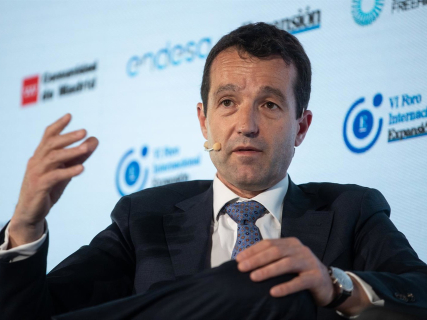

Ángel Escribano has presented his resignation as president of Indra. He did so on a Holy Wednesday, and at the extraordinary council convened at five in the afternoon, against many predictions, in view of the result of the last board of directors meeting, held last week, and where he apparently emerged unscathed and strengthened, resisting the pressures of the Government, which in recent weeks was taking a clear direction, especially when Escribano was called to Moncloa on Friday by Manuel de la Rocha, director of the Economic Office of the President of the Government to ask for his resignation.
The decision, advanced to a very narrow circle, as sources close to his environment have been able to confirm to Demócrata, occurs as a direct consequence of the intense pressures exerted by the Government of Pedro Sánchez, which would have gone so far as to hint at the possibility of withdrawing strategic contracts if his departure did not occur.
Finally, Escribano has succumbed. After weeks of resistance, he has not managed to hold his ground against an Executive that, through SEPI —owner of 28% of the capital—, has deployed all its capacity for influence to force a change at the helm of one of the key companies in the defense sector in Spain. The decision, also confirmed to Demócrata by sources familiar with the process, puts an end to a stage marked by tension between business interests and political control.
The controversy of the conflict of interests
The departure, which coincides with a rebound in its shares on the Stock Exchange, is especially significant because it dismantles the main argument that, apparently, justified the Government's reluctance: the supposed conflict of interest derived from the possible integration of Escribano Mechanical & Engineering (EM&E), Escribano's own family business, into Indra's perimeter. That operation, which had already been proposed in its day by the previous president, Marc Murtra, ceased to be a real obstacle when Escribano himself announced that he was giving up promoting said merger.
However, not even that gesture has served to reduce the pressure. The Executive's offensive has gone beyond the debate on the conflict of interest and has focused on ensuring effective control over Indra's management at a key moment for the sector, marked by the increase in military spending in Europe and the strategic relevance of technology companies linked to defense.
Just a week ago, Escribano had managed to resist, supported by a majority of the shareholders who endorsed his continuity. That victory, however, was ephemeral. In a matter of days, the balance of power shifted, and the weight of the State within the capital, along with its ability to influence the awarding of contracts, definitively tipped the scales.
The keys of a crisis that was coming from afar
The background of this crisis dates back to last summer and has multiple layers, beyond the surface of the conflict of interest. One of the first points of friction arose when Indra tried to acquire the business of General Dynamics Spain, an operation that did not prosper after the refusal of the American parent company. From that moment on, relations began to become complicated inside and outside the board of directors.
The scenario became even more complicated when, from General Dynamics' perspective, a possible strategic encirclement began to be perceived: on the one hand, the growing weight of Escribano and his family business; on the other, the industrial agreements being woven in parallel, such as the potential integration of EM&E and alliances with the German giant Rheinmetall. The feeling of an industrial "pincer" in the sector ended up activating defensive movements.
It is in that context where appears the figure of Iván Redondo, former chief of staff of Pedro Sánchez, who goes on to play a relevant role in the General Dynamics environment, reinforcing the political dimension of a battle that was no longer solely business-related.
This intersection of interests -corporate, institutional, and international- has elevated the struggle for Indra to a strategic dimension. Escribano's resignation is not just the fall of a president, but the outcome of a much broader struggle for control of a key piece on the Spanish and European defense board.
With his departure, the Government clears the way to redesign the company's leadership according to its own criteria. A new stage now opens at Indra, in which the balance between business autonomy and political direction will once again be at the center of the debate.