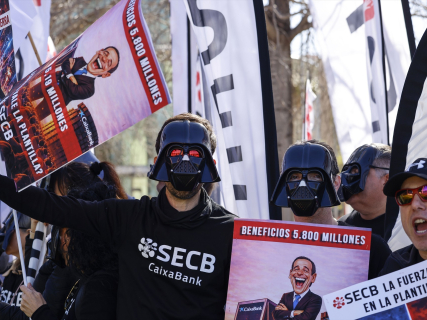

The unions with representation in CaixaBank have gathered this Friday in front of the Congress Palace of Valencia, where the Ordinary General Meeting of Shareholders of the entity is held, to denounce the commercial pressure and the deterioration of the work environment in the company. The mobilization has coincided with a 24-hour strike called in the central services and in the network of offices throughout Spain, on a day that has brought together union representatives and workers to make their demands visible.
During the protest, attendees have displayed banners with messages such as “The strength is in the workforce”, “Profit does not justify abuse”, “Fewer challenges, more respect” or “Enough of squeezing the workforce, benefits for those who generate them”. In this context, the CaixaBank Strike has become the latest episode in a calendar of mobilizations initiated in January with partial stoppages and protests to demand changes in the commercial demand model and in the organization of work within the entity.
UGT
From UGT, the Secretary of Union Action at CaixaBank, Iván Argüelles, explained during the concentration that the mobilizations respond to the need to say “enough is enough to a model of commercial demand and work organization that is wearing down the staff”. As he warned, “we have already reached a limit”.
Also from the union, the general secretary of UGT at CaixaBank, Raquel Ruiz, stated that the entity's staff is “living in a supertoxic environment where one cannot even work or even breathe” and that what the workers are demanding are “decent working conditions.” Likewise, she explained that UGT has filed a complaint with the European Central Bank, which, she noted, has initiated an investigation.
SECB
On behalf of the CaixaBank Employees' Union (SECB), its president Begoña Peiró highlighted during the protest that “the staff has shown that they know how to work and can take this entity to the top, to be the leader of the Spanish financial market”, although she warned that “the company has to understand that it cannot be at the expense of the workers' health”.
Peiró added that the union demands to recover the business model that has historically characterized the entity: “We want a company as this entity has always been, a company with values that helps employees, that helps customers.”
In their opinion, the commercial pressure not only affects the workers, but also the users, since “not only are we employees affected, but also the clients are affected by this daily commercial pressure”.
CCOO
The general secretary of CCOO at CaixaBank, Íñigo Vicente Herrero, defended the need to open a negotiation with the management to address different aspects of the internal functioning of the entity.
In this regard, he demanded that “the management sit down to talk about the variable remuneration system, sit down to talk about the model of commercial pressure increasing every year, about how to adopt measures that improve that work environment and that reinvest part of the record profits that CaixaBank is obtaining in those who make them possible”.
From the union they have also explained that the conflict has been intensifying in recent months. In a message disseminated on social media, CCOO pointed out that “the first 24-hour strike takes place today, coinciding with the General Shareholders' Meeting, and motivated by the situation of pressure and workload that the staff is experiencing”. Furthermore, they added that “now that the entity is in record profit, which continues to grow in profit year after year, those profits are not being invested in the staff”.
According to this union, the call is having effects on the entity's activity, since “this strike is causing a generalized closure of the network”, which is why they hope that “this will make the entity reflect”.
CSIF
From CSIF they also denounced the high commercial pressure and the deterioration of the labor climate within the entity.
As pointed out by the union headquarters, the objective of the protest is to demand “a dignification of the work of the entity's employees to offer the best service to citizens and that they are not forced to focus on commercial tasks unrelated to the proper mission of a bank”.
According to this union, the mobilizations occur after previous partial strikes that registered massive participation, without the management having presented “concrete measures nor verifiable commitments” to address the problems reported.
In this context, trade unions demand the opening of a real negotiation that allows for the introduction of structural changes in the commercial model and in the organization of work, with “concrete, measurable, and negotiated” measures aimed at creating sustainable work environments. Meanwhile, the CaixaBank Strike remains one of the main pressure tools of the staff to demand changes in the entity.