
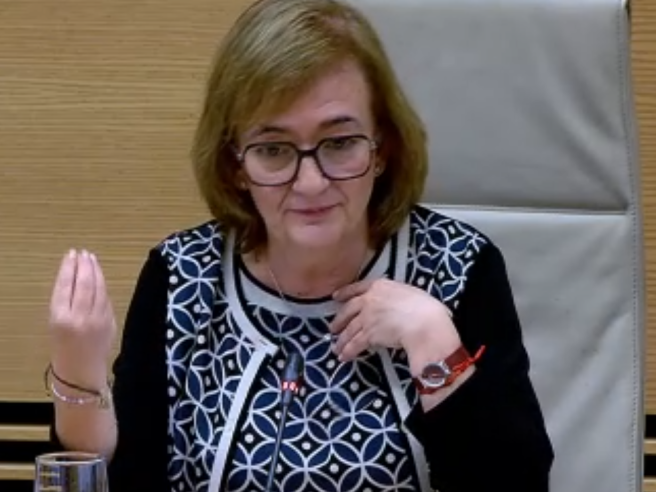
https://www.democrata.es/economia/el-gobierno-traslada-al-congreso-la-propuesta-de-ines-olondriz-para-presidir-la-airef/The former president of the Airef, Cristina Herrero, appeared this Tuesday before the Congress of Deputies to account for her management at the head of the institution for six years. This is an absolutely procedural act, similar to the one carried out at the time by José Luis Escrivá before assuming the governance of the Bank of Spain.
However, Herrero has not attended the Treasury Committee, as would have been pertinent due to her position and responsibility. The Socialist Party has not supported this appearance and, according to what Demócrata has learned, the first vice-president of the Government, Minister of Finance and PSOE candidate for the presidency of the Junta de Andalucía, María Jesús Montero, has not responded to any of the written requests that the former president of Airef made to her to appear before Parliament.
Finally, it was the Joint National Security Commission, chaired by the Popular Party, that took Herrero's appearance into consideration. From Sumar also showed interest in the president of the Airef attending the Treasury Committee, chaired by the socialists.
This Tuesday, Cristina Herrero presented some of the main lines of her work at the head of Airef. She recalled that, at the beginning of her mandate, the institution lacked reports to audit sustainability and had a short-term vision. To address these deficiencies, she explained how Airef has been adapting to the context, offering studies with a broader time horizon, including two supervisory actions with macroeconomic and fiscal scenarios, sensitivity exercises, transparency analysis and, of course, the usual opinions of the body.
A management with medium and long-term horizons
Herrero stressed that, as head of the supervisory body, he anticipated the reform of the fiscal rules, insisting on debt sustainability and on medium and long-term analyses. He also recalled that the Government has pending the national tax reform and recommended, constructively, an adaptation to the European model, circumventing current deficiencies.
The former president defended a credible fiscal framework, with the duty to maintain the sustainability of public accounts, and added that the Spanish economy faces enormous shocks. She pointed out that, although current fiscal variables are comparable to those of 2029, the prospects are delicate and it is advisable to prepare. She acknowledged that Spain has led economic growth thanks to debt absorption, population increase, and the lower tariff and energy impact derived from a mix that includes renewable energies.
However, he warned about the growth of net primary spending and the need for revenue measures. Although in 2025 the excessive deficit procedure set by Europe has not been activated, it is foreseeable that between 2026 and 2030 the control will detect that the deficit is exceeded both by annual and accumulated GDP. At this point, Herrero pointed out that his latest studies reflect an "economic slowdown, real and nominal," while "tourism is running out and European funds are disappearing," among other reasons.
The appearance had the presence of several parties, among them those of the Popular Group and the Socialist Group, despite the latter, and segúyn the sources of this newspaper, Montero has not processed Herrero's requests.
The PSOE criticizes that Herrero appear in the Security Commission
The socialist deputy Javier Rodríguez Palacios criticized that the appearance took place outside the Finance Committee. He accused Herrero of addressing issues that exceed Airef's mandate, such as the succession of the body and its future functioning, and pointed out that this “tarnishes a trajectory that we greatly respected”. He added that it did not seem appropriate for a CEO, upon leaving his position, to issue criticisms about what would come next.
Rodríguez Palacios recognized the function of Airef, but stated that current studies “cannot foresee events such as the kidnapping of Maduro or the launching of missiles in Iran, Israel, and the Persian Gulf countries,” highlighting the difficulty of conducting long-term analyses given global volatility.
Unlike the Socialist Group, Sumar thanked the presence of the former president. Deputy Carlos Martín Urriza stressed that, although ideally Herrero should have appeared before the Treasury Committee, the appearance before National Security allowed explaining six years of management and preventing relevant information about the work of Airef from being lost. Martín Urriza concluded by recognizing Herrero as “a great public servant,” whose trajectory is demonstrated even in this appearance.
Herrero warns: Spain does not comply with the spending rule
Herrero, at the close of the commission, weighed the compliance with the fiscal rule, given that Spain has gone two years without fiscal targets, which allows circumventing the lack of support that the Government has in Parliament. “Because, the truth -he stressed-, is that we are facing a complete, total and absolute non-compliance with the spending rule and, without an economic financial plan".
Then -he stressed-, "it is a priority, because of course our system is different from the European one, when, for example, in Social Security they contemplate an estimated growth of 4%, and the commitments are 3%. Therefore -he asked-, how are we going to distribute the excessive growth of Social Security, when territorial administrations also do not know how the Structural Fiscal Plan has been structured and how they have to contribute? That is why -he defended-, we need a coherent plan in line with the European Union if we do not want to have an added deficit of 10,000 million euros.”
This week, the appearance of the person proposed by the Ministry of Finance to succeed Cristina Herrero, at the head of AIReF, is also scheduled. It is the Secretary of State for Autonomous and Local Financing, Inés Olondriz, and who signed the minutes of the Fiscal and Financial Policy Councils.