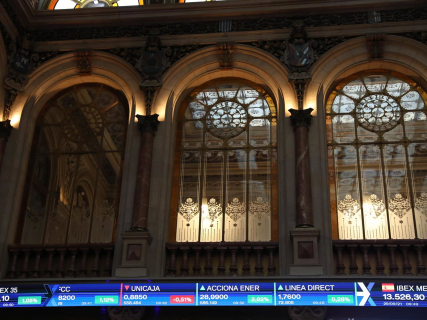

The Ibex 35 has signed this Wednesday its most bullish session since April 2025, with an advance of 3.94% that has taken it up to 18,132 points. The selective has been backed by the ceasefire agreement between the United States and Iran, sealed just a couple of hours before the ultimatum marked by the US president, Donald Trump, concluded.
The day has been conditioned by the sharp decline in crude oil prices, which has fallen to the area of 95 dollars per barrel, although it clearly remains above the approximately 72 "greenbacks" it marked before the crisis erupted in the Middle East.
The retreat of oil comes after Trump has agreed to curb attacks against Iran for two weeks, provided that the Islamic Republic guarantees the "total, immediate and secure" opening of the Strait of Hormuz, a strategic maritime corridor through which circulates around 20% of the world's oil supply.
The American leader, in a message disseminated on his social network 'Truth', has specified that "it will be a reciprocal ceasefire" and has argued that the US has "met and exceeded all military objectives" after the surprise offensive launched together with Israel last February 28.
These words come just hours after Trump himself warned that "an entire civilization would die" on Tuesday night and threatened to return Iran to the "Stone Age". In response, the Iranian Revolutionary Guard warned that it would respond "beyond the region" if Washington crossed "red lines".
After the understanding, which does not contemplate a pause in the Israeli offensive on Lebanon, Iranian authorities have communicated in the early hours of this Wednesday that during the agreed period "safe" transit will be allowed through the Strait of Hormuz, although "through coordination" with the country's Armed Forces.
In this scenario, the Brent barrel, a reference in Europe, was trading at the close of the Madrid Stock Exchange at 95.23 dollars, after a fall of 12.8%, while West Texas Intermediate (WTI), a reference in the US, stood at 95.77 dollars after cutting 15.21%.
At the same time, the TTF natural gas contract, negotiated in the Netherlands and taken as a reference in the European continent, fell by 14.8% at closing, to 45.36 euros per megawatt hour.
In this context, the head of Julius Baer's Research service, Christian Gattiker, points out that "a relief is beginning to be seen", although he admits that the environment continues "to be complex for operators", so it is probable that "uncertainty will continue".
For his part, the firm's Director of Economic Research and Next Generation, Norbert Rücker, emphasizes that supply has proven to be "more resilient than feared" and predicts that the oil crisis "is reaching its peak".
ArcelorMittal leads the rises of the Ibex 35
On the corporate level, the Ministry of Social Rights, Consumer Affairs and Agenda 2030 has confirmed the sanction of 3.6 million euros imposed on Alquiler Seguro for "abusive" conduct towards its tenants, after dismissing the appeal filed by the company.
Furthermore, this Wednesday the 2025 Income and Wealth Campaign has begun with the possibility of submitting declarations via the Internet.
Overall, equities have staged a strong rebound, although below the projections of Banco Sabadell analysts, who anticipated that the increases of the main European indices would be "above +5.0%".
Within the Ibex 35, ArcelorMittal has led the advances with a revaluation of 12.89%. Next were IAG (+8.53%), Indra (+8.15%), Acerinox (+7.78%) and Banco Santander (+7.60%). At the opposite extreme, only five values concluded in negative: Repsol (-5.76%), Naturgy (-1.07%), Enagás (-0.64%), Solaria (-0.61%) and Redeia (-0.46%).
The main European stock markets have also closed with significant increases. The German Dax has added 5.06%; the Cac 40 of Paris, 4.49%; the Italian Mib, 3.7%; and the FTSE 100 of London, 2.51%.
At Aberdeen Investments they explain that markets "do not need absolute certainty to rebound" and maintain that the ceasefire "is usually enough to trigger a rapid revaluation, even if long-term uncertainties persist."
Bonds, currencies and safe-haven assets
In fixed income, the yield of the Spanish 10-year bond has stood at 3.375%, below the 3.567% recorded at Tuesday's close. In this way, the risk premium against the German bund has remained practically stable at 43.81 basis points.
In the foreign exchange market, the euro has appreciated against the dollar at the close of the session in Madrid, to around 1.1694 "greenbacks". In this context, Ebury's Head of Market Strategy, Matthew Ryan, predicts that, despite the temporary agreement, "investors will not fully commit to risk", so that "neither oil futures nor the dollar will return to pre-war levels until a definitive agreement is reached". Ryan also recalls that, despite the euro's rebound, the greenback continues to trade more than 1% above pre-conflict levels.
As for safe-haven assets, gold, a traditional refuge in phases of volatility, advances in this Wednesday's session below the performance of equities (+1%) and was trading at the close of the Stock Exchange at 4,750 dollars per ounce.
Finally, Bitcoin rises slightly more than 4% compared to Tuesday's close and recovers the threshold of 71,000 "dollar bills".