
This average, which acts as the real starting gun of the campaign, reflects an initial trend that will likely adjust in the coming weeks, in a context where a significant share of the electorate has not yet decided their vote. In other words, it is a snapshot at the starting point of a campaign that will be intense and also strategic for parties at both regional and national levels, so changes are to be expected.
The PP nears an absolute majority, but loses two seats
The average places the PP at 56 seats and 42.9% of the vote, a figure that clearly puts it ahead of the rest of the parties and just one seat above the absolute majority threshold, set at 55. This is good news for Juanma Moreno, in a cycle marked by intense competition between the two right-wing blocs: PP and Vox, although that space continues to grow, in a context where the fragmentation of the left works in its favor.
Compared to the elections of June 19, 2022, when Moreno secured 58 seats and 43.1% of the vote, the current figure reflects a slight correction but maintains the structural dominance of the center-right in Andalusia. The key lies not so much in short-term fluctuations, but in the PP’s ability to retain voters and expand its cross-cutting base, especially in a fragmented left-wing scenario.
The PSOE falls to low levels, with timing on its side
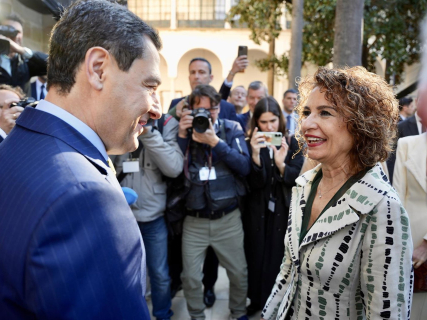
The PSOE stands in this average at 28 seats and 23.4% of the vote, which represents a decline compared to 2022, when it won 30 seats and 24.1%. The drop is only one point and two seats, but it has multiple interpretations: the new secretary general of the PSOE in Andalusia, María Jesús Montero, is weighed down by the polarized tone of national politics and attacks on Pedro Sánchez, but has the timing of the election in her favor. In 2022, the election took place on June 19, in the middle of summer in Andalusia, whereas this time it will be held on May 17, which is likely to increase turnout levels—something that traditionally benefits left-leaning voters.
From this perspective, she is playing on more favorable ground to stimulate participation and mobilize her base, which could improve these figures. However, the growing influence of national politics could complicate the Andalusian election, potentially altering the traditional balance of bipartisanship. For now, the data suggests that María Jesús Montero is not managing to reverse the downward trend of Andalusian socialism, which has gone through several electoral cycles since 2018 without any clear recovery.
Vox consolidates itself as a decisive player shaping the scenario
These elections have been called from San Telmo, the seat of the Andalusian government, with a clear focus on Vox—the PP’s real competitor in this political cycle—which has shown worrying signs for the ‘popular’ party in Andalusia, finishing second in several polls in provinces such as Almería, Cádiz and Huelva.
The strategy set by Juanma Moreno—calling the election for May 17 and as close as possible to the elections in Castile and León—is consistent with an approach aimed at containing Santiago Abascal’s party, which is also under pressure due to internal tensions.
Andalusia is key for several reasons: the weight of immigration and the proportion of young voters, both of which represent a strong base for Vox. In this average, it starts with 18 seats and 15.5% of the vote, clearly improving its position compared to 2022, when it secured 14 seats and 13.5% of the vote—something consistent with what has been observed in the current electoral cycle. However, it still fails to put real pressure on the PP or clearly close the gap with the PSOE. This allows Moreno to aim for an absolute majority and continue targeting voters in the center and center-left, traditionally a socialist stronghold.
Vox will once again be a central player in this regional campaign: its clear but not meteoric growth allows the PP to aim for a second absolute majority in Andalusia, while at the same time, according to polling averages, it does not consolidate itself as a real alternative to challenge the PSOE for second place. This gives socialists room to campaign with less pressure and continue indirectly appealing to voter mobilization against the “far right.”
The alternative left remains fragmented and unable to shift the balance
Meanwhile, despite the replacement of Inma Nieto by a political figure with the weight of Maíllo, the left continues to struggle in the polls, partly squeezed by the PSOE. The average places Maíllo’s bloc and Por Andalucía (which will almost certainly include Podemos again, as in 2022) at 4 seats (6.3%), fewer than in 2022 (5 seats and 7.7%), while Adelante Andalucía, led by José Ignacio García, would gain one seat compared to 2022, reaching 3 seats and 4.9% of the vote.
Overall, these figures barely improve on the combined result of the previous election, when the space to the left of the PSOE had already shown clear signs of weakness. Fragmentation remains its main structural problem: it neither gathers enough support to alter majorities nor manages to consolidate a competitive political space.
Open election: up to 30% decide in the final week
Despite the apparent clarity of polling averages, the scenario is far from settled. Various polling studies show that between 25% and 30% of voters decide their vote in the final stretch of the campaign, with particularly significant weight in the last days and even the final 48 hours. This is compounded by the timing of the election, which could increase turnout and shift votes toward tactical voting, as seen in recent national polling trends, potentially benefiting both the PP and PSOE.
| PARTY | SEATS | % VOTE |
| PP | 56 | 42.9 |
| PSOE | 28 | 23.4 |
| VOX | 18 | 15.5 |
| Por Andalucía | 4 | 6.3 |
| Adelante Andalucía | 3 | 4.9 |