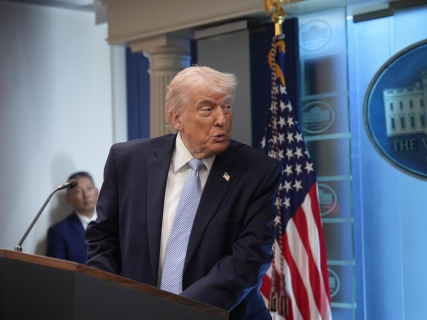

The countdown has begun. With just hours until the deadline granted by the White House to Tehran expires, President Donald Trump's rhetoric has reached an unprecedented level of hostility. His recent message on Truth Social, warning that "a civilization will die tonight", has not only set off alarms in international governments, but has caused an immediate tremor in financial markets.
Crude oil, in a zone of historical highs
The tension is not just verbal. The attacks on Kharg island have put the global energy supply in check. The Brent barrel already exceeds 110 dollars, while West Texas Intermediate (WTI) soars above 116 dollars.
The most pessimistic analysts, like those of J. Safra Sarasin, already draw a nightmare scenario: if the Strait of Hormuz remains blocked, the global crude deficit would reach 13 million barrels per day, pushing the price towards 150 dollars, levels not seen since the 2008 crisis.
Impact on markets: The Ibex 35 resists the onslaught
While European stock markets and Wall Street record falls of more than 1%, the Ibex 35 shows unexpected resilience, limiting its losses to 0.64%. However, the shadow of inflation again darkens the economic outlook. Sovereign debt yields tighten: the ten-year German bond climbs to 3.1%, a level that evokes the worst moments of the 2011 crisis.
Electoral rhetoric or real threat?
The great dilemma for investors is to decipher if Trump's words are a strategy of extreme pressure to force a negotiation or the prelude to a large-scale military intervention.
For now, the market moves in a dangerous duality: A last-minute agreement that normalizes flows in Hormuz and deflates the oil bubble or a prolonged military escalation that subtracts growth from global GDP and consolidates an era of "stagflation" (high unemployment and high inflation).
The key appointment is at 2:00 AM (Spanish time). By then, we will know if the ultimatum turns into ashes or into the beginning of a conflict that will redefine the economic order of the 21st century.