
The European Commission has put on the table a new instrument to transform innovation in defense: AGILE. Endowed with 115 million euros, this pilot program aims to radically shorten the deadlines that separate technological research from its application on the battlefield, in an international context marked by the speed of changes and geopolitical pressure.
The initiative arrives at a moment in which the war in Ukraine has evidenced that military superiority no longer depends solely on the volume of resources, but on the speed of adaptation. Innovation cycles, which before could last years, are now measured in weeks or months.
The program will focus on disruptive technologies such as artificial intelligence, quantum computing or drones, and will place special emphasis on the role of small and medium-sized enterprises, including startups and growth-stage companies.
The objective is to integrate these actors —traditionally distant from the defense sector— into an ecosystem that demands rapid, flexible, and low-cost solutions.
Rapid and unprecedented financing
One of the most innovative elements of the plan is its administrative design. AGILE promises to reduce the time for granting aid to just four months, an unprecedented figure in European programs. In addition, it is expected that the funded technologies can reach the armed forces within a period of between one and three years.
The instrument will finance between 20 and 30 projects, covering up to 100% of the eligible costs. It also incorporates a retroactive clause that will allow companies to recover expenses incurred before the closing of the call.
The program is structured into two main lines: on the one hand, the development of products and technologies oriented towards specific missions; on the other, the commercialization of these solutions to facilitate their arrival to the market. According to the Executive, the approach will be aligned with the most urgent needs of the Member States.
A culture of “agile action”
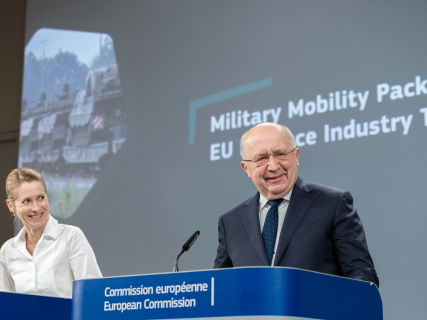
From Brussels, they emphasize that the goal is not only to innovate, but to do so on time. “We want to create a culture of agile action,” stated Executive Vice-President Henna Virkkunen, who highlighted the need to remove barriers so that technology companies can contribute to European security. Along the same lines, the Commissioner for Defence and Space, Andrius Kubilius, emphasized the growing role of smaller actors in modern conflicts, highlighting the importance of rapidly integrating these capabilities into European defense.
AGILE does not start from scratch. It adds to previous initiatives such as the European Defence Fund or the innovation program EUDIS, which have laid the foundations for technological cooperation in the military field.
However, the Commission recognizes that these instruments need to be complemented with more agile mechanisms and with greater risk tolerance.
Entry into force in 2027
The next step will be the formal presentation of the regulation that will allow its implementation, which must be approved by the European Parliament and the Council. If the foreseen deadlines are met, AGILE could be operational by early 2027.
With this initiative, the European Union seeks not only to reinforce its strategic autonomy, but to adapt to a new era in which the speed of innovation can mark the difference between advantage and vulnerability.