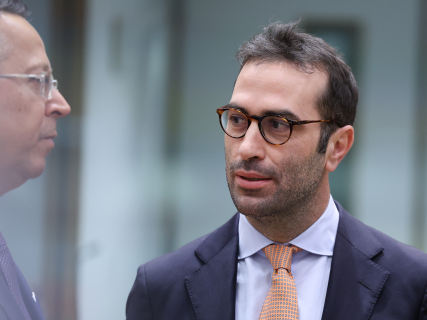

Almost nine days after the start of the bombings in Iran, the Eurogroup Finance ministers meet in Brussels to discuss the response to the economic consequences of a conflict that threatens to prolong over time. Europeans share a diagnosis of uncertainty and volatility that the markets have experienced as a consequence of the war. It is, in the words of the Spanish Minister of Economy, Carlos Cuerpo, “a war that is already having tangible effects on our economy”.
Energy triggers the alarms in Europe
In this time, the price of oil has risen more than 40%, standing today above the barrier of one hundred dollars per barrel. For its part, the price of gas has increased by around 90%, setting itself near sixty euros per megawatt hour.
In the Ministry of Economy they recognize that, although currently it is far from the levels registered during the most acute moment of the war in Ukraine, “the effect will depend on the duration of the conflict”. The evolution of the energy market has become the main indicator that European governments follow to evaluate the magnitude of the economic impact.
Direct effects on consumers
"We are seeing consequences in the daily lives of Spaniards," Cuerpo has expressed upon his arrival at the meeting in the community capital, pointing as an example to what is happening at gas stations with the increase in prices at the pumps.
An increase that, according to the head of Economy, would have been close to 15 cents per liter for gasoline and almost double —around 28 cents— in the case of diesel. Effects that would also be noticed in the energy raw material markets and in transport, where operating costs are beginning to increase significantly.
La Moncloa studies possible measures
La Moncloa is already studying the different scenarios that are opening up to “protect citizens, businesses, and workers”, using as a guide the measures deployed during the start of the war in Ukraine. Among those actions were direct aid, temporary tax cuts, and support mechanisms for particularly affected sectors.
However, for the moment the Executive avoids confirming what concrete measures will be used on this occasion, awaiting to observe how the situation evolves in the coming days. “Depending on the development in the coming days —taking into account the enormous volatility of the situation today— we will see when and how we have to intervene,” explained the government's economic official.
Strategic patience and European coordination
Thus, the strategy would involve “being patient in terms of seeing the evolution”, without losing sight of the effect's transfer to citizens to intervene when necessary “with the necessary intensity”. Cuerpo has also appealed to his European counterparts to maintain close coordination on the measures that are put on the table, just as —he recalls— was done after the Russian invasion of Ukraine.
“A key lesson was that we must work hand in hand. We need to coordinate all possible subsidies, actions, and tools that we implement to protect our companies”, he stated.
This containment does not prevent the minister's cabinet from maintaining constant attention on the evolution of fuel prices, since —as they point out— it is the factor that ends up impacting most directly on the daily lives of citizens and, especially at this time, on transport professionals. For the Spanish Government, the twenty-seven must advance “as soon as possible” towards greater integration of European energy markets through the promotion of interconnections and greater coordination in the continent's energy infrastructures.
Brussels warns of a possible economic shock
Brussels shares the idea that the economic impact of the crisis generated in the Middle East will largely depend on the duration of the conflict and its possible regional expansion. In the best-case scenario —if the conflict were to stop in the coming weeks— European institutions do not foresee a significant impact on economic growth. However, the risk of an escalation remains on the table.
According to the European Commissioner for Competition, Valdis Dombrovskis, a disruption in maritime transport in the Strait of Hormuz could lead to “a substantial stagflationary shock in the global and European economy”, characterized by higher energy prices that would translate into general inflation.
The Latvian commissioner has maintained that the main channel of economic impact is concentrated in the possible interruptions of energy supply and in the increase of prices derived from these geopolitical tensions.
For this reason, it has opened the door to future debates within the European Union on the concrete effects on energy markets. Among the options proposed to be activated by the Commission is the release of strategic oil reserves to increase supply in case of interruptions in international transport.
The debate on the carbon market
The twenty-seven will also begin discussing this week the modification of the design of the European Union's energy market, with the aim of analyzing to what extent it can be reformed to reduce the effects of energy crises like the current one.
Within the framework of these discussions, the Italian minister proposed temporarily suspending the European carbon market until the Commission presents its new reform proposal this quarter. For the Government of Giorgia Meloni, the current system would explain part of the loss of industrial competitiveness in Europe. "We are all aware that the ETS mechanism is just a fee for high energy-consuming companies that struggle to remain competitive," expressed the Italian minister Adolfo Urso.
To the Italian position are added countries like Hungary and Poland, which are pressing for not too much time to be waited before finding a solution to the current market design.
The G7 monitors the evolution of the markets
Prior to the meeting in the community capital, the members of the G7 held a telematics meeting with the executive directors of the International Monetary Fund, the World Bank Group, the Organisation for Economic Co-operation and Development (OECD) and the International Energy Agency.
At the end of the meeting they confirmed their willingness to closely follow the evolution of energy and financial markets, with the commitment to meet again “when necessary to exchange information”.
“We are willing to take the necessary measures, including support for the global energy supply, such as the release of reserves,” the communiqué released after the meeting indicates.
The gas station sector asks for tax cuts
Following these increases in gasoline prices, the sector has started to make its move. The Spanish Confederation of Service Station Business Owners has requested the Executive that it reduce by 11% the VAT on fuels and that it commit to applying a temporary reduction in the special hydrocarbon tax.
According to their estimates, these measures could reduce the price of fuel by around 15 cents per liter, which would alleviate the direct impact on consumers.
Along with this proposal, the employers' association has also put on the table the review of the special tax applied to fuels. In this way, service stations demand a 50% reduction in the diesel tax and a 40% reduction in the case of gasoline. According to their criteria, these measures should remain in force until international oil and fuel prices return to pre-conflict levels.