
How can the European Union respond to a trade war between one of its Member States and a strategic ally? It is a recurring question in the offices of the community capital since the president of the United States, Donald Trump, returned to the White House. The last occasion, this very Tuesday, after the threat of “breaking all trade with Spain” launched by the Republican administration.
It is not the first time that the US president threatens the Spanish Government with imposing tariff measures. He already did so previously after La Moncloa's refusal to allocate the 5% of GDP to military spending. Then, as now, Brussels recalled that commercial competence is exclusive to the European Union, so any response to an eventual measure of this type must be legally articulated from the Twenty-Seven, in accordance with the competence framework established in the Treaties.
I just had a call with President @sanchezcastejon to express the full solidarity of the EU with Spain.
— António Costa (@eucopresident) March 4, 2026
The EU will always ensure that the interests of its Member States are fully protected.
We reaffirm our strong commitment to the principles of…
Following the institutional statement by the President of the Government, Pedro Sánchez, the European Commission shows itself willing to act "if necessary to safeguard European interests". Sources from the European Commission's trade team point out that protecting the trade relationship between both powers is mutually beneficial: "it is more important than ever and clearly in the interest of both parties".
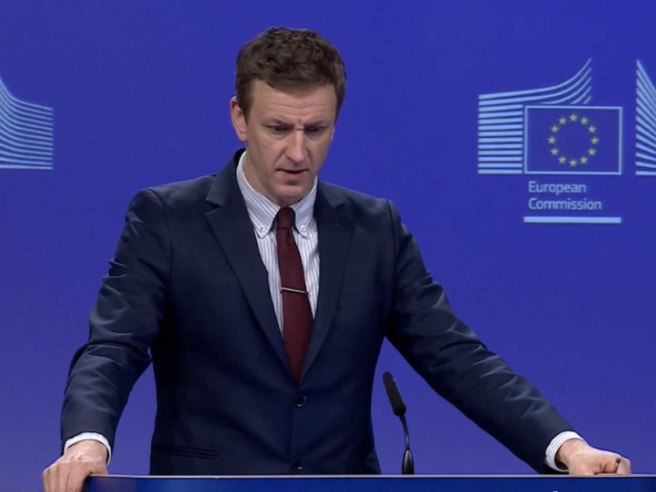
"We experienced something similar with Greenland, the important thing is to stand firm," has expressed the executive vice-president Teresa Ribera, in an interview with Cadena Ser. Further went the European technicians: “We hope that the United States fulfills its commitments,” expressed the community trade spokesperson, Olof Gill, after the challenge from the US president. In the Commission they underline that the Community Executive will ensure that the commercial interests of the Union are fully protected through the instruments provided for in Union Law and in the multilateral order.
Legal basis: exclusive competence and unity of external action
The Common Commercial Policy constitutes an exclusive competence of the Union, as established by Article 3 of the Treaty on the Functioning of the European Union (TFEU). This implies that Member States cannot adopt or maintain autonomous commercial provisions vis-à-vis third countries when the Union has legislated or assumed international commitments on the matter.
Consequently, in the face of a hypothetical trade escalation between Madrid and Washington, the European Commission would assume formal interlocution, would exercise the Union's external representation in trade matters and would channel any negotiation or dispute resolution procedure, whether bilaterally or within the framework of the World Trade Organization.
Likewise, the Commission can initiate investigations and propose the adoption of measures under the trade defense instruments (anti-dumping, anti-subsidy and safeguards), provided that the material and procedural requirements demanded by European regulations and WTO agreements are met.
Instruments of coercion and countermeasures
In addition to the classic trade defense mechanisms, the Union has specific tools against acts of economic coercion by third States. Among them is the so-called Anti-Coercion Instrument, adopted in 2023, which allows reacting to measures that seek to politically pressure the Union or one of its Member States through commercial or economic restrictions.
This mechanism enables the Commission, following an assessment of the existence of coercion and after consulting the Member States, to propose a graduated range of countermeasures:
-
Imposition of new tariffs or quantitative restrictions.
-
Limitations to access to the internal market in matters of services.
-
Restrictions to foreign direct investment.
-
Exclusion or limitation in public procurement procedures.
The design of the instrument responds to the principle of proportionality and prioritizes, in the first instance, the negotiated path. Only in the event that the third country does not withdraw the coercive measures, the restrictive response phase would be activated.
The bilateral dimension and the agreement pending ratification
In parallel, the ratification of the tariff agreement signed between Washington and Brussels last summer remains in the air, after the ruling of the US Supreme Court regarding the legal basis of certain commercial decisions adopted by the Trump Administration. The eventual alteration of the legal bases on which the Turnberry agreement was signed introduces an element of legal uncertainty that conditions the European parliamentary calendar.
The postponement of its ratification, requested by a broad majority of groups in the European Parliament, lacks immediate legal effects on the content of the agreement. However, prolonging the provisional situation could generate systemic risks, both in terms of legal certainty for economic operators and stability in the transatlantic relationship.
Parliamentary sources emphasize that it is a “technical freeze”, not a definitive break. The transatlantic dialogue remains open and the Commission maintains as a guiding principle that “an agreement is an agreement”, insisting on the need for European products to continue benefiting from the most favorable tariff treatment within the previously agreed limits.
Legal certainty and predictability for companies and workers
From the European socialist group, it has been reiterated that the tariffs adopted by the Trump Administration would be incompatible both with US domestic law and with WTO rules, a point that, if confirmed, would open the door to a formal dispute settlement procedure.
In this context, the priority declared by the European institutions is to preserve legal certainty, effective protection and regulatory predictability for European companies and workers. Community diplomats recall that the effectiveness of any international commitment depends, ultimately, on its correct ratification and execution in accordance with applicable Law.
The eventual trade escalation would not, therefore, be settled on the bilateral level between Spain and the United States, but within the institutional framework of the Union, which acts as a single entity in trade matters, with normative, executive, and sanctioning capacity within the limits established by the Treaties and international economic law.