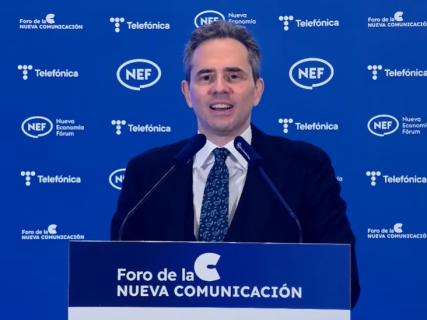

The regional director of the American publication for Europe, Jamil Anderlini, participated this Monday in a breakfast organized by Nueva Economía Fórum in Madrid. Anderlini, regional director for Europe of Politico, unveiled some of the publisher's plans in the Southern European market, the most important being the launch of its Newsletter -Playbook- in Spain after the summer, as well as the opening of Politico Australia and some of his opinions on current affairs, both European and American. Politico is owned by the German group Axel Springer and has its operational command in Washington D.C.
The event, held at the Hotel Mandarin Oriental Ritz of Madrid, organized by Nueva Economía Fórum and presented by José Luis Rodríguez, was attended by PP MEP Dolors Montserrat and European Parliament spokesperson Jaume Duch, as well as representatives of Spanish companies with a presence in Brussels.
Anderlini, CEO of the European division of the American Politico, was introduced by Adrián Jofre Bosch, president of the beBartlet consultancy, who praised Anderlini's journalistic capabilities and those of his publication. Thus, Anderlini offered his vision on geopolitics, European journalism and the situation of international media. He did so in a speech entirely in English, after clarifying that he did not speak "a word of Spanish" and emphasizing on several occasions "that he is not an expert on the subject", especially on Spanish issues.
All this coincides with a key geopolitical day, with criticism from Washington and Tel Aviv regarding the Spanish Government's stance on the attacks on Iran and where prominent politicians and activists close to the Trump Administration are starting to point to Spain for its latest pronouncements regarding the National Security agenda launched by the White House.
During my time in the U.S. Air Force in the mid-80s when I was assigned as a prosecutor in Europe at the height of the Cold War, I was tasked to American air bases in Spain as a part of my legal duties. I have great admiration for the Spanish people and they have been great…
— Lindsey Graham (@LindseyGrahamSC) March 2, 2026
After we get done with Iran and Cuba, we should seriously consider adding Spain to the list https://t.co/zXGhDuoQmL
— Will Chamberlain (@willchamberlain) March 2, 2026
Político's new 'rollout' will coincidentally occur just in time for two key dates: the November midterms in the United States and, above all, the end of the cycle of regional elections in Spain and the beginning of the window for general elections (and French presidential elections), where Pedro Sánchez's Government has placed all its hopes on mobilization. Precisely, despite calling itself 'apolitical', the editor of the American outlet has openly pointed to two countries, France and the United Kingdom, for "governing poorly" as well as Brussels itself, omitting the rest.
Anderlini praises Trump: he is the "most transformational president of the century"
Anderlini stated that Donald Trump is the “most transformational” president of the century after the recent warlike events in the Middle East. He underlined that what happened this weekend with the joint attack by the United States and Israel on positions in Iran -which ended with the death of Iranian supreme leader Ali Khamenei- evidences, in his opinion, Trump's ability to radically change the course of US foreign policy, something that few leaders have achieved in recent times.
The analyst also linked the current military intervention with other actions of the Trump administration, mentioning the operation in Venezuela in January to capture the then-president Nicolás Maduro, and described the U.S. president's stance as “truly impressive” for having weakened the Iranian regime and reduced its capacity to support armed groups in the region.
"Governments that don't do well, like United Kingdom", Trump "good for Europe"
Asked about the political and economic situation in Spain, Anderlini has remarked that Politico has the opportunity to contribute to the public debate context and ideas about the political reality of the country and has remarked that the American outlet is "good at pointing out when a Government does not do well, observe that coverage of United Kingdom, France and Brussels, but that comes precisely from a non-ideological perspective.”
Regarding the Union, he has stated that President Trump's agenda is good for Brussels. “Trump presents an extraordinary opportunity for the Union. I have the optimistic thought that Trump can make Europe great again".
He has praised the Trump Administration for being capable in the European Union of “bringing together people who do not necessarily understand each other" to contrast with the agenda of the American magnate. An element that may force the Union to consider "necessary reforms" within it.
Skeptical of mass immigration: "integration" has failed in many countries
Jamil Anderlini, born in Kuwait and raised between the Middle East and New Zealand, naturalized American and New Zealander and resident in Brussels, showed skepticism about migratory issues and migration management in the West and stressed that immigration is today “the most important issue for the electorate”. During his speech, he warned that it is a deeply emotional issue with enormous political impact.
Although he pointed out that the migratory experience in Spain has been “relatively positive”, he qualified that this integration has been “easier” in the case of the arrival of people from Latin America, due to sharing language and, in many cases, religion. That common cultural factor, he maintained, has facilitated the fit “for the moment” compared to other European countries.
However, Anderlini framed the migratory phenomenon within a “massive” increase in arrivals to Europe in recent years and warned that, in several Western countries, integration “has failed” when it comes to groups with different languages and religions. In his opinion, this situation has generated “quite severe” reactions and has fueled the rise of populist parties, both far-right and far-left, across Europe.
Compares the "exiled Puigdemont" with Karl Marx: "Fascinating"
Asked about the Catalan question, although he has admitted not being an expert on the subject, he did mention the former Catalan president Carles Puigdemont. Anderlini described him as an "exile" and compared his stay in Waterloo with that of historical figures like Karl Marx, who wrote the Communist Manifesto from his exile in Brussels, "living in Waterloo, and I remembered other exiles in Europe, people like Marx, and I wanted to meet this very interesting figure (...) the formal exiled president of Catalonia". He has called the phenomenon "fascinating".
However, Anderlini has reiterated that, just like on other occasions, he did not issue any political judgment about the Catalan. "I wanted to meet this very interesting figure," he explained, relying on how his movements and statements continue generating political and media impact.
Criticisms of Xi Jinping and the coverage from Brussels
Regarding foreign policy, Anderlini -who covered China for years for the Financial Times- warned that the environment for foreign companies in that country will be "increasingly difficult," and attributed part of the frustrated expectations of the past to a combination of "ignorance, naivety, or greed" and has pointed out that China's economy is experiencing clear problems due to issues, especially real estate.
The editor of the American media outlet, furthermore, has been particularly critical of Chinese President Xi Jinping, when analyzing the purges carried out in recent years within the leadership of the Communist Party and the military establishment. In his opinion, these decisions have concentrated power around the figure of the Chinese leader and have reduced the traditional internal balances of the system. Specifically, he stated that “Xi Jinping has purged practically all high-ranking political and military officials, leaving the world's second most powerful army without leadership, except for himself,” in reference to the scope of the dismissals and the growing centralization of power in Beijing.
Regarding European coverage and the presence of pan-European media, Anderlini shared that, when telling people around him that he was leaving journalism to cover politics from Brussels, a friend snapped at him: "You are making a mistake, Europe is a media desert".
When asked about the presence of Spanish companies in Brussels, Anderlini acknowledged that it has been historically limited and encouraged those present to strengthen that dialogue. The event concluded with an invitation to continue the conversation "in Washington and in Brussels", making clear the importance and leadership of the United States in the project.
Playbook in Spanish
The main novelty announced was the launch of a Playbook in Spanish -the daily newsletter format that Politico uses as a spearhead in each market- scheduled for September 2026 and which will be supported by the Brussels newsroom. Anderlini did not specify how many journalists, apart from the current ones, it will have in Spain and will be involved in the launch.
The executive justified the choice of Spain by the aforementioned dynamism of its economy and by the singularity of its politics, with express mention of the Catalan issue and the relevance of what happens in Madrid for the European debate. To take this step, he acknowledged having received feedback over the last year from several voices and analysts about his landing in Spain and has specifically pointed to the consultancy beBartlet.