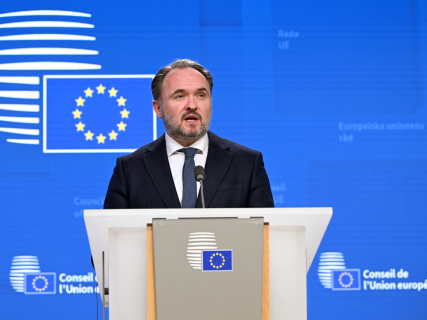
The Energy ministers of the European Union have opted this Tuesday for strengthening coordination at community level to face the impact of the war in the Middle East on energy markets, in an informal meeting marked by the price volatility and the uncertainty about supply in the coming months.
Thus, the ministers of the Twenty-Seven have held this Tuesday a videoconference, chaired by Michael Damianos, Minister of Energy of Cyprus, and held within the framework of the Transport, Telecommunications and Energy Council, which has served to confirm that, although the security of supply remains guaranteed for now, the international context demands anticipation and a community response.
Price increase and stability under pressure
After the meeting, Damianos appeared before the media to report on the conclusions reached by the Twenty-Seven to alleviate a conflict that is now entering its second month and that "is having a direct impact on global markets". Since its beginning, prices have increased by around 70% in gas and 50% in oil, affecting both households and European industry.
"Our debates today align with building a competitive, resilient, and strategically independent Europe in the current geopolitical context," he stated after thanking the European Commissioner for Energy, Dan Jorgensen, for his commitment to address the current situation.
The ministers have agreed that the Union's energy supply remains in a "relatively guaranteed" position thanks to the diversification of energy sources, although they warn that growing global competition for resources may intensify volatility in the short and medium term.
Preparation for winter and strategic reserves
Therefore, one of the main focuses of the debate has revolved around the need to prepare in advance for the winter of 2026, with special attention to gas storage and supply stability.
In this regard, the Member States have advocated for a greater "coordination" in the use of common tools, avoiding unilateral responses that could aggravate market tensions, especially regarding the gas storage targets, to avoid new price pressures.
"We agree that measures at European and national level must be carefully designed, in a coordinated, specific way and adapted to the current situation, remaining fully consistent with our long-term objectives, in particular decarbonization, diversification of suppliers and the reduction of dependence on imported fossil fuels", said Damianos.
On the other hand, member states have agreed on the need to act cautiously in the use of strategic oil reserves "so as not to compromise the future security of supply". "Greater coordination in gas storage requirements to avoid upward price pressures; ensure access to timely and accurate data with the support of the Commission to guide decision-making; and avoid measures that could distort the internal energy market," added the Cypriot minister.
During the meeting, member states have also pointed out that having accurate and up-to-date information will be key to anticipating risks and making effective decisions. In this regard, they have highlighted the role of the European Commission in providing high-quality data and clear guidance that allows for an agile and coordinated response across the Union.
Energy saving gains weight as axis of the strategy
One of the main consensuses among the ministers has been the importance of reducing energy demand as an essential part of the European response. The improvement of efficiency and the promotion of saving have been consolidated as fundamental tools to cushion the impact of price increases, strengthen the resilience of the system, and improve the energy security of the Union as a whole.
The EU has also reaffirmed its commitment to maintain close collaboration with international partners to contain the volatility of energy prices. In this area, joint work with organizations such as the International Energy Agency (IEA), stands out, with the aim of coordinating efforts that strengthen global market stability.
Likewise, the ministers have agreed that future supply agreements must align with the rules of the European internal market and with the community climate objectives, avoiding short-term solutions that compromise long-term sustainability.
Energy transition as a guarantee of resilience
On the other hand, the EU's commitment to accelerate the transition towards clean energy has been reiterated. This transformation is proposed not only as a climate response, but also as a key tool to protect the Union against future energy crises.
The promotion of renewable sources and the reduction of dependence on fossil fuels are presented, in this context, as central elements to strengthen European competitiveness and strategic autonomy.
Beyond short-term measures, the ministers have agreed that the meeting has served to lay the foundations for a more robust and sustainable energy model. The combination of political coordination, energy efficiency, and ecological transition shapes the EU's roadmap at a time marked by international uncertainty.
The Commission has asked to anticipate more adverse scenarios
In parallel to the meeting, the European Commission had conveyed this very Tuesday to the Member States the need to prepare for possible prolonged disruptions of energy supply, in a letter sent before that informal videoconference by the European Commissioner for Energy, Dan Jorgensen.
In that document, Brussels has warned that the geopolitical situation is exerting a significant pressure on oil and gas markets, especially after the closure of the Strait of Hormuz, a key route for global supply.
Although the immediate impact on European supply remains limited, the Commission warns that the intensification of international competition may translate into greater price tensions and difficulties in accessing certain energy products.
To face this scenario, Brussels had proposed, in line with the conclusions of the meeting, to coordinate the use of strategic reserves, optimize the supply of key fuels such as diesel or kerosene, and strengthen cooperation between Member States. In addition, it has proposed concrete measures such as reducing the maximum speed on highways by at least 10 km/h or promoting teleworking whenever possible.
Nevertheless, Tuesday's meeting leaves a shared diagnosis: the EU maintains stability for now, but the international context forces to anticipate, coordinate, and act quickly to prevent the energy crisis from prolonging and intensifying in the coming months.