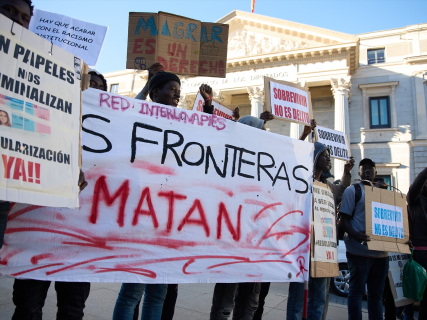

The reform of the Immigration Regulations for the extraordinary regularization of 500,000 migrants would already be ready to be approved by the Government. According to what Democrat has learned, the royal decree has already passed through the General Commission of Secretaries of State and Undersecretaries (CGSEYS), with the next step being its approval in the Council of Ministers, which would be scheduled for Tuesday, April 14. The chosen formula allows the Executive to push through the measure without needing to go through Congress, taking as reference the regularization by José Luis Rodríguez Zapatero of 2005.
The measure seeks to provide a legal solution for hundreds of thousands of people residing in Spain without administrative authorization and does so lowering the usual requirements of the immigration system, especially regarding initial access to the permit. After years of demands initiated by the Popular Legislative Initiative (PLI) of Regularization Now, its materialization has been possible after an agreement between Podemos and the Government.
social pressure
During the last weeks the Movement Regularización Ya has denounced the delay in the approval of the royal decree. As they recall, the Government has had on the table since last March 10 the opinion of the Council of State regarding it.
From the association they denounce on their social networks that the delay was not neutral, "it means more pressure for the Administration, more anguish for the people who are waiting to submit their documentation, and more fertile ground for hate speeches and the hoaxes of the radicalized right-wing parties."
In this same communication, they urge the Executive to release the text imminently, as it is going to happen. It is expected that next Wednesday the reform of the Immigration Regulations will be published in the BOE after approval in the Council of Ministers.
Lacking knowledge of the final wording of the royal decree, the text that the Ministry of Social Inclusion, Security and Migration put out for public hearing last January foresaw the following requirements.
Previous residency in Spain before 2026
The first key requirement is the accreditation of stay in Spanish territory. To be able to opt for regularization, the applicant must:
-
To have been physically in Spain before December 31, 2025.
-
To prove at least five months of effective stay in the country before submitting the application.
This temporary criterion aims to delimit the scope of the measure and avoid a possible "pull effect", one of the recurring arguments in the political debate about mass regularizations.
Absence of relevant criminal record
The agreement also sets as a condition that the applicant person does not have significant criminal records that prevent the granting of a residence permit.
It is not about demanding a completely clean criminal record, but about excluding those cases in which there are serious records incompatible with immigration regulations, a common criterion in this type of procedure.
How to accredit the stay: valid documents
To demonstrate permanence in Spain during the required period, the agreement contemplates a wide variety of means of proof, with the aim of adapting to the reality of people in an irregular situation. Among the admitted documents are:
-
Certificates of municipal registration.
-
Proof of medical appointments or care in social resources.
-
Rental contracts, payment receipts or accommodation documents.
-
Transport tickets, proof of money transfers or other documents that prove continuous presence in the country.
This documentary flexibility is one of the central elements of the procedure's design.
Without prior employment contract
One of the most relevant aspects of the agreement is that a prior employment contract will not be required to access the initial regularization.
This point represents a substantial difference compared to other ordinary channels of the immigration system and aims to break the vicious circle that prevents those who cannot work legally from regularizing their status and, at the same time, cannot obtain papers without a job.