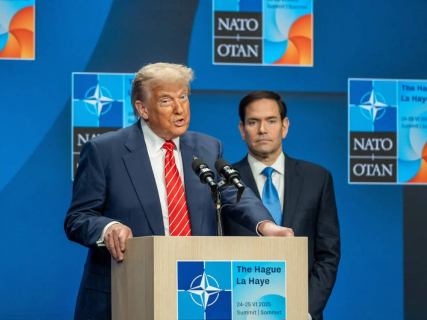
The war in Iran has opened a new rift in the relationship between the United States and its European allies. The American president, Donald Trump, affirmed this Wednesday that he is “more than considering” the exit from NATO, deepening his criticism of the Alliance partners for not backing Washington in the conflict.
In an interview with the newspaper Telegraph, Trump has assured that he always knew it was “a paper tiger”, questioning the strategic value of the organization in the face of current challenges, especially the war in the Middle East and the control of the Strait of Hormuz. But, how should Washington proceed if it wishes to abandon the Alliance?
The legal procedure for withdrawing from NATO
Beyond political rhetoric, the United States' withdrawal from NATO would be regulated by the North Atlantic Treaty, more specifically by its article 13, which states:
“After the Treaty has been in force for twenty years, any Party may cease to be a Party one year after its notification of denunciation has been delivered to the Government of the United States of America, which shall inform the Governments of the other Parties of the deposit of each notification of denunciation.”
What does it mean? That the United States should submit a formal notification of withdrawal to its own Government, which acts as depositary and communicates the decision to the rest of the members, and wait 12 months before the withdrawal becomes effective.
During that year, its defense and cooperation obligations would remain active, including the collective defense clause that commits members to respond to an armed attack against any of them. This framework turns the exit into a planned and supervised process, not a sudden act.
What financial implications would its departure have?
The American withdrawal would have important economic and strategic consequences. Currently, the United States contributes close to 70% of NATO's operating budget, covering administrative expenses, contributions to joint missions, and shared infrastructure.
During the transition year, these responsibilities would remain in effect and the Alliance would have to reorganize its command structures, strategic deployments, and shared intelligence systems without U.S. support. This would force European countries to increase their defense spending and develop new capabilities to compensate for the absence of the organization's main guarantor.
Geopolitical impact
The departure of the United States would also have immediate strategic consequences. Powers like Russia and China could interpret the departure as an opportunity to increase their influence in Europe and the Middle East, intensifying strategic competition in critical regions.
NATO, without its main guarantor, would lose part of its global deterrent capacity and would be forced to focus on internal European security, with limited scope against international challenges.
Although Trump's threat arises in the context of the war in Iran and the lack of European support, the process of leaving NATO is clearly defined by the treaty and requires formal notification and a year of transition, during which the commitments remain active.
The possibility that the United States abandons the Alliance introduces a level of strategic and geopolitical uncertainty that could redefine the global balance, leaving Europe facing the difficult task of assuming greater responsibilities in defense while Washington evaluates its role within NATO.