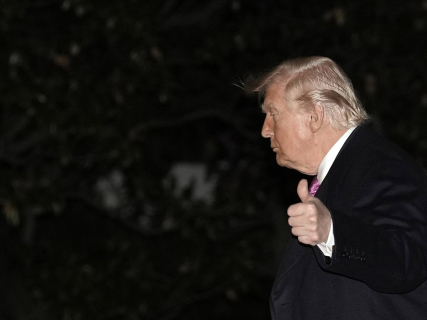
The president of the United States, Donald Trump, has intensified this Tuesday his criticism of several European countries for what he considers their passivity and lack of collaboration in the war in Iran. In messages disseminated on his Truth Social network, Trump has warned that Washington will no longer come to the aid of allies who do not actively participate in the conflict and that they will have to "learn to defend themselves by themselves".
Tensions have arisen following the decision of Spain to close its airspace to US flights involved in the war, a move now joined by France and Italy. Paris has prohibited planes loaded with military supplies destined for Israel from flying over its territory, while Rome has denied the use of the US base of Sigonella, in Sicily, for operations linked to the conflict in the Middle East, claiming that they are not contemplated in the current bilateral treaties.
"France has been very uncooperative with respect to the 'Butcher of Iran', who has been successfully eliminated. The United States will remember it!", Trump has written on his social network, referring to Iranian supreme leader Ali Khamenei, killed during the first bombings of the joint US and Israel offensive.
In relation to Italy and other European countries, Trump has insisted that "they will have to start learning to defend themselves; the United States will no longer be there to help them, just as you were not there for us". The president noted that Iran "has been decimated" after the offensive, so allies should now "go for their own oil" and face the consequences of their decisions.
European restrictions and legal justifications
France, which until now had not made the measure public, has confirmed that the overflight ban is consistent with its stance since the beginning of the conflict. The Élysée Palace has stressed that the decision remains within the legal and national security framework, and that the country has not changed its position since day one.
Italy, for its part, has defended the refusal to use Sigonella, alleging that the aircraft involved were not carrying out normal logistical flights and, therefore, were not covered by existing treaties. According to the Minister of Defense, Guido Crosetto, any military operation not contemplated in the agreements requires parliamentary authorization. The Italian Government has assured that its relations with the US remain "solid and characterized by full and loyal collaboration," despite the adopted restrictions.
Spain, whose airspace closure had already become effective, has defended its decision under similar criteria, prioritizing legality and security in the management of its territory. The spokesperson for the Spanish Government, Elma Saiz, has stressed that bilateral relations with the US are "absolutely fluid and normal" and has highlighted that Spain continues to be a reliable partner, with an active commercial and diplomatic presence in US territory.
Repercussions in NATO and warnings from the US
The refusal of its European allies to facilitate the transit of planes and the use of US military bases has reopened the debate on transatlantic cooperation and the commitment of the US to NATO. The American Secretary of State, Marco Rubio, has warned that Washington could "review" the relationship with the alliance after the conclusion of the war, due to the lack of support in essential military operations.
Trump, furthermore, has made a call to the countries affected by the closure of the Strait of Hormuz: "Buy fuel from the U.S., we have plenty, or gather the courage you have lacked until now and take your oil. The hard part is already done". The warning underscores the growing tension between the White House and its European partners over the management of the war and global energy security.
The conflict in Iran, which began in late February, has generated an international energy crisis, with crude oil prices exceeding 100 dollars per barrel and the partial closure of the Strait of Hormuz, a key route for oil transport.
The diplomatic pulse intensifies at a time when the war in Iran could be nearing its end, following recent statements by Donald Trump and the Iranian president, Masoud Pezeshkian, about the willingness of both sides to negotiate the cessation of the conflict under certain conditions.
However, the dispute over military cooperation and strategic transit evidences that, even in the final phase of the conflict, the tensions between the United States and its European allies could have more long-term effects on NATO, energy security, and international politics in the Middle East.