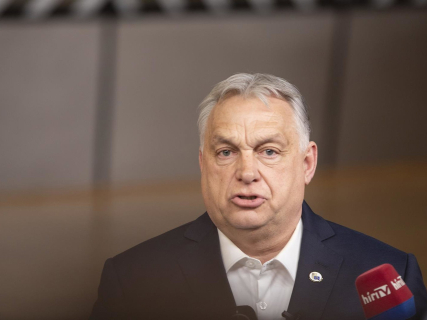

Hungary holds key elections that are interpreted as a direct plebiscite on the leadership of Viktor Orbánafter more than a decade and a half in power. Citizens are called to decide whether they maintain the current political course or opt for a change of cycle led by the opposition Péter Magyar, in elections that concentrate international attention.
The vote will not only define the political future of the country, but also its position on the European geopolitical board, marked by tensions between the European Union, Russia and the United States.
A plebiscite on Orbán and his political model
After 16 years in power, Orbán faces elections that go beyond political alternation. The result is interpreted as a judgment on his model of “illiberal democracy”, characterized by his confrontation with Brussels, his conservative discourse, and his closeness to Moscow.
The prime minister has focused his campaign on warning that the country's direction is at stake. "Not only is a Government chosen, the destiny of Hungary is chosen," he has reiterated in his speeches, in an attempt to mobilize his traditional electorate.
Magyar, favorite in the polls
Facing Orbán emerges Péter Magyar, leader of the Tisza party, who has starred in a meteoric rise in Hungarian politics. The main polls place him as favorite, although with uncertainty about the magnitude of his possible victory.
Its emergence occurred after breaking with Orbán's party, Fidesz, in 2024, amidst accusations of internal irregularities. Since then, it has managed to consolidate itself as the main alternative in a political scenario traditionally dominated by the ruling party.
Moderate change in foreign policy
On the international level, Magyar has promised to reduce tension with the European Union and improve dialogue with Brussels, although without completely breaking with the country's current lines.
It has maintained, for example, Hungary's opposition to Ukraine's entry into the EU and has proposed a progressive reduction of energy dependence on Russia, but in a distant horizon, set for 2035, above the European objectives.
Internal reform and limits of the system
In domestic politics, the opposition leader proposes to reduce the influence of Orbán's circle in the judiciary and in the media, although his ability to do so will depend on the election result.
The Hungarian political system requires reinforced two-thirds majorities to modify key laws, which turns the margin of victory into a determining factor for any attempt at structural reform.
A country divided between two models
The elections reflect a deep division between two visions of the country: one more aligned with European liberal values and another of a nationalist and conservative character, which has defined the Orbán era.
The prime minister himself has linked his rival with foreign interests, assuring that he has international backing to unseat him, in a speech that reinforces political polarization.
The international factor and Trump's weight
The campaign has also been marked by international support for Orbán, especially from the United States. Former President Donald Trump has publicly endorsed his continuity, calling him “a strong and powerful leader.”
This support adds to the usual tensions between Budapest and Brussels, aggravated by the Hungarian position on issues such as the war in Ukraine or European financing to Kyiv, which Hungary continues to block.
An open result with European impact
Despite Magyar's advantage in the polls, the final result remains uncertain. Factors such as the diaspora vote —traditionally favorable to Orbán— or the role of possible parliamentary allies can be decisive.
What is at stake transcends the national sphere: Hungary decides whether it maintains its current political model or if it begins a shift that could reconfigure the balance within the European Union.