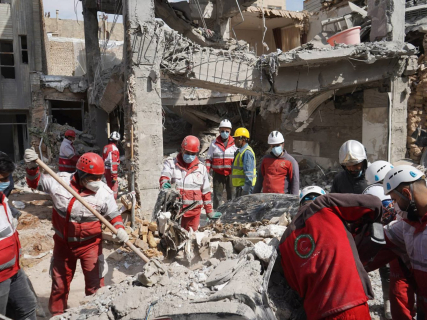

The intensification of the war in Iran is leaving a growing impact on the civilian population and raising the tone of threats between Tehran and Washington, in an increasingly volatile scenario.
Thousands of civil infrastructures damaged
The Iranian Red Crescent Society has denounced that Israel and United States airstrikes have already affected more than 93,000 civilian properties, mostly homes and small businesses.
Beyond the residential impact, Iranian authorities warn of damage to key infrastructure: at least 600 schools and 295 health and emergency centers have been affected, which seriously compromises response capacity in large areas of the country.
Added to this is the destruction of 48 emergency vehicles, 46 ambulances and three rescue helicopters, which aggravates the humanitarian situation and hinders the care of the wounded in the midst of the conflict.
Blows to essential services
The deterioration of these basic services reflects a change in the nature of the attacks, which are no longer limited to military targets. The impact on hospitals, educational centers, and rescue teams introduces a critical dimension to the conflict, with direct consequences on the civilian population.
In this context, humanitarian organizations warn that the pressure on the Iranian health system could increase in the coming weeks, especially if the bombings on urban areas continue.
Iran raises the pressure with new attacks
In parallel, the Iranian Revolutionary Guard has intensified its rhetoric and its operations. The spokesperson for Khatam al-Anbiya headquarters, Ebrahim Zolfaghari, stated that Iranian forces have attacked with missiles and drones two locations in Dubai where, according to Tehran, more than 500 American soldiers were located.
Zolfaghari stated that these attacks would have caused “serious losses” in the American ranks, in a statement that, for the moment, has not been confirmed by independent sources.
Direct threats to the United States
The Iranian spokesman also issued a direct warning to Washington, raising the tone of the conflict. “The region will become a graveyard for American soldiers,” he stated, in remarks reported by the Tasnim agency.
These words reflect a deterrence strategy based on military and rhetorical pressure, at a time when the conflict threatens to spread to other points in the Persian Gulf, such as the United Arab Emirates.
A conflict in phase of escalation
The exchange of attacks and threats confirms that the war has entered a phase of greater intensity, with increasing impacts on the civilian population and a real risk of regional expansion.
While diplomatic channels remain weakened, the combination of humanitarian damage and military escalation complicates any short-term de-escalation scenario.