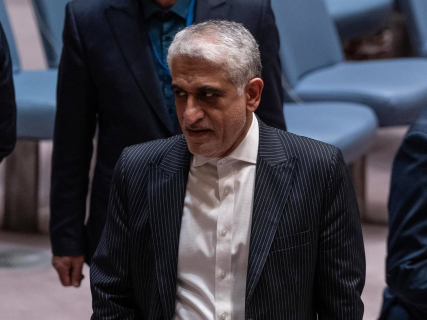

The permanent ambassador of Iran to the United Nations, Amir Saied Iravani, has warned this Tuesday before the UN Security Council that the United States could "commit a manifest war crime and a crime against humanity" if it materializes the threats formulated hours earlier by the American president, Donald Trump.
"In relation to the explicit threat by the President of the United States to commit large-scale war crimes and to attack and destroy Iran's essential civilian infrastructure, such a threat constitutes a flagrant and egregious violation of International Humanitarian Law and of the most fundamental norms governing armed conflicts," he stated before the 15 members of the Council, stressing that, if carried out, "the United States would assume full and undeniable responsibility for committing a manifest war crime and a crime against humanity."
Iravani has stressed that his country "will not stand idly by in the face of such atrocious war crimes" and that, in response, "it will, without hesitation, exercise its inherent right to legitimate self-defense and adopt immediate and proportionate reciprocal measures."
At the same time, it has criticized that the Security Council has not fulfilled "its primary responsibility to maintain international peace and security" in the context of the conflict that has been ongoing for more than a month, and has insisted that this "non-compliance does not deprive nor can it deprive Iran of its legitimate right to act."
The representative of Iran has added that Tehran's reaction after the offensive against its territory attributed to Israel and the United States "is firmly based on International Drecho" and has warned that it will be these two States who "will assume responsibility for all subsequent consequences."
Iravani has made these accusations during the debate and vote on an initiative presented by Bahrain in the Security Council that demanded the "immediate" cessation by Iran of attacks against commercial vessels in the Strait of Hormuz and encouraged countries to coordinate to strengthen maritime security, including through naval escorts.
"The objective of this project is evident," he remarked, maintaining that the purpose of the text was "to punish the victim for defending its sovereignty and its vital national interests in the Persian Gulf and the Strait of Hormuz, while providing political and legal cover for new illegal acts by the aggressors."
The diplomat has opined that the resolution, backed by 11 members of the Council, "in essence, it was a United States draft resolution." He has also expressed his gratitude to China and Russia for their "responsible" vote in blocking the initiative using their veto power in the Security Council.
In the same vein, he/she has referred to Pakistan, which in recent days has tried to mediate between Washington and Tehran to open a channel of dialogue that allows to put an end to the war, and to Colombia, for opting for abstention.
Likewise, he/she has defended Iran's "proportionate" reaction by preventing the transit of vessels "associated with the aggressors" in the Strait of Hormuz, in response to what he/she has described as a "brutal" war against the country. He/She has pointed out that "non-hostile" vessels will be able to continue crossing the strait.
On the other hand, it has rejected any proposal for a temporary ceasefire "especially in light of (its) experience last June", in reference to the so-called 12-day war, launched by Israel in the midst of conversations between Washington and Tehran to try to close a new nuclear pact.
For the Iranian authorities, Iravani concluded, any realistic solution to the current conflict must ensure the "definitive" end of attacks against its territory and that both countries assume "full responsibility for the suffering they have inflicted."