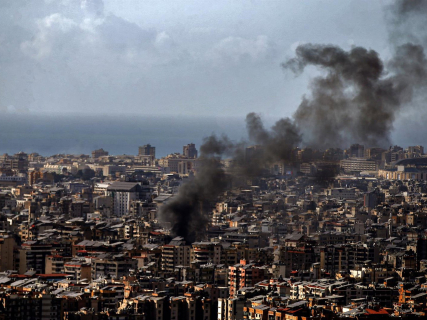

The Israeli Army has stated this Wednesday that it has carried out its "largest attack" against alleged targets of the Shiite party-militia Hezbollah in Lebanese territory since the start of the current offensive, after Prime Minister Benjamin Netanyahu stressed that the ceasefire agreed between the United States and Iran does not cover Lebanon.
"The Israel Defense Forces (IDF) have recently completed a broad attack against Hezbollah military sites and infrastructure in Beirut, the Beqaa Valley, and southern Lebanon," the Army has stated, subsequently highlighting that "it is the largest attack against Hezbollah infrastructure" since the beginning of the campaign, framed within the aerial offensive initiated on February 28 alongside the United States against Iran.
According to the military statement, the bombings have impacted "headquarters, command and control locations, and military formations of Hezbollah", among them facilities "used by terrorists of the organization to organize and plan terrorist plots against IDF elements and citizens of the State of Israel".
The Army has insisted that among the selected targets were "infrastructures" used by the group to "launch missiles" and has defended that the operation was carried out based on "precise Intelligence information" and after "careful planning over several weeks".
Likewise, he has remarked that "most of the attacked infrastructure was in the heart of the civilian population, as part of Hezbollah's cynical exploitation of the Lebanese population as human shields for its activities," while maintaining that, before the attacks, "he took steps to minimize as much as possible the damage to uninvolved people."
Before this announcement, the Israeli Armed Forces had notified the suspension of their direct operations against Iran in the context of the aforementioned ceasefire, although they made it clear that they maintained their offensive in Lebanese territory, in line with Netanyahu's statements, who stressed that the ceasefire agreement does not extend to Lebanon, despite Pakistan defending that it did.
On the other hand, the president of Lebanon, Joseph Aoun, celebrated the truce and demanded "a regional peace that includes Lebanon," while Hezbollah affirmed that "it is on the threshold of a great historical victory," although it urged the inhabitants of the south of the country not to return yet to their homes given the continuity of Israeli operations.
According to the latest balance sheet released by the Lebanese authorities on Tuesday, Israeli attacks have already caused more than 1,500 deaths and 4,600 injuries, in addition to more than one million internally displaced persons. At least another 200,000 people have crossed the border into neighboring Syria since March 2, according to data from the UN High Commissioner for Refugees (UNHCR).