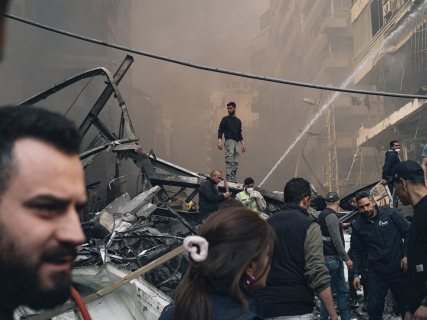

The Ministry of Foreign Affairs of Israel responded this Wednesday to the authorities of Lebanon assuring that the new offensive aims to strike the Shiite militia party Hezbollah given the lack of action by the Lebanese leaders, in an attempt to legitimize the most intense campaign until now on Beirut and the south of the country.
"The president and prime minister of Lebanon have no shame in attacking Israel for doing what they should have done: striking Hezbollah", the Israeli Ministry of Foreign Affairs has stated in a message in which it denounces that Beirut "offers no apologies" for the thousands of attacks against Israel but "comes with demands".
"It's time to start acting against Hezbollah. With actions, not with words. And if you are unable to do so, at least don't stand in the way."
Along these lines, the Foreign Ministry has stressed that Lebanon did not proceed with the disarmament of Hezbollah nor took measures to stop aggressions against Israeli territory. "They lied when they claimed they had demilitarized the area up to the Litani. Now we must do it instead", the Ministry has stated, which thus presents the continued attacks against Lebanon despite the agreement closed between the United States and Iran for a two-week truce that, in principle, includes both parties and their allies, although Israeli Prime Minister, Benjamin Netanyahu, has maintained that it does not apply to Lebanon.
Israel has also reproached that the ministers linked to Hezbollah continue to be part of the Lebanese government and that the Iranian ambassador continues in Beirut, "openly defying its own decisions."
The Israeli Army has launched this Wednesday a series of bombings on the neighboring country which it has described as its "biggest attack" against alleged targets of the Shiite organization.
The attacks have been strongly rejected by Lebanon's prime minister, Nawaf Salam, who has denounced that "Israel continues to expand its aggressions" and attack "densely populated residential neighborhoods." "The victims have been unarmed civilians in various parts of Lebanon, and particularly in the capital, Beirut," he lamented.