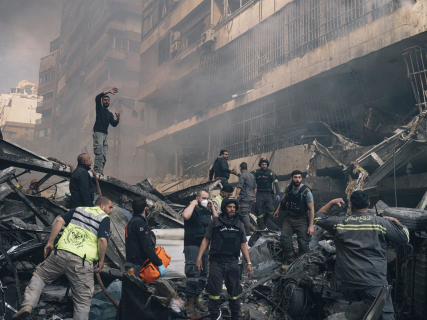

The first hours of the ceasefire agreed between United States and Iran have been marked by a serious escalation of violence in Lebanon. At least 254 people have died and 1,165 have been injured after an unprecedented wave of Israeli bombings, according to the Emergency Operations Center of the Lebanese Ministry of Health.
The attacks, which would have reached more than one hundred targets in barely ten minutes, constitute the most intense offensive recorded in Lebanese territory since the beginning of the war against the Shiite group Hezbollah, an ally of Tehran.
A truce in question: different interpretations of the ceasefire
The offensive has occurred despite the announcement of a two-week temporary truce between Washington and Tehran, which has generated a deep controversy about its real scope.
The Israeli Government, headed by Prime Minister Benjamin Netanyahu, maintains that the agreement does not include operations against Hezbollah in Lebanon, which, in practice, leaves out of the ceasefire one of the main regional tension hotspots.
From Beirut, however, the authorities consider these attacks a direct violation of the spirit of the truce, denouncing that the civilian population is paying the cost of a restrictive interpretation of the agreement.
Iran raises the tone and threatens to respond
Tehran's reaction has not been long in coming. The Revolutionary Guards have issued a direct warning to both the United States and Israel, assuring that they will respond if the bombings on Lebanese territory continue.
"If the aggression against beloved Lebanon does not cease immediately, we will fulfill our duty," they stated in a communiqué broadcast by state television, in which they accused Washington of violating international commitments and Israel of acting as its "executor."
Humanitarian impact and risk of escalation
The magnitude of the attacks and the high number of victims have rekindled international concern for the humanitarian impact of the conflict, especially in densely populated areas such as the southern suburbs of Beirut.
The situation evidences the fragility of the ceasefire and the risk that violence intensifies on multiple fronts, compromising any diplomatic progress.
In this context, the international community faces increasing pressure to clarify the terms of the truce and ensure its compliance, at a time when the stability of the Middle East hangs on an increasingly precarious balance.