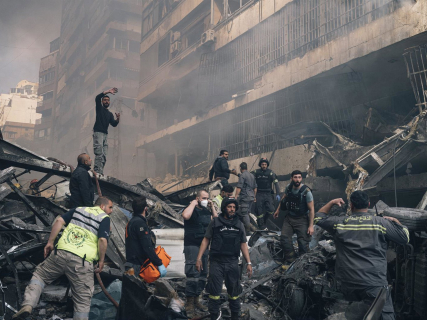
The negotiations between the US and Iran to definitively end the military escalation in the Middle East begin this Friday, in neutral Pakistani territory, with an explicit demand from Tehran: stop Israel's attacks on Lebanon. For Iran, the conflict is not exclusively bilateral with Washington, but regional, with Hezbollah as a central actor.
Diplomatic sources agree that this point introduces a red line for Tehran:
- Considers that the attacks against Hezbollah amount to a prolongation of the war.
- Demands consistency: there cannot be a partial truce while its main regional ally is a military target.
- Uses Lebanon as a negotiating lever to broaden the scope of the ceasefire.
The problem is that Israel is not part of the bilateral agreement with Washington, which leaves Americans with limited room to guarantee compliance with the condition imposed by the Iranian regime. For the moment, the Israeli prime minister, Benjamin Netanyahu, said this Thursday that he will continue "attacking Hezbollah with force and precision", after the more than 1,500 deaths caused by the latest offensive launched.
Opposing interpretations
The second element that will condition the conversations is the very nature of the ceasefire. There is no single or binding text, but a political framework with divergent readings and that has resulted in an ambiguity that affects the weakness of the agreement:
- The United States argues that the truce covers direct attacks with Iran.
- Tehran maintains that it must extend to all linked fronts.
- Israel maintains its operational autonomy in Lebanon.
Thus, the immediate risk for negotiations in Pakistan is based on a lack of common ground on what exactly "ceasefire" means, the possibility of incidents in Lebanon that energize the dialogue table and the dficulty to transform a tactical truce into a structural agreement.
Diplomatically, the challenge will be to move from a flexible political commitment to a verifiable framework accepted by all relevant actors, including indirect ones like Israel.
Ormuz, the economic thermometer of the truce
The third key factor will be the evolution of traffic in the Strait of Hormuz, whose behavior has become an immediate indicator of the credibility of the ceasefire.
If on Wednesday Iran announced the new closure of the Strait of Hormuz commercial route in response to Israel's attacks on Lebanon, on Thursday what is doubted is what the real traffic of ships through this passage is, given that the Iranian Revolutionary Guard has recommended using "alternative routes" to avoid possible anti-ship mines in Hormuz, which today is anything but safe.
In any case, maritime transit is far from normal, which directly impacts the negotiation of a ceasefire while there is international pressure for the truce to be consolidated and the immediate risk of a global energy crisis is dissipated. Ormuz introduces economic incentives for both parties towards a lasting agreement.
Pakistan, scenario of a negotiation with multiple fronts
The conversations of this Friday in Pakistan face a complex equation:
- Integrate the Lebanese front without Israel's direct presence at the table.
- Define the real scope of the ceasefire and its verification mechanisms.
- Leverage the stabilization in Hormuz as an element of positive pressure.
The margin of success will depend on whether the parties manage to align these three levels —military, political, and economic— within the same framework. The two weeks of truce will function as a trial period: if containment is maintained on all fronts, the options for a definitive agreement will increase, if attacks continue in Lebanon Iran could walk away from the table; if Hormuz becomes tense again the energy factor will accelerate international pressure for