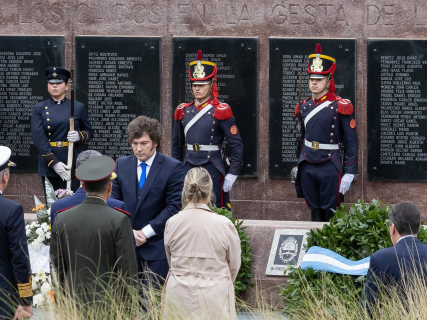

Argentina has commemorated this week the 44th anniversary of the start of the conflict over the Malvinas Islands, under British administration and whose sovereignty Buenos Aires claims. That armed conflict concluded with the Argentine surrender and with the imposition by London of an arms embargo that President Javier Milei now hopes will be lifted on his next trip to the British capital, scheduled between April and May.
It will be the first time since 1998, when Carlos Menem occupied the Casa Rosada, that an Argentine head of state sets foot in the United Kingdom, and it will take place eleven years after the resumption of diplomatic relations after an undeclared war of 74 days.
Milei himself has acknowledged that he maintains contacts with the British authorities to achieve the suspension of this measure, which would open the door to the purchase of advanced military technology and to the modernization of the Argentine Armed Forces, as he explained in an interview with "The Telegraph" newspaper at the end of last year.
In that conversation, the president maintained that "there are no world powers without military might" and that "no country has relevance in the international context if it cannot defend its borders." Although "Downing Street" later denied the existence of "specific" conversations on this matter, government sources indicate that London and Buenos Aires will continue discussing Defense issues throughout 2026.
It remains to be determined what cards the Argentine Executive will play to achieve the end of the arms embargo and if an ultranationalist leader like Milei will be willing to modulate his historical claim of sovereignty over the Malvinas.
During the act of commemoration of the 1982 war held this same week, Milei reiterated his "full right" to sovereignty over the archipelago, an "unwavering" claim, and underscored his "will to reach a peaceful and lasting solution" to the conflict through the resumption of negotiations with the United Kingdom.
Even so, the formula proposed by the president involves the consent of the islands' population, something that certain sectors in Argentina interpret as a concession to London. "The most important vote of all is the one made with the feet and we long for the islanders to one day decide to vote for us with their feet. That is why we seek to be a power, to such an extent that they prefer to be Argentinians, that there is no need to use dissuasion or persuasion to achieve it," he stated in a speech last year.
For now, no concrete details of the far-right leader's trip to the United Kingdom have emerged, although in the Casa Rosada it is taken for granted that the agenda will include a meeting with the prime minister, Keir Starmer. The Labour leader has reiterated on several occasions that the Falkland Islands "are British" and will remain so, citing the March 2013 referendum, in which 92% of the just over 1,500 voters opted to maintain the archipelago's status as an overseas territory of the United Kingdom.
A arms embargo linked to the resources of the Malvinas
The arms embargo was established during the first of Margaret Thatcher's three consecutive terms (1979-1990) and, since then, it has been tightened or relaxed according to the state of bilateral relations. Since 2018, these restrictions prevent the sale of material "that is considered to improve Argentine military capability," after David Cameron's Conservative Government removed some additional limitations imposed five years earlier.
The tensions reached one of their most critical points in 2012, coinciding with the 30th anniversary of the Argentine landing, when London accused Cristina Fernández de Kirchner's Executive of "harming the economic interests" of the inhabitants of the Malvinas.
The British Government thus reacted to the diplomatic and judicial actions that the then president announced against five British oil companies, among them Rockhopper Exploration, for carrying out hydrocarbon prospections with authorization from the authorities of the archipelago and not from the Argentine Government.
That struggle bears similarities with the controversy that arose at the beginning of this year, when Rockhopper Exploration and the Israeli Navitas presented the "Sea Lion" project, a crude oil extraction platform located 220 kilometers north of the islands, with which they plan to extract 170 million barrels of oil.
According to their calculations, only the first phase of the project could generate more than 10 billion dollars, taking as reference the price of the barrel in January, before the surprise offensive by Israel and the United States against Iran, the blockade of the Strait of Hormuz by Tehran and the consequent increase in the price of hydrocarbons.
The initial oil production is not expected until early 2028, but the announcement has already provoked the formal complaint from Buenos Aires, which considers these activities "illegal" and "illegitimate", according to a statement from the Minister of Foreign Affairs, Pablo Quirno.
United States, the Monroe Doctrine and the Malvinas board
In parallel, the United States has shown its interest in strengthening its influence over the so-called Western Hemisphere, and the strategic position of the archipelago, about 500 kilometers east of Patagonia, makes the Malvinas an attractive enclave for Washington.
In this scenario, Milei, ally of the American president, Donald Trump, could obtain gains even if the White House prioritizes the issue of the sovereignty of the islands above the lifting of the arms embargo that Argentina demands.
To the geopolitical location are added important reserves of oil, fishing, and minerals —especially zinc, lithium, and copper—, in addition to a privileged access to Antarctica, which concentrates the largest reserve of fresh water on the planet, in a context in which water has become a resource as or more valuable than crude oil.
The war in the Middle East, one of the most arid zones in the world, has highlighted this reality. Attacks against desalination plants —both in Iran and in other Persian Gulf countries— threaten the supply of millions of people who depend on these infrastructures for human consumption, industry, urban development, and agriculture.
The conflict, which has already entered its second month, has also evidenced the fragility of the bond between Washington and London, after Starmer's initial refusal to back Trump's offensive, who declared himself "very disappointed" with the Labour leader and went so far as to call his traditional partner "weak" and "unreliable". Despite this, the United Kingdom has allowed the United States to use its military bases in the area for defensive operations in the Strait of Hormuz.
The unknown now is what moves the US Administration will make to pressure the British Government in favor of Argentina in the Falklands dispute and what it will demand in return, taking into account that the clear ambitions of the Trump era in foreign policy make the installation of a military base in the extreme south of the continent not seem a far-fetched hypothesis.