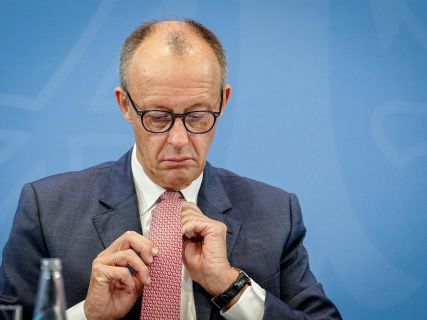

The German Chancellor, Friedrich Merz, has conveyed to the interim president of Syria, Ahmed al Shara, his intention that around 80% of Syrian refugees in Germany return to their country in the next three years.
More than a year after the fall of the Bachar al-Assad regime and the end of the Syrian civil war, the number of refugees in Germany equivalent to more than 900,000 people, which reflects an ambitious repatriation plan that will prioritize those who lack a valid residence permit and those considered “problematic” due to criminal records.
Cooperation and reconstruction: Germany as ally of Syria
Merz has announced the creation of a joint working group between Berlin and Damascus to oversee the country's reconstruction and facilitate the safe return of refugees. According to the chancellor, “in a few days a delegation trip to Syria will take place” to begin preparations on the ground.
In addition, Germany will allocate more than 200 million euros this year to stabilization projects and will promote German investment in Syria, where, according to Merz, conditions have “fundamentally improved.”
The chancellor has emphasized the need to re-evaluate the protection rights of refugees: “Whoever no longer has the right to remain in Germany, must leave the country. We need a reliable return option and cooperation with Syria, especially for those who abuse our hospitality and do not respect our laws,” he explained.
The vision of Al Shara: investment and stability
During the meeting, Al Shara has assured that the country offers “a rule of law” and has promised to guarantee the rights of all minorities. Thus, he has highlighted an economic potential of up to 400 billion euros in investment partnerships between Europe and Syria and has appealed to Germany as a key partner: “We need a partner with whom we can build bridges and Germany is, of course, that partner”.
The 43-year-old Syrian interim president assumed power after overthrowing al-Assad at the end of 2024. Previously, he led the Al Nusra Front and participated in conflicts linked to Al Qaeda and its successor, Hayat Tahrir al Sham, a past that generates international controversy and criticism within Germany.
The repatriation policy has sparked protests in Berlin, where demonstrators have denounced the violence against minorities in Syria and have criticized the official reception of Al Shara by the German government.
Organizations like ProAsyl have questioned whether this policy could legitimize the new regime and pointed to the precariousness of infrastructure and insecurity in Syria as significant risks for returnees.
However, Merz defends his initiative insisting that the objective is to create “a space for all Syrians, regardless of their religion, ethnic origin, and gender”, and emphasizes that the Syrian civil war has ended, offering the “possibility of returning to the country of origin” with security and stability.