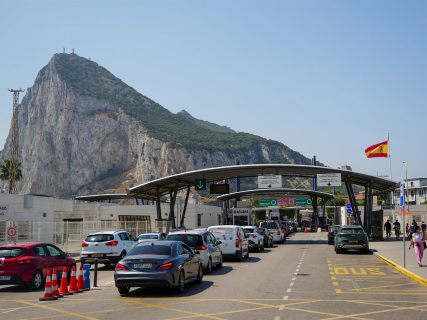

The Twenty-Seven are scheduled to grant this Wednesday, barring a last-minute change, their political backing to the signing and provisional application of the agreement between the European Union and the United Kingdom that redefines the community bloc's link with Gibraltar and foresees the dismantling of the Gibraltar Fence. However, the formal signing will be postponed until the official adoption of the texts is completed later, a more prolonged process on both the European and British sides, so it is not expected before summer.
Thus, the ambassadors of the 27 before the European Union will address this matter in their Wednesday meeting, according to various community sources have indicated to Europa Press, given the need to accelerate the procedure in view of the imminent implementation of the new system for controlling the external border of the European Union next April 10, which will impose reinforced controls at crossings with third countries.
With this decision, the capitals intend to send a political message that facilitates the transition until Gibraltar's new status is consolidated, after the initial goal of closing in April the signing and provisional application of the Treaty was not reached.
The procedures for its ratification require more time than initially calculated, so now the scenario of taking the first step in summer is being managed, with provisional application, while the full ratification by the Council and the European Parliament concludes, as well as by the United Kingdom, whose Parliament has not yet received the definitive text.
The European Union Entry/Exit System (EES, for its acronym in English) began to be gradually introduced in the Member States last autumn, but its full deployment is set for within ten days, when the new digital register that will replace the manual stamping of passports at the borders of the Schengen area must be operational at all access points to the European Union.
Sources from the Ministry of Interior cited by Europa Press assure that the facilities and technical equipment necessary for control at the Gibraltar crossing towards community territory are "operational and available", although they do not specify the implementation schedule.
Spain negotiates with the European Commission
In any case, and beyond the technical preparation, the absence of application of the Treaty that regulates Gibraltar's relationship with the European Union when the EES system comes into force implies, in practice, that this territory continues to be treated for border control purposes as a third country. In this way, travelers crossing from or to the Rock from Spanish soil would have to undergo registration in the new European system.
To circumvent this gap, the Spanish Executive has submitted to the European Commission a proposal to make the application of the EES more flexible at that specific point, although no details have emerged nor is it yet known if Brussels —which generally opposes modifying the calendar of the new border system— considers the Spanish request viable.
"The Commission has received the letter from the Spanish Government regarding the EU-UK Agreement on Gibraltar and the EES and will respond to it in due course," a spokesperson for the Community Executive has indicated to questions from Europa Press.
Most Member States already register "more than 75% of border crossings", although some continue to face "technical difficulties" despite the fact that the timeline was agreed upon and validated by the 27, the spokesperson recalls, who emphasizes that the Commission maintains "close contact" with them to ensure that the system operates properly.