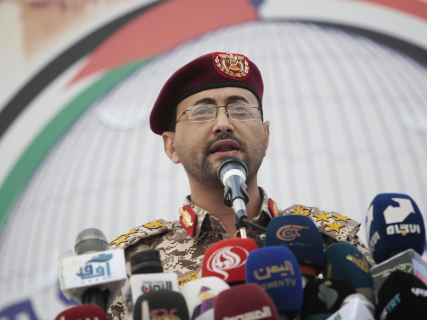

The war in the Middle East has crossed a new threshold. Yemen's Houthis, the armed movement backed by Iran, have fully entered the regional escalation with direct attacks against Israel and a warning that goes far beyond the military: the possible closure of the Bab el Mandeb strait.
The Israeli army confirmed this Saturday the detection of a missile launched from Yemeni territory against the south of the country early in the morning. It was intercepted, as happened hours later with a cruise missile and a drone also attributed to the Houthis. There was no impact, but the message was clear: the conflict no longer has close borders.
For months, Yemen had been a peripheral actor, uncomfortable but constant. Now it has decided to take a step forward. And that changes the balance.
Bab el Mandeb: the point that can strain the global economy
The Strait of Bab el Mandeb, located between Yemen and the Horn of Africa, is one of the key arteries of global trade. A good part of the maritime traffic that connects Europe with Asia through the Suez Canal transits through there. Oil, gas, goods… everything passes through that bottleneck.
One of the Houthi spokesmen, Mohammed Mansour, expressed it bluntly: closing the strait is “one of the options” within the group's strategy. It is not a symbolic declaration. It is a direct threat to the global logistical system.
It already happened in the recent past. The attacks on commercial and oil tankers in that area forced the diversion of routes, increased costs, and strained markets. If Yemen becomes an active focus again, the impact will not be only regional. It will be economic and global.
The “ring of fire” of Iran activates again
The entry of the Houthis is not an isolated movement. It is part of a broader scheme.
For months, they have been the only actor of Iran's so-called "ring of fire" -alongside Hezbollah in Lebanon or militias in Iraq- that maintained constant attacks against Israel even during truce phases on other fronts. But their role in this war, until now, had been contained.
The Houthi military spokesman, Yahya Sarea, announced a “first operation” with ballistic missiles against Israeli targets and made it clear that the attacks will continue “until the aggression stops on all fronts.” The narrative is the same as Tehran's: a coordinated response from the so-called axis of resistance.
From Israel, the response has not been long in coming. Military spokesperson Effie Defrin warned that any actor that attacks the country “will pay a price,” in a sign that Yemen could also become a direct target.
More pressure on Israel: multiple fronts, same war
The entry of Yemen adds a new level of attrition for Israel. Until now, the country faced attacks from Iran, Lebanon -through Hezbollah- and the constant pressure derived from the conflict with Hamas. Now it adds one more front, more than 1,500 kilometers away, which forces it to stretch even further its defensive system and its air capacity.
The Houthis had been hinting for weeks at their entry into the war, but had maintained an ambiguous position. Their involvement can be interpreted in two opposite ways.
On the one hand, as part of a plan coordinated with Iran to broaden the conflict and disperse the pressure on Tehran. On the other hand, as a reaction to the weakness of the Iranian regime after weeks of attacks, forcing its allies to get more directly involved.
There is also an internal factor. Yemen has been in years of war and attrition. Re-escalating the conflict is not necessarily the most convenient for the Houthi movement itself.