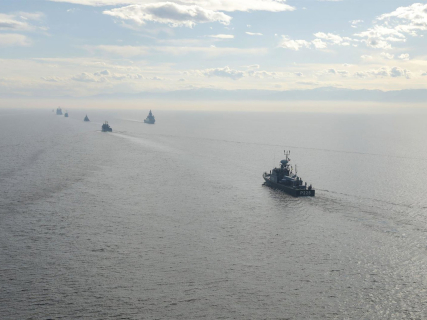
The world observes with caution the recent events in the Middle East after having crystallized this afternoon the threat of the United States president, Donald Trump, to impose a naval blockade on the Strait of Hormuz.
"If any of your ships approaches our blockade at all, they will be immediately eliminated, with the same annihilation system we use against drug traffickers on ships in the Caribbean," the US president warned Iran a few minutes after said blockade came into effect.
In a second block of statements, Trump has assured that Tehran has contacted this Monday with Washington to reactivate the peace negotiations and that, according to the American president, “they have a tremendous desire to reach an agreement”.
Trump has also stated that the work of his vice president, JD Vance, in the mediated talks in Pakistan had been “excellent”, although he has maintained that Tehran continues to systematically reject the United States' conditions to curb its nuclear program. “Iran will not have a nuclear weapon. We cannot let a country blackmail or extort the world”, he has declared.
And with crude oil prices through the roof, having already surpassed the barrier of 100 dollars per barrel, European stock markets in negative territory due to frictions between Tehran and Washington, and the International Energy Agency (IEA), "prepared" to release more oil reserves if necessary, the world has welcomed this Monday expectantly another step up in this conflict.
Trump says that the Iranians "want to try to reach an agreement"
The passage of any military vessel through the maritime route, where 20% of the world's oil crosses, will be considered a violation of the agreed two-week ceasefire. This is how Trump has proposed his blockade, from which any vessel carrying humanitarian material on board is excluded. In any contrary case, Trump will prevent its passage in a "rapid and brutal" manner.
Even so, it seems that conversations between Washington and Tehran are still ongoing. From the White House, Trump assured this afternoon that Iranian negotiators “called this morning” because, in his opinion, “they want to try to reach an agreement”, in an attempt to reopen the diplomatic path after the failure of the talks held in Islamabad.
Meanwhile, this afternoon hundreds of people have gathered in Tehran in support of the Iranian regime against Trump's threats. From the Trump Administration, this afternoon advances in those talks have been confirmed, according to a source familiar with the state of the negotiations to Reuters agency.
Pakistan intensifies mediation and seeks to unblock dialogue
For his part, the prime minister of Pakistan, Shehbaz Sharif, has assured that intense diplomatic efforts are underway to try to overcome the so-called "red lines" that have blocked dialogue between the United States and Iran, amid a full escalation of tension over the situation in the Strait of Hormuz.
In a televised speech, Sharif has stressed that “at this very moment as I speak to you, all necessary efforts are being made to resolve the issues that are still pending,” in reference to the frustrated negotiations in Islamabad.
Government sources have confirmed to the EFE agency that the Pakistani leader will travel to Saudi Arabia in the next 48 hours, as part of a diplomatic offensive to try to contain the crisis.
According to these same sources, Pakistan has elevated its mediation role “to a higher level” and is working to promote a second round of talks that allows extending the ceasefire and reopening the negotiating path between Washington and Tehran.
Europe does not hide its concern over the escalation in Hormuz
Despite negotiations appearing to continue, Europe does not hide its concern over the escalation in the Middle East. Hours before Trump carried out his threat, European leaders have spoken out against the warning that the US president issued this Sunday about Iran.
Thus, the president of the European Commission, Ursula von der Leyen, has warned that the closure of the strait is “very serious and damaging” and has demanded the reestablishment of freedom of navigation as an absolute priority.
Von der Leyen has also urged member states to coordinate on energy prices, recalling that the conflict has already caused an increase of 22 billion euros in fossil fuel bills since the start of the war.
Along the same lines, the EU High Representative for Foreign Affairs, Kaja Kallas, has stated before the UN Security Council that the crisis in Hormuz is an urgent call to promote an international maritime security coalition.
The French president, Emmanuel Macron, has announced together with the United Kingdom the preparation of an international conference in the coming days to coordinate a possible mission aimed at guaranteeing freedom of navigation in the strait.
The British prime minister, Keir Starmer, has backed the plan and stressed that the United Kingdom has mobilized more than 40 countries to keep the maritime passage open. Starmer has warned that the closure of the strait directly impacts the global energy supply and could translate into an increase in the cost of living in Europe and other regions.
For his part, the Secretary-General of the United Nations, António Guterres, has called for the immediate restoration of freedom of navigation in the Strait of Hormuz, amid a full increase in tension in the region.
According to his spokesperson, Stéphane Dujarric, “no one should do anything that undermines the freedom of navigation in the Strait of Hormuz, as said freedom is based on international law and a long tradition,” stressing the need for it to be reestablished “fully for all.”
The conflict in Lebanon leaves already more than 2,000 dead
Meanwhile, the conflict does not give ground in Lebanon, where every minute the number of fatalities continues to increase within the framework of the military escalation in the region. At least 2,089 people have died and 6,762 have been injured since the beginning of the intense Israeli bombing campaign last March 2, to which a ground offensive in the south of the country was subsequently added.
According to the latest data from the Lebanese Emergency Operations Center, among the deceased are 166 minors, while 648 of the injured are children, which reflects the high impact of the conflict on the civilian population.
In the last 24 hours, authorities have registered 34 dead and 174 injured in different parts of the territory, on a day that confirms the persistence of the fighting and the seriousness of the humanitarian situation.
Netanyahu supports the blockade on the eve of a meeting with Lebanon
The Army of Israel has claimed to have carried out attacks against approximately 150 Hezbollah targets in different areas of southern Lebanon during the last 24 hours, in a context of strong military escalation in the region.
For his part, the prime minister of Benjamin Netanyahu has expressed this Monday his support for the blockade of Iranian ports announced by Trump, in a new sign of alignment between Washington and Tel Aviv in full escalation region.
The Israeli leader ordered last week direct talks with Lebanon to advance a ceasefire in the region that would include the disarmament of the Shiite party-militia Hezbollah. Its leader, Naim Qassem, has urged this Monday the Lebanese Government to reject any direct negotiation with Israel and to cancel the meeting scheduled for tomorrow in Washington between representatives of both countries.
This Tuesday, a new attempt at diplomatic de-escalation is scheduled with the meeting in Washington of representatives from Israel and Lebanon, with United States mediation. The meeting, which will be held at ambassadorial level, seeks to open the door to a ceasefire and lay the groundwork for future formal negotiations.