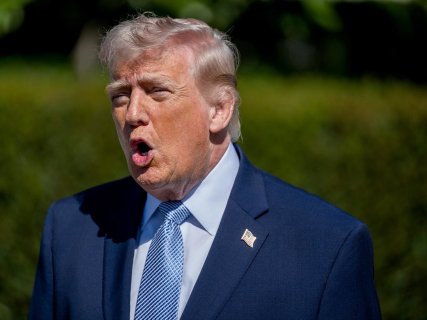
In the midst of escalating tension with Iran and a few hours before his ultimatum expires, the president of the United States, Donald Trump, faces not only international pressure, but also a viral phenomenon gaining strength on social media, the so-called "TACO", for its acronym in English, "Trump always chickens out" (Trump Always Chickens Out).
The term, emerged on digital platforms and critical political circles, has become a satirical nickname that questions the strategy of the president. According to those who use it, Trump tends to launch forceful threats, like the recent warnings about the destruction of Iranian infrastructure or even the disappearance of “an entire civilization”, to later lower the tone or open the door to negotiations.
Military and verbal escalation
After more than a month of war, the strategy of the American president has been repeated with a clear pattern: verbal escalation, tension in the markets and subsequent messages that promise a quick solution.
However, this formula seems to have lost effect. Energy and stock markets show that investors no longer react to their attempts to calm the situation, which has consolidated the so-called "TACO" as an informal reference in decision-making.
The impact is tangible. The price of oil has soared to historic levels, with increases close to 60% in just one month, while gas and other energy indicators also register sharp increases.
At the same time, the U.S. debt has suffered a significant deterioration, with the ten-year bond increasing its yield and reflecting a growing distrust in the economic stability of the White House.
The origin of this distrust lies in the dissonance between discourse and facts. Messages in which Trump assures that the war is close to ending or that there are thousands of targets still to attack coexist with the reality of a conflict that is prolonged, with sending of troops, attacks on infrastructure and new threats.
Even when the president has tried to curb the nervousness with announcements of diplomatic advances, Iran has denied on several occasions any imminent negotiation, leaving in evidence the fragility of those messages.
Trump pressures with extreme threats
In this context, the “TACO” is no longer just a political critique, but a strategic reading of presidential behavior: the idea that Trump pressures with extreme threats, but avoids the definitive clash, forcing markets to anticipate more prolonged and complex scenarios.
The consequence is a paradigm shift. Where before each statement by the president could move the price of crude oil or calm investors, now skepticism dominates. Markets not only analyze what Trump says, but what they believe he will actually do, incorporating that distance as part of the risk.
With the midterm elections on the horizon and a war that remains unresolved, the loss of credibility becomes a political and economic problem of the first order.