
The Executive is scheduled to give the green light next May, at a meeting of the Council of Ministers, to the draft Organic Law on Civil Protection of the Right to Honor, personal and family privacy, and one's own image. This future regulation will raise the minimum age to 16 years to be able to give consent regarding the use of one's own image and will strengthen the protection of crime victims given the rise of the 'true crime' phenomenon, that is, television series based on real crimes.
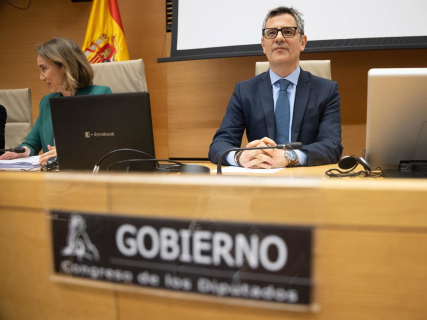
"I want to announce to you that once we receive the mandatory reports, in the month of May, we are going to approve in the Council of Ministers and we are going to send to Parliament the draft Organic Law on Civil Protection of the Right to Honor, to personal and family privacy and to one's own image, which adapts a regulation that is currently outdated, the law in force since '82, with very important novelties both in the digital sphere and in the protection of minors. Consent will not be able to be given to be on social networks below 16 years of age", stated the Minister of the Presidency, Justice and Relations with the Cortes, Félix Bolaños, this Wednesday during his appearance before the Constitutional Commission, in Congress.
Later, the head of the Presidency has specified that the objective of this regulation will be "that young people under 16 years old cannot give consent for something that may affect their privacy or their honor."
In parallel, it has been recalled that the restriction related to the access of minors under 16 years of age to social networks will be addressed in the law for the protection of minors in digital environments, currently being processed in the Cortes, which raises from 14 to 16 years the age from which minors can authorize the processing of their personal data.
Likewise, it has indicated that the new law on the Right to Honor will include the prohibition of using artificial intelligence for advertising or commercial purposes when the voice or image of any person is used without their express authorization.
The text will also contemplate measures to protect victims of crimes against the so-called 'True crimes', "these series that flourish in the television landscape" with the aim that "the perpetrators of those crimes cannot profit from this crime".
Debate on the shielding of abortion in the Constitution
At another point in his speech before the Constitutional Commission, the Minister of the Presidency, Justice and Relations with the Cortes addressed the Popular Party to question its position on the proposal to enshrine the right to abortion in the Spanish Constitution, an initiative approved this Tuesday by the Council of Ministers, and asked it if it would be "close to women" or "to the far-right and machismo".
"The question is what the Popular Party will do with this constitutional reform that we propose from the Government. If the Popular Party will be close to women and therefore to shielding their rights as the Government intends or will be close to Vox and the far-right and machismo," he/she/it has posed.
The minister has stressed that the proposed constitutional amendment goes "in line with what other surrounding countries have done" such as Luxembourg or France, where, as he recalled, "it was supported by the party of (Marine) Le Pen."
Nevertheless, has regretted that in Spain "it does not seem" that all political forces are going to be "in agreement on protecting women's rights" and has reproached Vox its "very clear position against abortion" and its "sexist postulates".