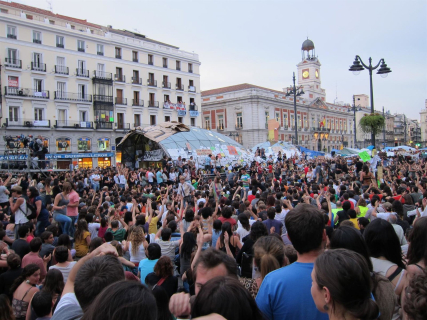

Next May 15 will mark fifteen years since the movement of the indignant occupied squares and streets like Puerta del Sol. That 15M channeled the discontent of a generation punished by the economic crisis and became the origin of what was later called the 'new politics,' which ended up taking shape in projects like Podemos or in municipalist initiatives like Ahora Madrid.
At the start of this cycle of protest, the one known as 'Indignant Bible', a brief essay signed by Stéphane Hessel, played a key role. The writer and activist, member of the French Resistance, Buchenwald survivor, and diplomat who participated in the drafting of the Universal Declaration of Human Rights, contributed to articulating the rage of a society hit by the global crisis.
"Get Indignant!" is a "plea against indifference and in favor of peaceful insurrection" that Hessel wrote at 93 years old. The text saw the light in 2010, in parallel with the Arab Spring, a year before the 15M filled Spanish squares with protests.
The book connected with a social climate that had been brewing since 2008, when the great recession exploded after the fall of the giant Lehman Brothers in a Spain marked by the brick and the real estate bubble. The first great citizen shake-up came from Iceland: between 2008 and 2011 protests against the Government for the management of the crisis were chained, organized in an assembly-like manner, a model that the 15M and other 'indignant' movements would later replicate.
In Iceland, the mobilizations not only forced the resignation of the conservative Executive, but achieved what seemed unattainable: prison sentences for several bankers and the prosecution of former prime minister Geir Haarde for gross negligence.
The Arab Spring and the climate prior to 15M
Another of the milestones that fueled the wave of indignation was the Arab Spring, initiated in 2010 after the self-immolation of a street vendor, Mohamed Bouazizi, who set himself on fire in front of a police station in Tunisia as a denunciation of corruption and police abuses. The protests managed to overthrow the Tunisian Government.
His gesture became the spark that ignited in 2011 a chain of revolts known as the Arab Spring, whose symbolic epicenter was Tahrir Square in Cairo and that culminated with the resignation of Hosni Mubarak after 30 years of authoritarian power.
Greece also proved decisive when it came to extending a feeling of social rejection in the face of the harsh austerity programs imposed after the collapse of the financial system linked to the 2008 crisis.
A May 15 that changed politics
In that global context, the protest went viral and ended up spreading across the entire planet. Spain was no exception. On Sunday, May 15, 2011, Madrid was celebrating San Isidro, but it also became the scene of the call by the platform Real Democracy Now (DRY) which, together with collectives such as the PAH and Youth Without Future, called on "all citizens discontent with the system" to demonstrate from Cibeles to Sol.
The march denounced the economic, social, and political situation and was held barely a week before the municipal and regional elections, which the PP would win again with Alberto Ruiz-Gallardón and Esperanza Aguirre at the head of the candidacies.
DRY, emerged in the heat of social media, grouped more than a hundred citizen associations and had promoted calls in nearly fifty Spanish cities. It invited the population to "take the streets" under the slogan 'We are not merchandise in the hands of politicians and bankers' and set a red line: the direct adherence of parties or unions was not admitted, although any person could participate individually.
Following the spirit of "Get Indignant!" by Stéphane Hessel, the promoting organizations defined themselves as a "peaceful movement", with civil disobedience as its core. Hundreds of people joined the demonstration in Madrid, which ended with 80 young people spending the night camped in Puerta del Sol. They were evicted, but the next day thousands of people returned to the same place.
Sol Encampment and the extension of the 15M
The spontaneous encampments consolidated in Puerta del Sol, converted into a symbol of the fight against corruption, the austerity that suffocated households, the cuts and precarity. They also crystallized the rejection of the 'old politics' of the PP-PSOE bipartisanship.
Soon, the squares of other cities began to fill with tents and open assemblies. Madrid's example was replicated in spaces such as Plaza Cataluña in Barcelona, the City Hall square in Valencia, the Salón promenade in Granada, the Candelaria square in Tenerife, the Constitution square in Málaga, Plaza del Pilar in Zaragoza, the Obradoiro in Santiago de Compostela, the Porticada in Santander, Plaza España in Palma de Mallorca or the Obelisco de los Cantones in A Coruña.
The Sol Encampment was lifted on June 12, following the mandate of the general assembly, with the premise that the end of the encampment did not mean the closing of the demands. For four weeks, the assembly movement organized itself into commissions and open working groups tasked with developing proposals that would give political and social content to the protest.
"We slept/we woke up": slogans and images for history
Those four weeks remained etched in the collective memory and in recent history, with a Kilómetro Cero crowded with citizens who felt swindled by the system, surrounded by tents and banners.
Among the iconic images is the large advertising canvas of a cosmetic firm at the confluence of Carmen and Preciados, starring actress Paz Vega, which was covered by a banner with a Heinrich Himmler, head of the Nazi SS, with Mickey Mouse ears and the slogan 'They do not represent us', one of the most repeated slogans of 15M.
Other slogans that became famous were 'We were sleeping/we woke up'; 'They call it democracy and it is not'; 'Hands up, this is a contract'; 'If you don't let us dream, we won't let you sleep' or 'We go slowly because we go far'.
A plaque in Sol to not forget the 15M
In the same environment where the banner of Himmler with mouse ears and the slogan 'They do not represent us' was hung, the Madrid City Council presided over by Manuela Carmena installed in 2018 a commemorative plaque in the Puerta del Sol to remember a collective event that transformed the country.
The then councilor-president of the Centro district, Jorge García Castaño (Ahora Madrid), explained that with this plaque "the 15M movement and all the people participating in it were recognized, contributing their work and collective intelligence in favor of the transformation of this society and this city".
The plaque, with the municipal coat of arms, was placed on the facade of number 10 Puerta del Sol with the text 'The people of Madrid, in recognition of the 15M movement that originated in this Puerta del Sol. We were sleeping, we woke up.'