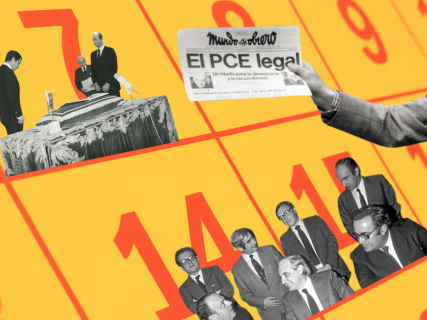

During Holy Week of 1977, Spain projected itself before the world as a budding democracy. In the same way, months earlier, the attitude of the PCE during the funeral of the victims of the Atocha attacks had endowed it with legitimacy before public opinion.
That April 9, which has gone down in history as "Red Holy Saturday", the Board of Prosecutors issued a report in which it declared that, based on the documentation submitted by the Executive, there was no element that would prevent the PCE from being registered in the Register of Associations. For practical purposes, "the party" abandoned clandestinity after 40 years.
Without a doubt, this is the most recognizable milestone that took place in during April of 1977, but in successive years, during this month other key events also occurred for the consolidation of the Transition.
Furthermore, as if that weren't enough, ten days after the legalization of the PCE, the BOE published the call for the first democratic elections. Elections in which all formations that so desired could participate.
Hello Constitution, goodbye Leninism
In April 1978 the Constituent Cortes had already begun to legislate in line with a society in transition. But without a doubt, the most important task they had in hand was the drafting of the Constitution.
In this regard, on April 10 the seven rapporteurs, the seven fathers of the Magna Carta, signed the constitutional draft, which days later was published in the Official Gazette of the Cortes Generales (BOCG). On that text, the rest of the deputies and senators would continue the work in the following months.
On the other hand, coinciding with the first anniversary of its legalization and now fully integrated into political life, on April 23, 1978, the PCE held its IX Congress. It was the first out of clandestinity and organized in Spanish territory.
The importance of this conclave lies in that the communist formation decided to abandon Leninism and eliminate this reference from its statutes to adjust to Eurocommunism towards which it was heading.
It is the neighbor who chooses the mayor
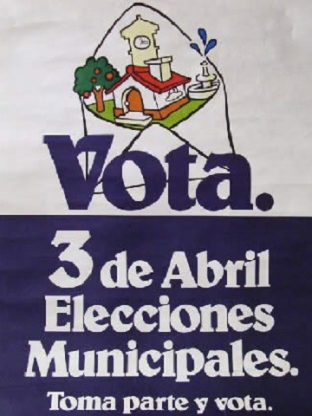
April 1979 was key in the legitimation process of the arrival of democracy in Spain. On Tuesday the 3rd the polls opened for the third time in four months.
After the referendum of the Constitution (December 1978), the second general elections (March 1977), it was time to elect the mayors. The political transformation of Spain that had begun from top to bottom, finally reached the first level of socialization: the municipalities.
As it was a working day, workers had four paid hours at their workplaces to go to the polling stations. The UCD achieved victory with 30% of the votes. But due to the electoral law, an absolute majority was necessary for the governance of the city councils, for which it lacked support.
The same night of the elections, Santiago Carrillo sent an offer of pact to the PSOE and they began to negotiate stable majorities that would allow the stability of the city councils after almost 45 years under Francoist rule.
As a result of these agreements, the left took control of most of the large city councils, including Madrid, Barcelona, Valencia, Seville, Zaragoza and Malaga. Of the 50 provincial capitals, the PSOE obtained 23 mayoralties, UCD 20, PNV 3, and PCE, Socialist Party of Andalusia, Galician Unity and Union of the Canarian People 1 each.
72 hours later, on April 6, Adolfo Suárez swore his oath before King Juan Carlos I as president of the Government. The first democratic president had won the elections again and at the end of March, thanks to an agreement with Alianza Popular, he was invested.
That year, Spaniards went on Holy Week with a new centrist Government and with the municipal political fabric in full effervescence. Spain was already a democracy at all levels.