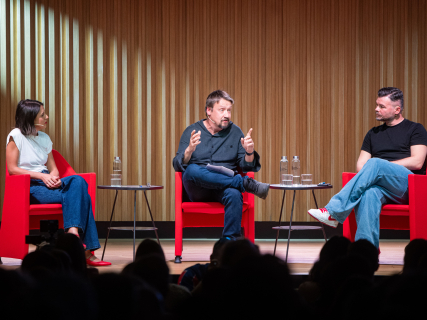
Barcelona has become this Thursday the epicenter of the debate addressing the future of the left to the left of the PSOE. Gabriel Rufián, spokesperson for Esquerra Republicana in Congress, and Irene Montero, MEP for Podemos, have met on the Ciutadella campus of the Universitat Pompeu Fabra (UPF) to explore how to articulate a progressive front with an eye on the 2027 general elections.
The event, moderated by former deputy Xavi Domènech, has resumed the path started in Madrid last February between Rufián and Emilio Delgado, from Más Madrid. The day, under the slogan "Què s'ha de fer?" (What needs to be done?), has once again generated expectations for the left, which this Thursday has asked to stop the advance of the right and the far-right, although equally generating enthusiasm for the electorate.
Thus, both leaders have gone a step further by claiming a leading role for their respective parties in that process. Rufián has been especially explicit in asking for internal leadership in his party: "I ask my party to lead this and if my position is at stake, I'm going home", he stated.
The republican leader has proposed a scheme in which Podemos promotes the unity of the left to the left of the PSOE throughout Spain and ERC does the same in Catalonia, arguing that separatism cannot remain outside the state scenario. "We cannot say you'll manage on your own", he warned. "Otherwise, they will kill us separately," he concluded.
Spain and Catalonia want left. There are people who are fed up with hearing that migrant people are criminals or that violence has no gender.
— Podemos (@PODEMOS) April 9, 2026
There are people who want to fight for the public, who want to recover the compass of morality.
🎥 @IreneMontero pic.twitter.com/tDf8Oe1hzc
Montero insists that "it's worth it" to try an agreement
For her part, Montero has picked up the gauntlet and has insisted on the need to explore that alliance, even assuming the difficulties: "It's worth trying, I think it could get many votes, but if not, it's equally worth it". Because, according to her, "to win once, you have to lose 700".
Beyond the political gestures, the meeting has shown that the project is still in a very early stage. There is no concrete proposal for an electoral coalition nor a defined architecture, although there are some initial ideas that were already presented at the event last February: sharing programmatic points, creating a group or coordinating strategies.
In this regard, Rufián has made it clear that the immediate objective is not to close an agreement, but to force the party leaderships to sit down and negotiate: "We must pressure the party structures to talk", he pointed out, admitting that there is no "magic formula". "Why can't ERC inspire this left?", he asked.
The event, which has filled the 340 available seats with a predominantly young audience, has also served as a thermometer of social interest for a possible reunification of the progressive space, at a time marked by electoral fragmentation.
Warnings in the face of the advance of PP and Vox
During the debate, both leaders have insisted on the need to articulate that front as response to the possible rise of PP and Vox to the Government. Rufián has directly appealed to the "historical responsibility" of the left to "stop fascism", while recognizing the need for an internal self-criticism.
Along the same lines, Montero has called for recovering the "moral compass" of progressivism and for placing principles at the center of the political project.
The left has never stopped talking about security. Feminism, public healthcare, public education, limiting rental and food prices.
— Podemos (@PODEMOS) April 9, 2026
Against those who enrich themselves with inequality, the security of dignified lives for all.
🎥 @IreneMontero pic.twitter.com/hd47RqouJN
In the final stretch of the meeting, Irene Montero has vindicated the historical role of the left in social matters, defending that "the left has never stopped talking about security" and appealing not to fall into the "frameworks" of the right. In this sense, she has linked that idea to the protection of rights and public services, citing feminism, public healthcare and education, or intervention in housing and food prices.
Against this, it has contrasted the economic model of the right which, in its opinion, promotes inequality, betting on "the security of dignified lives for all" as the central axis of the progressive project.
Furthermore, Montero has launched a criticism of Vox by questioning its discourse on the defense of the working class. "When Vox tells you it speaks to the working class, remember", she warned, before giving as an example the labor conflict of the stevedores of the Port of Avilés, on strike for more than 40 days. The Podemos leader has stressed that the company involved belongs to the family of José María Figaredo, a Vox leader, whom she has accused of "making life impossible for those workers".
Internal resistances and misgivings among allies
However, the initiative is born with important resistance. Parties like Bildu, BNG or CUP have already shown distance from the proposal, while formations like Sumar or Comuns observe the movement with caution.
Tensions are also visible within ERC. The party leadership, headed by Oriol Junqueras, rejects for now sharing a project with state forces, which has generated friction with Rufián. The deputy himself has responded to these criticisms: "They say I harm my party. Let them explain to me what harm it does to fill a room like this with young people".
Despite this, he has reaffirmed his commitment to the republican party: "I am from ERC and I feel very proud. I hope to continue representing it", he has assured, although his future as a candidate is not completely clear.
A photo with significant absences
The level of support for the event has also reflected those doubts. Neither the leaders of ERC nor of the Comuns have been present, while Podemos has sent its top leadership, with Ione Belarra at the helm. The meeting between Rufián and Montero confirms that the reconfiguration of the left remains open and without a clear roadmap. The will for unity coexists with strategic differences, organic suspicions, and internal tensions.
For now, the only evident thing is that the intention to recompose the space remains latent, but also that the path towards a joint candidacy is far from being resolved.
Next April 19, the parties of Sumar, Más Madrid, Comuns, Movimiento Sumar and Izquierda Unida will meet in Seville for a new meeting of 'A step forward', continuing the one held in Madrid last February.