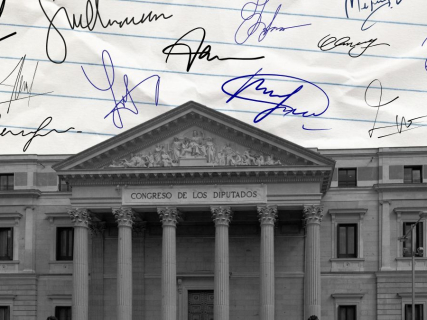

The curtain opens and a dozen people appear carrying boxes along the Carrera de San Jerónimo; they pose before the steps of the Congress; they hand over the hundreds of signatures collected; the cameras turn off and they leave.
It is a very common image. Social movements and associations that champion a cause and see in the collection of citizen signatures a form of political pressure. 100,000, 200,000, 300,000, hundreds of thousands of signatures that, however, if they do not reach the half million required by Popular Legislative Initiatives (PLI) fall on deaf ears. A gesture that goes no further than mere symbolism, unless some parliamentary group takes pity on the cause and promotes a bill.
One of the most recent examples is that of the Safe Public Healthcare movement, which on March 30 presented 100,000 signatures against the Framework Statute promoted by the Ministry of Health. An initiative driven by doctors that rejects the text agreed upon between the Government and the unions that in their opinion "do not represent the medical profession."
From Secure Public Health they do not rule out that in the future an ILP could be presented, "there is still a need to continue adding support," they point out. Specifically, 400,000 signatures, although as they acknowledge in conversation with Demócrata, "even if the signatures are gathered, getting it approved is also complex."
The percentage of ILPs that are approved is very low. The minimum number of signatures is one of the main barriers, but not the only one. For this reason, from some political and social sectors they see an update of Organic Law 3/1984, which regulates this procedure to reverse the situation, as necessary.
A rule that in the almost forty years it has been in force has only been reformed on two occasions, the most significant one in 2006, although it has accumulated various failed attempts.
IU asks for way
In 1999, Izquierda Unida registered a bill proposal in which it proposed to increase from 30 to 65 million pesetas (from 180,304 euros to 390,658) the state compensation for expenses incurred by the Promoting Commission. The progressive party argued the need for this change due to the obsolescence of the foreseen amount “very much below current needs as a consequence of new dissemination means and variations in the Consumer Price Index that make the foreseen costs obsolete, once 15 years have passed.”
In its statement of reasons, IU denounced that until now none of the Promoting Commissions that had promoted a PLI had received any compensation “due to bureaucratic problems that cause neither the Ministry of Interior nor the Ministry of Finance to consider themselves competent and to resend the documentation.” The PL also included the publication of a regulation that would regulate the competence of the Ministry of Finance as the entity responsible for the administrative procedure and the requirements for its effective compliance. However, it ended up expiring.
They raise the stake
In 2002 IU tried again with another proposal more ambitious than the previous one. On the one hand, they insisted on the need to readjust the economic compensation to the Promoting Commission once parliamentary procedures had begun. With the peseta gone, and the amount of 30 million outdated, they considered that the fair amount should be set at 400,000 euros (at the exchange rate, 66,554,400 million pesetas).
On the other hand, they extended their initiative of reform to another of the most controversial points of the law, the minimum number of signatures required (500,000) and to combat “the lack of knowledge of plurilingualism”. IU considered it appropriate to reduce the number of necessary signatures to 400,000 and was in favor of the forms used for collecting signatures in the territory of an Autonomous Community with its own co-official language being able to be written “in Castilian, in the co-official language of the same or in both jointly”. This PL did not fare better than that of 1990.
The great reform
Finally, on the third attempt, in 2004, it was the one that won for IU. Its PL for the reform of Organic Law 3/1984, went ahead with modifications in 2006. The most notable changes introduced in the norm were the following:
- The requirement for the presentation document to include a document detailing the reasons that, in the opinion of the signatories, advised the processing and approval of the Bill proposal by the Chambers was removed.
- The prior existence of a Non-Legislative Motion (PNL) approved by a Chamber that would deal with the subject matter of the popular initiative was eliminated as a cause for inadmissibility of a Bill.
- The deadline was extended from six to nine months, once the Central Electoral Board notified the Promoting Committee of the admission of the proposal, for the collection of signatures.
- Validity was given to signatures collected electronically.
- The possibility that the forms could be written in the co-official language in the case of bilingual Autonomous Communities (CCAA) was endorsed.
- A maximum period of six months was set, once the signatures were verified and the proposal published by the Bureau, for it to be included in the Plenary's agenda.
- It was defined that the parliamentary processing would be carried out in accordance with what the Regulations of the Chambers provide.
- The maximum state compensation to the Proposing Committee was set at 300,000 euros.
Years later, in 2013 UPyD presented two PNLs, one before the Plenary and another before the Constitutional Commission, of identical content, in which it urged the Government to extend the signature collection period from nine to twelve months, to include a new article to grant the Promoting Commission a period of time during which it could defend and argue the proposed Popular Legislative Initiative before the Plenary of Congress. In turn, it also advocated for shortening the maximum time in which the proposal should be incorporated into the Plenary's agenda from six to three months. Both PNLs ended up expiring.
Subtle modification of the Government of Rajoy
In February 2014, the Government of Mariano Rajoy, registered the bill Organic Law on the control of the economic-financial activity of Political Parties.
Although, in the initial text there was no reference whatsoever to Organic Law 3/1984, it was during the period of amendments when the Popular Parliamentary Group presented one of addition to reform article 13 of said law, linked to the parliamentary processing of the ILP.
The amendment, unlike the previous much broader one, was limited solely to this point. It specified how the participation of the person designated by the Promoting Commission would be in the processing of the proposal. Consequently, prior to the debate on consideration by the Plenary, a spokesperson explains in Committee the reasons that justify the presentation of the ILP.