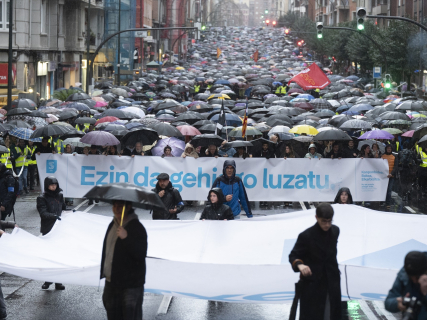
This Holy Week, the Partido Popular is focusing its opposition on “the releases of ETA members” which, in its understanding, respond to the “political pact” between the President of the Government, Pedro Sánchez, and Bildu.
A controversy that arises after it became known that the ETA prisoner Ángel Tellería Uriarte, has accessed a semi-freedom regime through the application of article 100.2 of the prison regulations, which allows for softening the fulfillment of the sentence. In this way, he will be able to leave the Zaballa penitentiary center from Monday to Friday, although he must sleep in prison.
With the law in hand
The Prison Regulations were approved in February 1996, in the last throes of Felipe González in Moncloa. The norm distinguishes up to three degrees of imprisonment:
- First degree: closed regime (inmates of special dangerousness)
- Second degree: ordinary regime (most inmates)
- Third degree: open regime or semi-freedom
The article that is the object of controversy, 100.2, allows applying an individualized regime that combines elements of different degrees. Broadly speaking, those who can avail themselves of this premise are in second degree but are applied conditions typical of the third degree in some aspects.
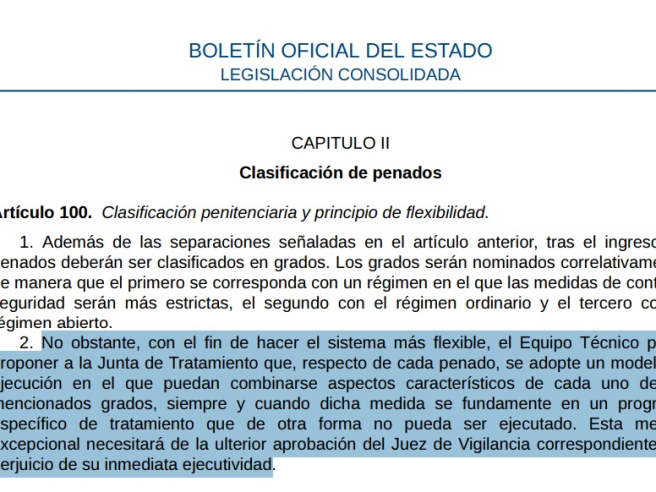
For the popular party it is a "covert third degree" and it is "unacceptable" that this interpretation of the prison regulations "circumvents", through the form of execution of the sentence, the rule of effective compliance with the sentences set by the courts.
The opposition of the PP
In this regard, and taking advantage of a non-legislative motion (PNL) so that those convicted of revisable permanent prison cannot access any type of prison benefit, the PP has opened the door to also exclude prisoners linked to ETA.
The initiative advocates for reforming the Prison Regulations "to prevent those convicted of terrorism from benefiting from a model of sentence execution combining characteristic aspects of the second and third degree provided for in article 100.2."
Nevertheless, it is worth mentioning that this norm approved at the end of felipismo, has been in force with the Governments of José María Aznar (1996-2004) and Mariano Rajoy (2011-2018), nine years of which had an absolute majority, without this article having been subject to changes.