
The president of the United States, Donald Trump, is evaluating the possibility of withdrawing his troops from the bases that the North American country has in Spain. It is his response to the lack of support from the Spanish Government for his offensive, and that of Israel, against Iran and Lebanon.
The plan reflects the White House's frustration with what they consider a lack of collaboration from certain allies. A debate that intensified in parallel with Trump's conversations with NATO Secretary General, Mark Rutte, in which they sought to strengthen the Alliance's ties despite internal tensions.
Currently, the United States has two bases in Spain: the Rota Naval Base and the Morón Air Base. The origin of this settlement lies in what are known as the Madrid Pacts, which were signed on September 26, 1953.
The negotiations
As pointed out by the doctor in Contemporary History Rocío Piñeiro Álvarez, in her work The Hispano-American Agreements of 1953, the regime of Franco was subjected to great isolation after the Second World War. The change in attitude towards Spain, which began in late 1947, points out the historian, “was due to its relations with the US, which helped consolidate Franco's regime both domestically and internationally.”
The reasons for the American rapprochement with Spain were “the height of the Cold War and its strategic situation at the entrance to the Mediterranean, which favored the US policy of creating military bases to prevent the expansion of communist countries. At that time, one of the priorities of the American authorities was the development of various plans or strategies to be prepared in case a war with the USSR broke out. From there emerged the Marshall Plan, which granted 12,000 million dollars to help rebuild Europe,” he explains.
But Spain was left out of the Marshall Plan and the Organization for European Economic Cooperation (OEEC), recalls Lorenzo Delgado in the study "The American Friend"? Spain and the United States during Francoism, published by the Institute of History of the Superior Council for Scientific Research (CSIC),
“The political nature of Franco's regime had made it impossible for Spain to join the trend towards multilateralism that dynamized the economies of Western Europe. The situation lasted until the late 1950s, when the implementation of the Stabilization Plan and entry into the OEEC would give a new economic orientation,” indicates Delgado.
Since the early 1950s, adds the historian, “the officials responsible for U.S. military planning insistently demanded a definitive revision of American policy with Spain. Spanish territory had to be incorporated into the common defense of the area of NATO, despite the objections shown in this regard by Great Britain and France”.
That unavoidable claim is mentioned by Vernon A. Walters (retired lieutenant general of the United States Armed Forces, who, as military aide to President Eisenhower, knew from inside the White House the Hispano-American negotiations since 1951), in an article about the entente between both countries for the bases.
In it, Walters (who ended his career as ambassador to United Nations and in Bonn) points out that the policy of the United States, with regard to agreements with Spain, had been largely based on the resolutions of the National Security Council which established, among others, these two general conditions:
- The geographical and strategic situation of Spain is extremely important for the urgent defense of Western Europe and the Near East and for the security of the NATO and US area.
- The use of military facilities in Spain makes possible the control of the Strait of Gibraltar and the Western Mediterranean and a greater dispersion of bases to carry out offensive or defensive operations.
The agreements
The negotiations, which began in 1951, came to fruition two years later, with a signing in which, Delgado maintains, “the degree of dependence that Spain assumed was superior to that of the rest of the Western European countries, and much less profitable.”
The Spanish Government, adds the historian, “assumed the cause of Western defense and committed to providing a series of facilities —exemption from multiple taxes, land for the construction of the bases, admission of the American personnel necessary to keep them operational, sale of strategic products, etc.—. The American Government would subsidize the construction of the bases, supply war material to the Spanish army, and provide complementary technical and economic assistance.”
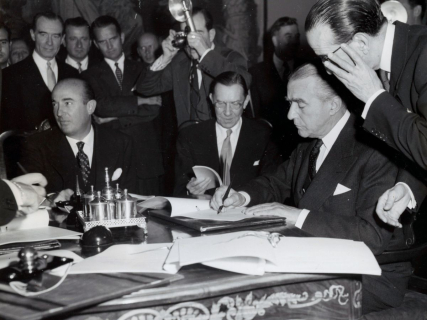
The agreement –signed by James Clement Dunn, ambassador of the United States, and Alberto Martín Araujo, Minister of Foreign Affairs of Spain, at the Santa Cruz Palace in Madrid– consisted of three agreements: one defensive, another for economic aid and one for mutual defense.
The defensive one was the one that established the establishment of the bases. According to the study prepared by Delgado, the areas agreed upon as air and naval bases, along with their possible installations and destination, were specified in ‘Annex No. 1 to the technical agreement’. A total of eight air bases were made available to the North American forces (Torrejón, El Copero, Morón de la Frontera, Sanjurjo-Venezuela, Muntadas, Los Llanos, Los Palacios, Alcalá and San Pablo), plus a loading dock (Matagorda) and an aeronaval base (Rota).
Regarding the economic agreement, the stipulated figure was 465 million dollars, which were to be distributed as follows: 60% for the construction and maintenance of the bases, 30% to improve transport means and increase military material production, and 10% to cover the expenses of the North American mission. In other European countries, Delgado mentions, “90/95% of the funds were made available to the respective governments.”
And in the mutual defense pact, Rocío Piñeiro details, “the US Administration was responsible for providing military aid to Spain, but in it the amount was not specified, nor was an elaborate plan for how it would be distributed presented. However, Spain's obligations were laid out in a technical agreement, four annexed documents, two secret notes, and 22 procedural agreements.”
“Another example of this imbalance is that the obligations accepted by the Spanish Government had a validity of 10 years and could not be altered until this period of time elapsed. In contrast, those assumed by the Americans could be submitted for consultation within this period or, even, be canceled before it ended,” highlights the historian.
The secret clauses
Beyond the foregoing, the secret clauses were of great relevance. In Piñeiro's words, “they entailed a significant curtailment of national sovereignty and on occasion contradicted the articles made public”. And there were not few, the historian enumerates based on information published in Diario 16 on October 12, 1988, “a secret technical agreement annexed to the defensive convention; four annexed technical documents –also secret– and 22 procedural agreements concluded between 1954 and 1960, with various annexes and amendments and which did not have the classification of secret, but which were not made public”.
Piñeiro highlights the additional secret clause to the second paragraph of article III, which remained in force until 1970 and which was unknown until 1979, with the title of ‘Additional note to the second paragraph of article III of the defensive agreement between the governments of Spain and the USA’.
Such a clause, he explains, foresaw two scenarios: “The first authorized the American forces to use the bases in case a communist aggression occurred, provided it was communicated to the Spanish Government. The second point referred to a case of emergency or threat of aggression, in such a situation both countries would notify each other to decide on the use of said military facilities. This meant that, if the Americans so decided, they could involve our country in a war, without it however implying that, in case of an attack on Spain, the Americans would commit to helping in its defense”.
That is to say, “they had the capacity to activate the bases without Spanish consent,” highlights Delgado, who concludes that “the United States Armed Forces had absolute freedom to move within Spanish territory, in its jurisdictional waters and in its airspace. Their access to public services (mail, transport...) would have the same advantages that applied to the Spanish Armed Forces. A special legal regime was recognized for them, by which crimes committed by members of the American forces in Spanish territory would be judged by North American courts. This legal regime was also quite lax in its application, as it not only affected military personnel, but also technical personnel and their families.”