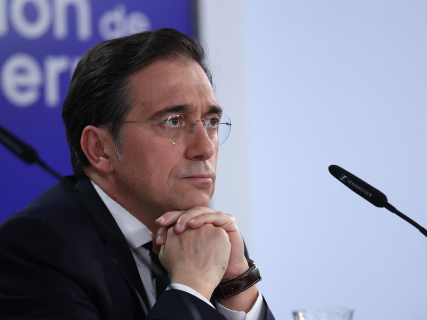

The Minister of Foreign Affairs, European Union and Cooperation, José Manuel Albares, considers that the "unacceptable" escalation of violence in the war in Iran "moves away" after the announcement of a two-week ceasefire, after having "brushed with catastrophe." Nevertheless, he has called for maximum caution because "it is still early" to know how the conflict will conclude. As a sign of that fragility, he has regretted that the "first divergence" has already emerged: Israel rejects that Lebanon be part of the agreement while Iran does demand it.
"We are all going to agree that it is a day of hope, because after 40 days of war something similar to a light has finally arrived," the head of Spanish diplomacy stressed in an interview on 'Las mañanas de RNE', collected by Europa Press.
Albares has also highlighted the "mediation efforts" of Pakistan and other States, among them Spain, so that the solution to the conflict is negotiated. Along these lines, he has stressed that Spain will not "spare efforts to support" the "Pakistani mediation" and that "diplomacy opens the way".
An unprecedented escalation that seems to be slowing down
"But what today we do have to welcome is that the risk of violence and an unacceptable escalation, as humanity had not seen since the Second World War, recedes," the minister added.
Even so, he has insisted that it is "early" to anticipate the outcome of the negotiation, since the US and Iran have only granted themselves a "short time" of two weeks. "We have skirted catastrophe, it seems we have saved it and it is still early to say that the war ends," Albares reiterated, who said he takes Trump's threat to annihilate a civilization very seriously: "Of course I take it seriously."
After analyzing this morning the proposals on the table —one of 15 points and another of 10—, the minister has explained that he has already detected the "first divergence". In his opinion, Iran considers "correctly" that Lebanon must be integrated into the negotiation, while Israel "makes it clear that no".
The role of Lebanon and the situation in the region
Albares has argued that the international community must ensure that Lebanon is included in the agreements, that the bombings on Iran cease and also the "unjustified launch of missiles and drones" from this country towards the entire Middle East, as well as guarantee the reopening of the Strait of Hormuz. "It must remain open safely for any vessel that wishes to transit it," the minister demanded.
Regarding Israel's attacks on Lebanon, he has reiterated that they must cease immediately: "Israel's invasion of a sovereign country like Lebanon is unacceptable," he has condemned, recalling that the country has a legitimate Government that, with international support, was trying to deploy its army in the South to disarm Hezbollah. In his opinion, that effort has "gone to waste" due to the Israeli bombings.
In relation to the Spanish troops present in Lebanon, he/she has clarified that "they are not in direct risk" at these moments, although he/she has condemned the attacks suffered by the Indonesian forces, which have caused fatal victims.
Albares has also recalled that Spain has proposed sanctions against Israel for violating international law and has warned that, if other countries with influence over the Israeli Government, such as the US, were to join that line, "things would change."
Ormuz, London and the role of the United Nations
About the meetings held last week in London between several European countries to study formulas for reopening the Strait of Hormuz, the minister explained that he was invited but chose not to attend because, while hostilities persist, Spain will not participate in any initiative that implies a position of force.
In contrast, it has made it clear that Spain would indeed be willing to integrate into a mission if it is organized under the umbrella of the United Nations, which it urges to "get involved" in the safe reopening of the Strait of Hormuz.
Albares has avoided commenting on the crossed statements of the US and Iran, both attributing victory to themselves, but has stressed that the true beneficiaries of the ceasefire are the citizens of Iran and the Persian Gulf, as well as Spaniards and Europeans, who suffer the rising cost of fuels every time they go to a gas station.
Regarding China's mediation, it has indicated that it may have participated at some level, like other countries, and has pointed out that Beijing's position is "very clear": to return to respect for international law and to the negotiating table.
The response of the EU and the role of Spain
In relation to the European Union's reaction to the ceasefire, the minister has assured that he has no "the slightest doubt" that Europe, "unanimously", will celebrate "this ray of hope, although there is still much work ahead to make it concrete".
At the same time, he has pointed out that the Spanish Government would have wished for "a faster and stronger voice from the European Union". He has claimed, in this regard, that Spain was the first EU Executive to take a stand against this war "contrary to international law", as already happened with Gaza, and that subsequently "other countries have been joining this position that has clearly been led", in his opinion, by the Government of Pedro Sánchez.