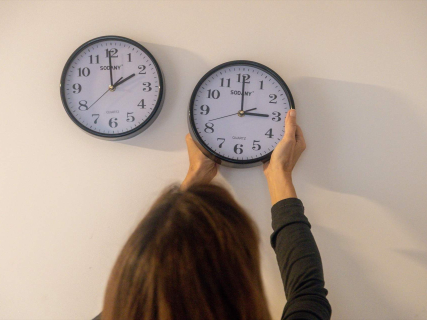

The time change once again puts Spaniards' biological clock to the test. At two it will be three and the day will have only 23 hours, an adjustment that is repeated twice a year but continues to generate doubts both about its usefulness and its impact on health.
A “mini jet lag” for the organism
The experts compare this change to a small jet lag. It forces the body to adapt abruptly to a new pace, altering the balance between the internal clock and social schedules.
Although it does not reach the intensity of an intercontinental trip, the loss of an hour of sleep —as occurs in the transition to daylight saving time— is the most difficult to assimilate.
Effects that go beyond tiredness
The consequences can last several days. During that period, it is common to experience sleep problems, fatigue or difficulty concentrating.
At a general level, specialists point out that this imbalance can also cause worse cognitive performance, mood alterations and even digestive disorders, in a pattern similar to that which occurs in travels with time zone changes.
In addition, some studies point to a temporary increase in accidents or cardiovascular problems in the days following the change.
A debate that divides society
The time change has been under discussion for years. The question is recurrent: to keep summer time or winter time?
However, experts warn that the debate is conditioned by social perception. Daylight saving time is usually associated with more leisure and light, but this does not mean that it is the most appropriate from a biological point of view.
In fact, the so-called daylight saving time was conceived as an energy-saving measure, an objective that nowadays is considered minimal or even non-existent.
Mismatch with the sundial
Spain also presents a particularity: its official time is not completely aligned with the solar cycle, which causes many daily activities to be carried out when, biologically, the body is not yet prepared.
This phenomenon, known as chronodisruption, can have long-term effects, such as increased risk of metabolic diseases, cardiovascular diseases, or cognitive problems.
The winter schedule, the preferred option by the experts
In the scientific field there is a clear consensus: if one had to choose, standard time —winter time— is the most suitable, as it is more aligned with natural light.
Maintaining daylight saving time permanently could generate a chronic misalignment, with very late sunrises in winter and a sustained negative impact on the body.
Without total agreement among the specialists
Even so, there is no absolute unanimity. Some experts consider that maintaining a single schedule —even if it is not ideal— could be less harmful than changing it twice a year, while others argue that a permanently incorrect schedule would have more damaging long-term effects.
The key: the daily routine
Beyond the debate, specialists agree on an essential point: regularity in habits is more important than the time change itself.
Maintaining stable sleep schedules, adapted to one's own biological rhythm, and reducing factors that alter rest —such as the use of screens or irregular routines— has a greater impact on health than the punctual adjustment of the clock.
In this context, the time change remains in force, but the debate about its continuity and about the most suitable schedule remains open both in society and in the scientific community.