
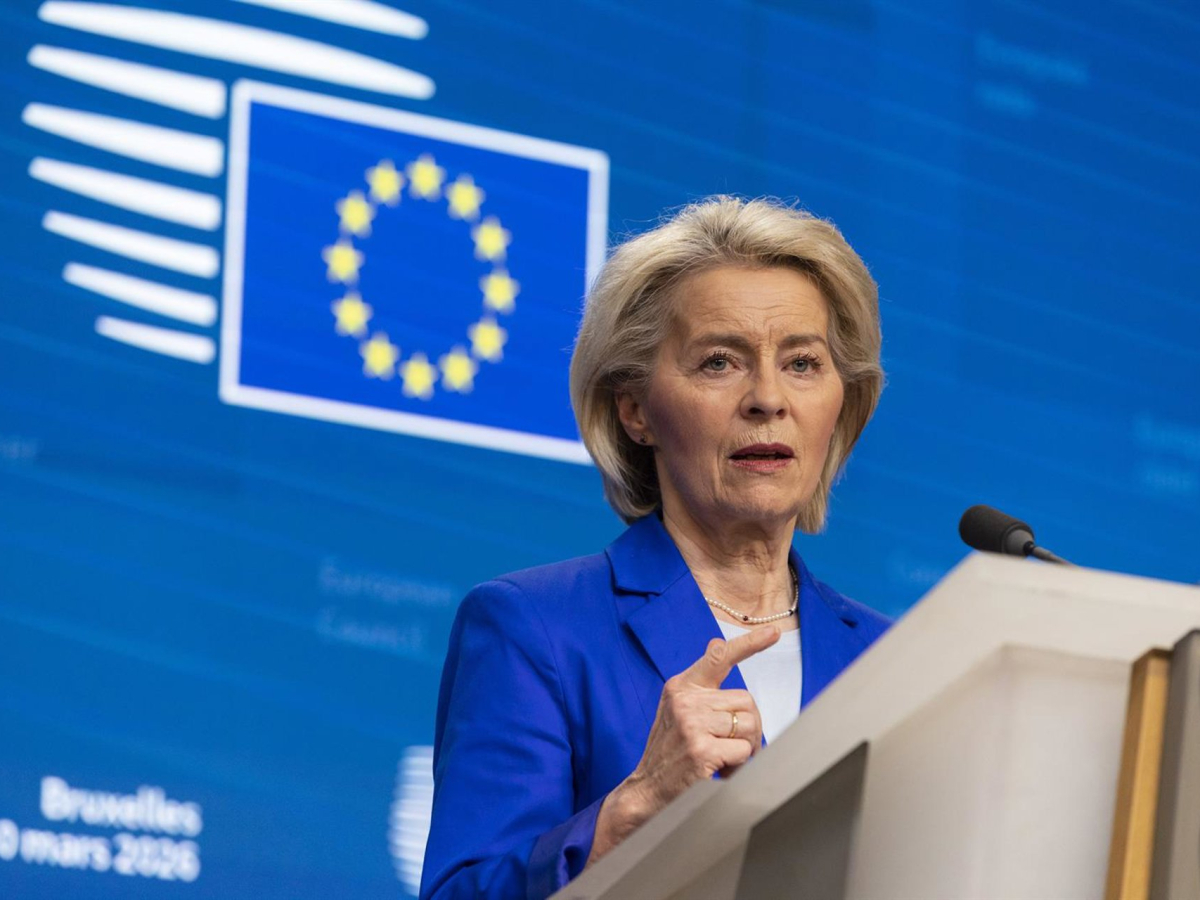
After negotiations between the diplomatic teams of the United States and Iran failed in their attempt to find a solution to the conflict this week, the European Commission begins to unveil some of the details of the energy plan it is working on to address the crisis. “The measures must be specific, not general. Timely, rapid, and temporary”, explained this Monday the President of the European Commission, Ursula von der Leyen.
In Brussels, they want to present a communication to the Twenty-Seven during their informal meeting next week in Cyprus. During that meeting, the Community Executive —the European Commission— will discuss the possibility of adopting more flexible aid rules so that States have more leeway when offering support to sectors most exposed to current shocks. Von der Leyen intends for this temporary aid framework to be adopted before the end of April, in an attempt to accelerate the European response to rising energy prices and the volatility of international markets.
Another of the measures being studied by community services has to do with a European-level coordination of the filling of gas storage facilities of each of the Member States, with the aim of preventing many of them from going to the market at the same time, competing with each other and raising prices. “We will also coordinate oil reserve releases to achieve the greatest possible effect from these releases. We will ensure that emergency measures do not affect the single market”, the German leader assured the press.
Previous recipes for current crises
Europe has learned, according to the leader, the lesson from previous crises: “unity is our strength”. The truth is that the Commission boasts about one of the proposals it deployed after the start of the war in Ukraine. The EU Energy Platform has helped to add ninety billion cubic meters of gas purchases for the Union and has connected buyers with suppliers with seven hundred billion cubic meters matched, consolidating itself as a key tool for the continent's energy security.

“We must reduce demand because the cheapest energy is the one that is not used”, Von der Leyen confirmed amid rumors about possible energy efficiency measures, such as the renovation of buildings or the modernization of equipment in industrial operations. This approach, according to Brussels, seeks to reduce the structural dependence on fossil fuels and improve the resilience of the European energy system in the long term.
In this regard, Brussels is also preparing more structural measures to reduce energy prices and provide relief to citizens beyond the most immediate proposals. It is in this scenario that the leader defends the current model of the emissions system, but introducing new adjustments that will be consulted with the States along with the “updated benchmarks”, in order to improve the efficiency of the carbon market without compromising European industrial competitiveness.
Updated Calendar
It will be next month when the College of Commissioners gives the green light to new legislative initiatives to act on other components of the cost of energy, such as electricity taxes and network charges. At this point, the Commission insists that a significant part of the final price of electricity does not depend solely on the wholesale market, but also on fiscal and regulatory burdens that vary among Member States.
Featured story
The ceasefire relieves the pressure and gives margin to Brussels to recalibrate its energy strategy
5 minutes
The Commission is aware that citizens are immediately feeling the impact of the closure of the Strait of Hormuz “at the gas station, in the supermarket and on household bills”. Von der Leyen assures that it is not a distant crisis, but rather a situation where everything is connected and the effects are direct in the daily lives of Europeans.
The diagnosis that Europe makes involves pointing to the community's dependence on fossil fuels as one of the main causes explaining the current shock. Therefore, what is sought is to expand local, affordable, and reliable energy as a guarantee to reform the system, progressively shifting electricity generation towards renewable and nuclear sources. This structural change is presented as a way to reinforce the continent's energy sovereignty.
All goes to the winner
“Electrifying Europe means making Europe more independent”, repeats the German leader, who wants to win the electrification race against the United States or China. How to achieve it? According to her words, through a new electrification strategy that will include “a new electrification objective”. This plan will be accompanied by a removal of remaining regulatory obstacles and a mobilization of direct investment in this area. For this reason, the European Commission plans to convene an investment conference to mobilize private capital in each of these strategic areas.
Von der Leyen looks favorably upon nuclear proposals such as small modular reactors when looking for non-fossil energy sources within the European Union. “We must bear in mind that not only the United States and China are investing heavily in it, but also the United Kingdom, South Korea, Japan, and Canada, so we must be vigilant and follow this very promising technology. The advantages of small modular reactors are clear”, she stated.
Featured story
Von der Leyen endorses extending the closure of nuclear power plants like Almaraz
4 minutes
In his/her/their opinion, the advantage of this proposal lies in its lower cost, its scalability through standardized production, and its possible “perfect” combination with renewable energies, which would allow for a more flexible and diversified energy system within the European Union.
Less taxes?
Facing a possible relaxation of fiscal rules, Brussels insists that relief measures “must be specific, temporary, and timely”. The existing fear is that overly broad economic measures will lead to an undue deterioration of national public deficits. What is ruled out for the moment is activating alternative mechanisms such as the general escape clause or national clauses, at least in this initial response phase.
A few days ago, the community economic official, Valdis Dombrovskis, warned in the European Parliament of the need not to lose urgency when presenting and approving the set of measures in the face of a possible ceasefire in the conflict, which continues to generate uncertainty among European partners. “The European economy remains exposed to the risk of a stagflation crisis”, he expressed before the MEPs of the Committee on Economic and Monetary Affairs.
From the European People's Party, several MEPs ask the Community Executive to seek structural reforms typical of a geopolitical context like the current one, in which energy and economic shocks run the risk of repeating themselves on new occasions. In conversation with Demócrata, the popular MEP Fernando Navarrete explained the impossibility of acting “at the stroke of crisis” when the forecasts of the co-legislators indicate that these scenarios will be recurrent. “We will have to draw a lesson of structural reform from the functioning of the system”, he affirmed.
In his opinion, the response that the European Commission must outline must go a step further than creating an exceptional framework “every time something happens to us”. Navarrete asks the community Executive to be capable of “building a robust framework against all crises”, an exercise that, according to his diagnosis, has not yet been completed.

For its part, in the socialist group of the European Parliament, given “the enormous volatility”, they point out that “all savings are always positive if they do not create a destruction of demand”. The socialist MEP Nicolás González Casares concludes that “the lesson learned is that whoever bet the most on decarbonizing, has suffered the least during this time”, thus reinforcing the idea of accelerating the energy transition.
In any case, the European Commission is still asking for more time to tie up all the loose ends before next week, when it communicates its definitive proposal to the States. As peace talks advance, Von der Leyen tries to strike a balance between the immediate response to the energy crisis and a long-term structural plan that does not force Europeans to react crisis after crisis, but rather to anticipate them through a more resilient, integrated, and coordinated system at community level.