Brussels correspondent for Demócrata. Covers the activity of European institutions -European Parliament, European Commission and Council- with special attention to community policies that impact Spain. Reports from Brussels on institutional agenda, regulation, internal market and strategic decisions of the European Union.
The director of Security Policy of NATO explains in Demócrata how the Alliance faces the greatest transformation since the end of the Cold War, with a Europe called to take on more responsibilities, an expanding defense industry, and a new threat landscape marked by Russia, China, and military innovation.`>
The European Commission proposes to review the prudential treatment of technological investments within its new banking roadmap, which seeks to reduce the regulatory complexity accumulated over the last fifteen years.`>
The annual report on the Rule of Law from the European Commission reproaches the Government for the parliamentary blockage of the transparency law for interest groups and warns of the limited progress on conflicts of interest.`>
The community executive redesigns the Emission Trading System (ETS) with a progressive reduction of the emissions cap, new rules for the allocation of permits, and an Industrial Decarbonization Bank capable of mobilizing up to 100 billion euros.`>
Spain claims from the European Commission to maintain the regulatory stability of the Emissions Trading System (ETS), preserve industrial competitiveness and adapt the system to sectors that still lack technological alternatives, such as the ceramic industry and maritime transport.`>
Luxembourg considers that the Spanish norm does not violate Community Law and allows the application of the pardon measure to embezzlement crimes linked to the procés and to the terrorism proceedings of the CDR, a ruling that paves the way for the return of Carles Puigdemont and reinforces the position of the Government of Pedro Sánchez`>
The socialist MEP analyzes in Demócrata the energy roadmap that the European Commission is preparing, from the electrification targets for 2040 to the future of the carbon market, the role of storage, and the impact of data centers on the electricity grid.`>
The Court of Justice of the European Union will resolve the preliminary questions raised by the National Court and the Court of Audit on the compatibility of the Amnesty Law with EU law. Its decision will not directly apply the rule in Spain, but it will set the legal criteria that will condition the scope of action of the Supreme Court and the Constitutional Court in the main cases of the procés`>
The pact puts an end to the last pending chapter of Brexit and opens a new stage in the relationship between the European Union, the United Kingdom and Gibraltar, with the aspiration of turning a historically conflictive border into a space of permanent cooperation`>
The European Commission will present after the summer a legislative proposal that will establish a common age verification model throughout the EU. The Community Executive is studying progressive access to social networks according to the age of the minor and is committed to holding platforms responsible for the security of their services`>
The head of Spanish diplomacy assures that he conveyed to Paris that the statements of the former President of the Government do not reflect the Executive's position and demands that the Popular Party rectify the controversy generated`>
The anecdotes from the Atlantic meeting reveal as much as the speeches: from a hamburger joint on the scale towards Turkey to Erdoğan's gift revolver, through the press center's kebabs and a city adorned to receive NATO leaders.`>
The European Commission preliminarily concludes that the "addictive" design of Meta's platforms violates the Digital Services Act and opens the door to a fine of up to 6% of its worldwide turnover.`>
The NATO summit in Ankara consolidates the leap of the European defense industry towards a new phase of integration marked by joint production and increased military investment`>
Ankara aspired to close months of uncertainty with an image of shared strength, but the summit ended up recalling that NATO's biggest difficulty is no longer reaching agreements, but keeping them alive`>
The US president maintains that the increase in allied military spending will boost the production of the North American arms industry, praises Mark Rutte's leadership at the head of NATO, and lowers his tone after a day marked by his criticism of European partners for their level of defense investment.`>
### Headlines
* **Rutte again comes out in defense of Trump and endorses US attacks against Iran**
* **Rutte shields Trump in Ankara and justifies bombings over Iran**
* **Rutte closes ranks with Trump and backs the US offensive against Iran**
* **Rutte aligns with Trump and defends US attacks on Iran**
* **Rutte supports Trump at the NATO summit and justifies the offensive against Iran**
* **Rutte acts as a shield for Trump in Ankara and endorses attacks against Iran**
* **Rutte again acts as a bulwark for Trump and backs the offensive on Iran**
### My journalistic recommendation
**Rutte again comes out in defense of Trump and endorses US attacks against Iran**
It is more precise than "justifies the latest attacks on Iran." In journalistic Spanish, **"contra Irán"** (against Iran) is used (not "sobre Irán" - over Iran) and **"avala"** (endorses) provides more political strength than "justifica" (justifies).
### Subtitle
The NATO Secretary General backs Washington's military response following Iranian actions in the Strait of Hormuz, again justifies Trump's threats over Greenland, and claims that the US president has managed to force a historic increase in defense spending among European allies.`>
The Ankara summit tests Mark Rutte's consensus strategy against a Donald Trump who once again challenges his European allies with new threats about the US military deployment and Greenland's sovereignty.`>
The US president arrives at the NATO summit in Ankara redoubling pressure on his allies, criticizing their stance on Iran and reviving his aspirations for the Danish island`>
The Ukrainian president claims from the United States the license to manufacture Patriot systems and their interceptor missiles, urges Europe to support the project to accelerate air defense production, and defends that Kyiv's industrial experience can become a pillar of NATO's rearmament against the Russian threat.`>
The Government backs at the allied summit the deployment of new early warning, air surveillance, and strategic transport capabilities at a time when NATO is accelerating the integration of its defense industry and betting on large multinational programs`>
The Executive considers that Spain arrives with the capabilities objectives met and wants to move the debate on the percentage of spending to innovation, industrial production, and the strengthening of the European defense technological base`>
On the eve of the Ankara summit, the secretary general calls for a more integrated, competitive, and innovative Defense industry and anticipates the announcement of new multi-million dollar contracts to strengthen the military capabilities of the allies.`>
The summit that begins on Tuesday in Ankara will seek to turn the decisions adopted in The Hague into concrete commitments: boosting the defense industry, redistributing capabilities among allies, guaranteeing military support for Ukraine, and reaffirming Article 5, while Turkey receives the leaders under a strong security deployment and in a context of growing internal political tension.`>
The next summit of the Atlantic Alliance returns the focus to a country that went from depending on US military support during the Cold War to becoming a power exporting weaponry, with a defense industry that today serves as a benchmark for several European partners`>
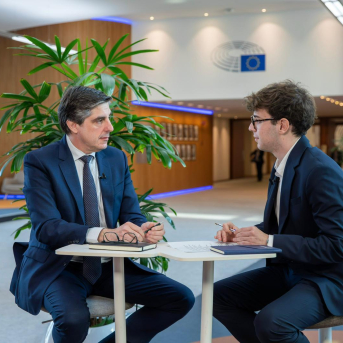
In a joint conversation with Democrat, the popular Nicolás Pascual de la Parte and the socialist Javi López agree that Europe must assume a leading role in its own defense in the face of the withdrawal of the United States and the growing Russian threat, in addition to urging industry to achieve the necessary scale to take off.`>
The jurist from Cordoba, one of the main architects of the European Union's energy and climate policy over the last two decades, makes the leap to the president of the Commission's inner circle amid the redefinition of the European Green Deal.`>
The regulation will oblige to prioritize the European market in certain investments, will favor community production in tenders and will establish new mechanisms to coordinate strategic reserves among the Twenty-Seven`>
Council and Parliament close a political agreement to adapt ECHA to the increase of its powers, strengthen its scientific committees and guarantee greater budgetary stability in the face of challenges such as microplastics`>
Brussels premieres the three-euro tariff for small packages from third countries while launching a new dialogue framework with Beijing to monitor imports, rebalance trade, and reduce tensions`>
Brussels studies taxing big tech companies, cryptocurrencies, and online gambling to reinforce the European Union's financial autonomy and reduce dependence on national contributions.`>
Brussels considers that AWS and Azure act as an essential gateway for thousands of companies despite not reaching the automatic thresholds of the DMA and opens the door to imposing new competition obligations on them in a key market for Artificial Intelligence and European technological sovereignty.`>
The Community Executive proposes that companies can access tax exemptions without waiting for the approval of national administrations, in a reform aimed at reducing bureaucracy and strengthening European competitiveness`>
MEPs endorse that NATO allies receive equivalent treatment to Member States in operations and exercises, while promoting permanent permits, priority corridors, and a common logistics network to strengthen European military readiness.`>
The European Commission maintains contacts "at a technical level" with a delegation linked to the Kabul regime within the framework of the new Return Regulation, while several member states push to expedite the expulsion of Afghan citizens in irregular situations and reinforce the debate on the limits of cooperation with internationally unrecognized authorities.`>
The Eurochamber will give the green light today to its negotiating position on one of the most ambitious financial reforms of the last decade, a digital payment system backed by the ECB that will coexist with cash, will offer offline payments and seeks to reinforce European strategic autonomy against large international providers`>
The socialist MEP claims in an interview with Demócrata the promotion of European digital sovereignty given the risk of "being dependent on the technology of third countries" because "any day they unplug us and we are left without email or essential services"`>
The negotiation on the next European Union financial framework begins with strong divisions between the frugal countries and the cohesion defenders while the shadow of a forty percent cut in financial capacity forces Brussels to seek alternative revenue streams`>
European leaders commission the European Commission to develop a new strategy to correct trade imbalances with Beijing, betting on strengthening political and economic dialogue without giving up on developing new trade defense tools if negotiations do not yield results.`>
The President of the Government defends at the summit in Brussels a strategy based on dialogue with Beijing against voices calling for a more forceful response to trade imbalances, while the Twenty-Seven debate how to protect European competitiveness without jeopardizing economic relations with the world's second-largest power.`>
The president of the PP takes advantage of the European Council summit to question the uniqueness of the Spanish position in relations with Beijing and points to the influence of the former president of the Government in the Chinese technological ecosystem`>
The suspension of access to the most advanced artificial intelligence models for foreign citizens has reinforced in Brussels the conviction that technological autonomy is no longer just an industrial issue, but also a strategic one`>
While António Costa designs a labyrinth of diplomatic euphemisms to avoid direct conflict, Úrsula von der Leyen finalizes a battery of commercial defense measures against a technological and manufacturing deployment that already threatens the strategic autonomy and the most sensitive sectors of the Union.`>
The allies are already working on a plan to replace part of the military capabilities that Washington provides, anticipating a lesser US commitment to European defense, while Brussels accelerates the strengthening of the continent's industry and strategic autonomy.`>
The Twenty-Seven back the legal structure proposed by Brussels for the next Multiannual Financial Framework and endorse the model of single national plans, despite the reservations of Spain and Belgium, while the negotiation now enters its most delicate phase: the distribution of more than 1.7 trillion euros among agriculture, cohesion, competitiveness and defense`>
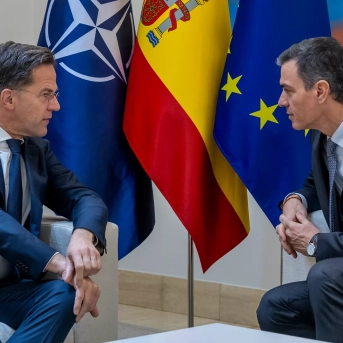
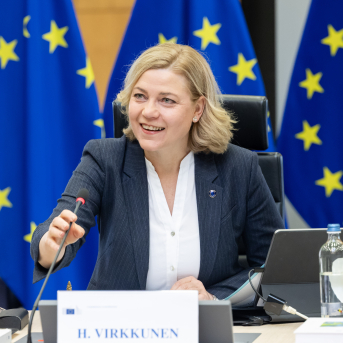
The Eurochamber will ratify this Tuesday the Artificial Intelligence Act simplification package, which reduces administrative burdens for innovative companies, expands access to regulatory testing environments, and strengthens prohibitions against sexual deepfakes and AI-generated child abuse material.`>
The Vox MEP maintains in an interview with Demócrata that the new Pact on Migration and Asylum will be insufficient without an increase in expulsions and calls for the use of all available diplomatic tools to accelerate the returns of irregular immigrants.`>
The Eurochamber and the Council close an agreement after months of negotiation that preserves the current compensation system for passengers, maintaining at three hours the threshold from which airlines will have to compensate economically for delays, in a context of pressure from the sector to flexibilize the regulations and reduce operating costs.`>
The Cypriot presidency proposes a more austere Multiannual Financial Framework than the one put forward by the European Commission, halves the future Competitiveness Fund, and opens the debate on new own resources to finance the debt of the Next Generation EU funds.`>