
One month has passed since the beginning of the attacks by the United States and Israel against Iran, with the subsequent escalation of tension in the Middle East, which has forced Europe to react to minimize the impact on its systems and economies. This scenario has intensified concern in community institutions and national governments, given the possible energy, commercial, and geopolitical consequences of a prolonged conflict.
During this time, the Government of Spain has raised criticism of the American Administration, led by Republican Donald Trump, brandishing the slogan of "No to war". A stance that has been gaining support and has ended up convincing part of the Twenty-Seven, who at the last summit of the European Council opted for the diplomatic path as a solution to the conflict, insisting on the need to stop the escalation.
In this context, European patriotic parties look to the United States as a reference when it comes to designing their policies and ideological programs. Jorge Martín Frías (1980), MEP for Vox and president of the Disenso Foundation, has led since 2020 the think tank of Santiago Abascal's party, whose mission is to generate ideas, studies, and proposals on politics, society, and economy, as well as to build networks with like-minded organizations in other countries.
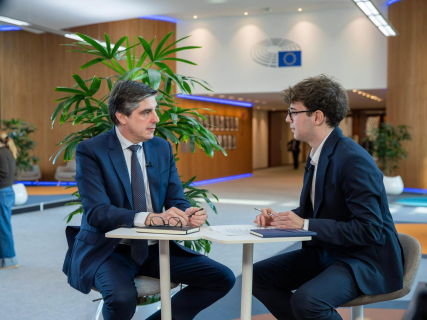
Part of that work takes place in the vicinity of Luxembourg Square, enclave of the European Parliament in Brussels. From there, Frías recognizes, in conversation with Demócrata, a similarity between Trump's priorities and those of his formation: "We agree on issues such as mass immigration, suffocating regulation, and the lack of democracy in the European Commission, which leads to decisions alien to national and European interests".
Question: Is the United States a reliable partner for the European Union?
Answer: Yes, of course, without a doubt. The question is whether the European Union is a reliable partner for the United States. Over time there has been a distancing, especially due to the policies that the European Commission has been developing, which is not the European Union, but the political body that sets the direction. These policies have moved away from what united us with the United States.
That is what we are seeing now. The European Union makes sense within the Atlantic bond; in fact, it is subsequent to other organizations such as NATO.
Q: However, the United States does not count on Europe for, for example, the attack on Iran.
Answer: Europe has lost relevance on the international map. We have seen it with Iran and with other issues. It has its reason for being: when the European Union has not shown itself as a reliable partner, it is logical that the United States does not share information with who should be its main partner, although its desire is to maintain strong relations.
This has been seen in the Munich speeches, both J. D. Vance's and Marco Rubio's. The Trump administration seeks an alliance based on shared values with the European Union, but the European Commission has moved away from those values.
Jorge Martín Frías:"When the European Union has not shown itself to be a reliable partner, it is logical that the United States does not share information with who should be its main partner"
Q: Where do you draw the line between cooperation and subordination of Europe to the United States?
R: In the defense of national interests, that is to say, of the Member States. The problem is that the current European Commission has forgotten that the European Union are its Member States.
Q: You are part of the Patriots group in the European Parliament. What relationship are you seeking with the current US administration?
Answer: We have always worked on a relationship with the Trump administration, especially from Vox, because we share a diagnosis about reality and threats. It's another thing that there isn't a programmatic alliance.
We want sovereign and strong States that defend their national interests. We agree on issues such as mass immigration, suffocating regulation, and the lack of democracy in the European Commission, which leads to decisions alien to the national interests and those of Europeans.
Question: From Trump's environment, European digital legislation has been criticized for considering it censorship. Do you share that diagnosis?
Answer: Yes, we share it. It is a well-founded diagnosis. There is a report from the House of Representatives Justice Committee of the United States, of more than 130 pages, where it is exposed how, through the Digital Services Act and other measures, there have been interferences from the European Commission even in electoral processes.
For example, through pressure on digital platforms or by labeling legitimate discourses as disinformation, especially on topics like immigration. This is corroborated in that report.
Q: However, Vox did not oppose the vote on that law in June 2022.
R: One must differentiate between the norm and its application. The Digital Services Act is well conceived in its form; the problem is how it is used.
Question: So, is there a competition of models or a clash of values?
Answer: Probably both things, but above all a clash of values. In the United States the focus is placed on freedom of expression, which is being threatened in the European Union.
There is also the debate about how to guarantee that freedom without it being used against national interests.
Jorge Martín Frías:"The Digital Services Act is well conceived in its form; the problem is how it is used"
Question: What evolution do you observe in the position of other European conservative parties, particularly in Spain?
Answer: The assessment is that they are proving us right. In Spain, the Popular Party initially equated Trump with Sánchez or Maduro, and he was even called "orange ogre".
However, now we see a turn that we welcome with satisfaction, although we do not know if it is tactical or a reading of global change. In any case, they are beginning to support the Trump administration's agenda, for example in Iran or Venezuela.
Q: Is there a common geopolitical space among conservative formations?
R: Yes. We have seen it in votes like the so-called "Venezuela majority," driven by Vox and the Patriots group, to which popular parties and other groups joined.
This shows that there are majorities to change the course of the European Commission towards policies such as reducing tax pressure or reviewing the green pact. The problem is that there is not always the will, especially on the part of the European People's Party, which maintains its pact with socialists, greens, and liberals, along with the sanitary cordon against patriotic forces.
Question: What future do you foresee for that cooperation?
Answer: For our part, our hand has always been extended. We want real change and to seize a historic opportunity to reform the European Union.
The problem is that the European People's Party, and specifically the Spanish one, functions as a confederation of autonomous parties, without a clear interlocutor. Even so, our willingness to understand remains.
Jorge Martín Frías:"The Trump administration seeks an alliance based on shared values with the European Union, but the European Commission has moved away from those values"
Q: How is the daily cooperation between the PP and Vox in the European Parliament?
A: I am not the head of delegation, that would correspond to Jorge Buxadé. The relationship varies: there are members with whom it is easier to reach agreements and others with whom it is not.
It is seen in the votes. For our part, we continue seeking understandings, but it is complicated.
Q: What assessment do you make of the recent disagreement between the White House and La Moncloa following the Government's refusal to authorize the use of the Rota bases in the context of the conflict in the Middle East?
A: As an irresponsibility of a judicially cornered president who conditions national interests according to his personal situation and that of his party.
Q: In relation to the stance of European countries, which for the moment have ruled out supporting a mission aimed at unblocking the Strait of Hormuz, what assessment do you make of this decision?
A: There is not enough data to make an assessment. The position can change in one direction or another in a matter of minutes. There are initial statements that have been nuanced.
Jorge Martín Frías:"Putin's Russia financed many NGOs whose purpose was to promote the climate fanaticism that the Commission itself was pushing"
Q: The president of the Popular Party, Alberto Núñez Feijóo, has recently adopted the slogan "No to war", although accompanied by criticism of President Sánchez. Do you share this position against participation in the conflict?
At no time has Spain's participation in the conflict as such been on the table. That is a government trick that the PP and its president have fallen for, moved by the fear that characterizes them. It is absurd. As much as the discursive flag of the socialists and Pedro Sánchez regarding their respect for international law and human rights.
If they do not respect the law in Spain and have Bildu as government partners, whose spokesperson in Congress was ETA's editorialist and whose members toasted to the murder of every Spaniard. If human rights and international law mattered to them, they would have stopped collaborating with the Venezuelan regime, with the Cuban tyranny years ago, or they would not have sent bombs to the ayatollahs' regime.
Q: In the wake of the war's consequences, the President of the European Commission has defended a shift towards nuclear energy, despite it not being a direct competence of her institution. In your opinion, what should be the appropriate energy strategy for Europe?
A: Total rectification of the negligent policies developed to date that have impoverished Europeans and weakened our security and freedom of each nation-state to explore its resources and guarantee energy sovereignty.
Jorge Martín Frías:"We want sovereign and strong States that defend their national interests, and we agree on issues such as mass immigration or suffocating regulation"
Q: After the last European Council, Polish leader Donald Tusk accused Hungary of leaking confidential information to the Kremlin. In this context, do you consider Viktor Orbán to still be one of your main allies within the European sphere?
A: Without a doubt, he is one of the main allies of Europeans for Europe to remain Europe, along with Giorgia Meloni and Czech Prime Minister Andrej Babis. Donald Tusk should stop trying to interfere in the Hungarian elections and explain why one of the first measures of his government consisted of closing the commission that investigated his previous government's relations with Putin.
He should also clarify why he did nothing to clarify the death of former president Lech Kaczyński and the more than 90 Poles who died in the aerial "accident" near the military base of Smolensk (Russia). And Tusk's case is applicable to many leaders who today pretend to silence debates with the recourse to Putin as a scarecrow, when many of them, from German socialists to the CDU and even Spaniards, have done business and weakened Europe's energy sovereignty.
What's more, Putin's Russia was financing many NGOs whose object was to promote the climate fanaticism that the Commission itself was promoting.
Upon finishing the conversation, Frías keeps pondering the dichotomy between a competition of models or a clash of values between Europeans and Americans. "I will share with you the report from the House of Representatives", he says upon saying goodbye in the corridors of the European Parliament, where the parliamentarians tighten their agendas in a constant balance between journalists, civil society and their own legislative activity.
Due to the rapid evolution of the international landscape, contact is maintained until the moment of the interview's publication, with the consequent expansions of the conversation. The context changes at such a speed that the analysis could be updated almost daily, as the American president introduces new twists in his decisions on Iran.