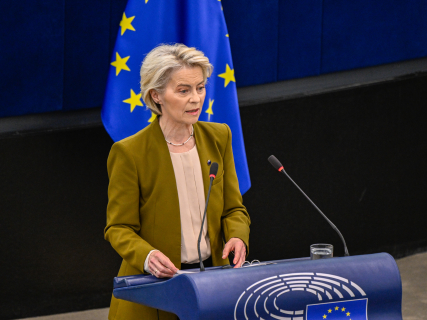

Europe and the end of the old order
“Europe can no longer be the guardian of the old world order, of a world that has disappeared and will not return,” declared the President of the European Commission, Ursula von der Leyen, on Monday before an audience composed of the diplomatic corps of the Twenty-Seven. For the German leader, the continent can no longer rely on the international order as the sole way to defend its interests. Her remarks stand in clear contrast with those of the EU’s foreign policy chief, Kaja Kallas, who before the same audience described the situation in the Middle East as an “erosion of international law”.
The Commission president did not merely declare a rules-based system to be dead; she also used her speech to align herself with the military actions carried out by the United States and Israel against Iran, stating that “no one should mourn the Iranian regime.” The former prime minister of Estonia, more restrained, argued that the situation had sent a message to the world that “actions must carry consequences: the rules have gone overboard,” echoing the President of the European Council, who called for the need to “defend the rules-based order”.
Two speeches before the same audience. Two positions regarding a war that has now entered its second week, and two views on the reconfiguration of the new world order. A single competence. Because, despite the foreign policy agenda that President von der Leyen continues to pursue, competences in this field, according to the rules governing the functioning of the European Union, lie exclusively with the High Representative.
Discontent in Brussels
For this reason, the position adopted by the European Commission, which the spokespersons’ team later tried to nuance, has not been well received in the offices around the Schuman roundabout. For instance, the unease within the Spanish delegation was voiced by Second Deputy Prime Minister Yolanda Díaz herself. The leader of the second party in the governing coalition urged the European executive to “defend international legality”, since in her view “anything else is barbarism”.
From the European Parliament, one of the prominent voices of the socialist group, MEP Jonás Fernández, suggested: “Someone is earning a motion of censure the hard way.”
In Brussels, the European Union’s international position, for instance regarding a war such as the one involving Iran, is determined unanimously by the Member States through the Foreign Affairs and Security Council. In this way, the heads of government of the Twenty-Seven set the general orientations in a first stage, after which the Council chaired by the High Representative adopts the decisions. Within this framework, the presidency of the Commission is not expected to play a role.
However, this is not the first time that von der Leyen has taken a stance in an international conflict without the endorsement of the twenty-seven capitals. After the Hamas attacks of October 7, she travelled to Israel without any mandate from the Council or the foreign ministers.
Just six days after those first attacks, she met with Israeli Prime Minister Benjamin Netanyahu and stated that “Europe stands with Israel,” adding that Jerusalem had the right to defend itself, without insisting on respect for international law. Following this episode, more than two thousand officials signed a critical letter publicly stressing the need for restraint by Israel. The issue also reached the European Parliament, where several MEPs formally asked under what competence and mandate she had acted.
At the Berlaymont building, the headquarters of the European Commission, officials avoided giving a concrete answer regarding a specific mandate. All of this eventually led to a later correction by von der Leyen, who urged Netanyahu’s government to respect international law.
A recurring pattern
It was in March 2023, before travelling to Beijing, when she decided to unilaterally redefine the framework of relations between the European Union and China without first obtaining a formal mandate from the Council. She described the relationship as “more distant and more difficult”. Now, amid the escalation of tensions with Iran, von der Leyen has used the Commission as a direct actor in foreign policy by leading conversations with Middle Eastern leaders.
How can this willingness to stretch the EU treaties be explained? In fact, the first time von der Leyen personally took charge of an international crisis helped her consolidate her leadership. Following Russia’s invasion of Ukraine, she assumed a highly visible role in the European response: announcing sanctions packages, military support commitments, and issuing messages similar to those of European heads of state. The German leader moved away from the traditional role previously followed by the Commission and that alone allowed her to capitalize politically on the situation.
The former EU foreign policy chief, Josep Borrell, had already described as “misleading” the German politician’s 2024 decision to create the position of a Defence Commissioner for her second mandate. At the time, he argued that the European Union “has zero competences in defence policy”. Regarding Gaza, he accused her of acting without a mandate, describing her as “a convinced Atlanticist and militant Zionist” who had imposed a pro-Israeli line.
Since her appointment, Kaja Kallas has refrained from public criticism over institutional overreach, prioritizing institutional cohesion, although her interventions diverge from those of the Commission president, as happened this Monday. “Let us not forget our DNA, made up of human rights and international law. You are not only our eyes and ears on the ground, but also our heart,” she told EU ambassadors.
Community sources defend von der Leyen’s actions, citing her competences as part of the institutional representation of the European Union, as well as the Commission’s role when engaging directly with world leaders. However, when such conversations concern wars, they go beyond her role and must be coordinated with the High Representative.
The Iranian case
The issue of Iran does not stop at a round of diplomatic phone calls. The president has called for “a credible transition for Iran” that would include the end of its nuclear and ballistic programmes, as well as the cessation of destabilising actions in the region.
Furthermore, speaking to the press, she said she saw “renewed hope for the oppressed people of Iran, and we strongly support their right to determine their own future.” A political stance that, for the moment, is not shared by several European leaders, who maintain a more cautious approach regarding the development of events.
Even so, the unease within the EU diplomatic corps surfaced as early as Saturday after the first bombings, when she decided to convene the “Security College” even before the High Representative called a meeting of the foreign ministers of the Twenty-Seven. This body, which in practice amounts to a meeting of the College of Commissioners focused on a single issue, was created by von der Leyen in March 2025 to keep track of “possible threats” and receive regular updates “on the security situation of the European Union.”
Nevertheless, there has been no sign of condemnation of the military intervention by the US administration throughout the series of statements issued by EU institutions. By contrast, the president of the Commission herself has gone as far as to say that “Europe strongly condemns” the attacks carried out by the Iranian regime.
“These attacks constitute a blatant violation of sovereignty. It is not the first time that the United Arab Emirates have faced this kind of attack,” von der Leyen wrote on social media.