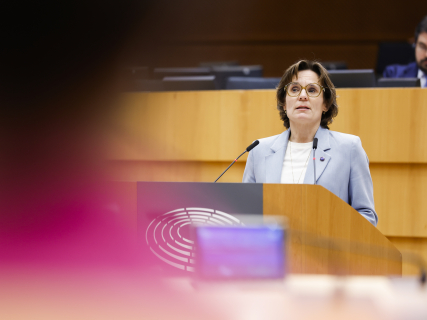

Problems in the supply of medicines in Europe are becoming more frequent. A growing concern that, according to some political leaders, could worsen with new regulatory demands. “We are increasingly having more problems with the supply of medicines. This worsens if we create additional burdens for their production,” German MEP Oliver Schenk reproached this week in the Plenary Session of the European Parliament.
Her intervention was addressed to the European Commissioner for the Environment, Jessika Roswall, who was listening from the hemicycle. The response was clear, though conciliatory: “We want to support a strong pharmaceutical system,” defended the former Swedish Minister for European Affairs. The exchange reflects the growing clash between the environmental objectives of the European Union and the economic sustainability of a strategic sector such as the pharmaceutical one.
The origin of the conflict: the directive on water treatment
At the heart of the debate is the application of the new European directive on wastewater treatment, a regulation that represents a structural change in the environmental regulation of the pharmaceutical sector. For the first time, the European Union explicitly introduces the principle of “polluter pays” in this area, through the so-called Extended Producer Responsibility (EPR).
This mechanism implies that companies are no longer only responsible for manufacturing and marketing medicines, but also for managing the environmental impact of the waste they generate, especially the micropollutants that end up in wastewater.
The directive, which member states must incorporate into their legal systems before July 2027, establishes that manufacturers, importers and distributors who market medicines must bear part of the cost of eliminating these residues.
Who pays the bill and how much does it cost?
One of the most controversial points of the regulation is its economic impact. According to the legal text, companies must cover at least 80% of the total costs of the so-called “quaternary treatment”, an advanced phase of water treatment aimed at eliminating micropollutants.
These costs include:
- Investments in new infrastructure and machinery
- Operating expenses, such as electricity, personnel, or maintenance
- Systems of surveillance and water quality control
From the European Commission, they openly acknowledge that the pharmaceutical industry is one of the most affected sectors. Roswall herself has admitted having heard these concerns in multiple meetings with representatives of the sector.
However, Brussels clarifies that the burden is not total. “The primary, secondary, and tertiary costs will continue to be covered by public budgets,” explained the commissioner. That is to say, the business effort is limited to the most advanced phase of treatment.
Even so, there are doubts about whether the calculations are realistic. Community sources admit that costs could be underestimated and assure that they continue analyzing the data. The current estimate places the impact at around three euros per citizen per year, although this figure could vary when the regulation is fully applied.
A mandatory collective management model
Another key aspect of the directive is that companies will not be able to manage these obligations individually. The text establishes the creation of collective organizations, called producer responsibility organizations, which will centralize the entire process.
These entities will have several functions:
- Collect the economic contributions from companies
- Manage jointly the elimination of waste
- Guarantee regulatory compliance
- Undergo annual independent audits
The objective is to ensure a homogeneous and efficient application of the system, avoiding inequalities between companies and Member States.
In data
Key dates:
- December 31, 2028: It is the deadline for Member States to apply these liability measures for companies.
- 2033 - 2045: During this period, quaternary treatment will be progressively installed in cities, largely financed by these contributions.
The doubts of the European People's Party
Despite sharing the principle that “whoever pollutes pays”, the European People's Party has expressed serious reservations about the implementation of the rule.
According to this group, the European Union could be “reaching its regulatory limits”. The main fear is that the increase in costs will especially affect generic medicines, whose prices are highly regulated and whose margins are reduced.
“We are going to have a reduction in production that will affect patients,” warned Schenk, alerting of possible consequences in access to essential treatments.
A debate that escalates in the European Parliament
The controversy will not remain in a specific exchange. Schenk has promoted a formal debate in the European Parliament that will be raised to the April plenary session.
The objective is to question whether the European Commission can justify the application of the regime without a comprehensive impact assessment. Specifically, the possibility of activating a regulatory pause mechanism, known as “stop the clock”, is being considered, which would allow temporarily suspending the application of certain provisions.
The doubts also reach the circle of the President of the Commission, Ursula von der Leyen. From her political family, they point out questions about:
- The proportionality of the system
- The reliability of cost estimates
- The impact on the availability and affordability of medicines
“Some deputies, interested parties, and Member States have repeatedly raised these doubts, which remain unresolved,” they denounce.
The response from Brussels: balance between health and environment
Faced with criticism, the European Commission defends its approach. It insists that a strong and competitive pharmaceutical industry will remain a pillar of the European Union, while underlining the need to address the problem of micropollutants.
These residues, largely from medicines, pose a growing risk to aquatic ecosystems and human health.
Brussels trusts that the directive includes sufficient flexibility mechanisms to avoid supply problems. Among them:
- Measures for States to guarantee access to generic medicines
- Possibility of using public funds in exceptional cases
- Promotion of good industrial practices
Roswall has assured that in the coming months, work will be intensified to prevent any negative impact on the supply.
New incentives for the industry
Beyond the costs, the directive introduces new obligations regarding transparency. Companies must provide each year:
- Precise data on the quantities of substances marketed
- Detailed information on their environmental hazardousness
- Indications on their biodegradability
Additionally, the contribution system will be variable. Not all companies will pay the same, as two main factors will be taken into account:
- The volume of marketed substances
- The level of environmental risk of said substances
This approach seeks to generate incentives for the industry to invest in more sustainable and less polluting medicines.
A delicate balance
The debate opened in Brussels reflects a broader dilemma that crosses European politics: how to reconcile the ecological transition with industrial competitiveness and social well-being.
On the one hand, the need to protect the environment and reduce water pollution is unquestionable. On the other hand, there is the risk that a too demanding regulation affects key sectors and, ultimately, the citizens.
The final decision will depend on the capacity of the European institutions to find a balance between both objectives. Meanwhile, the struggle between the Commission and the pharmaceutical industry will continue to mark the political agenda in the coming months.
What is at stake is not only who pays the pollution bill, but also the future of access to medicines in Europe and the sustainability of its healthcare system.