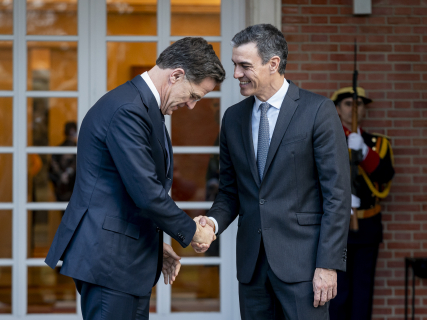

“At the beginning of last year, Spanish defense spending was approximately 1.3–1.4%, and in April I received a call from Pedro Sánchez saying they would go to 2%. And they did,” were the praises of the NATO Secretary General to Spain this Thursday after the presentation of his annual report. A balance that confirms not only the growth of national investment in the sector, but also a new structural trend: the channeling of these allocations towards the modernization of equipment and technological innovation.
Spend more, but above all spend better
The latest conflicts in the Middle East and in Ukraine demonstrate that military superiority is not solely a matter of the volume of resources, but of the speed of adaptation. On each occasion that the debate reopens in Brussels about the economic efforts that each State must make to strengthen its contributions to the Alliance, diplomatic sources repeatedly warn that it is not about spending more, but about spending better.
The Government emerges from the annual balance not only with the approval for having reached the stipulated minimum, but also with the confirmation of being one of the allies that has committed to taking advantage of this process for the technological modernization of its armed forces. Reports indicate that in recent years a profound strategic change has occurred in the structure of military spending to prioritize innovation and the acquisition of advanced systems.
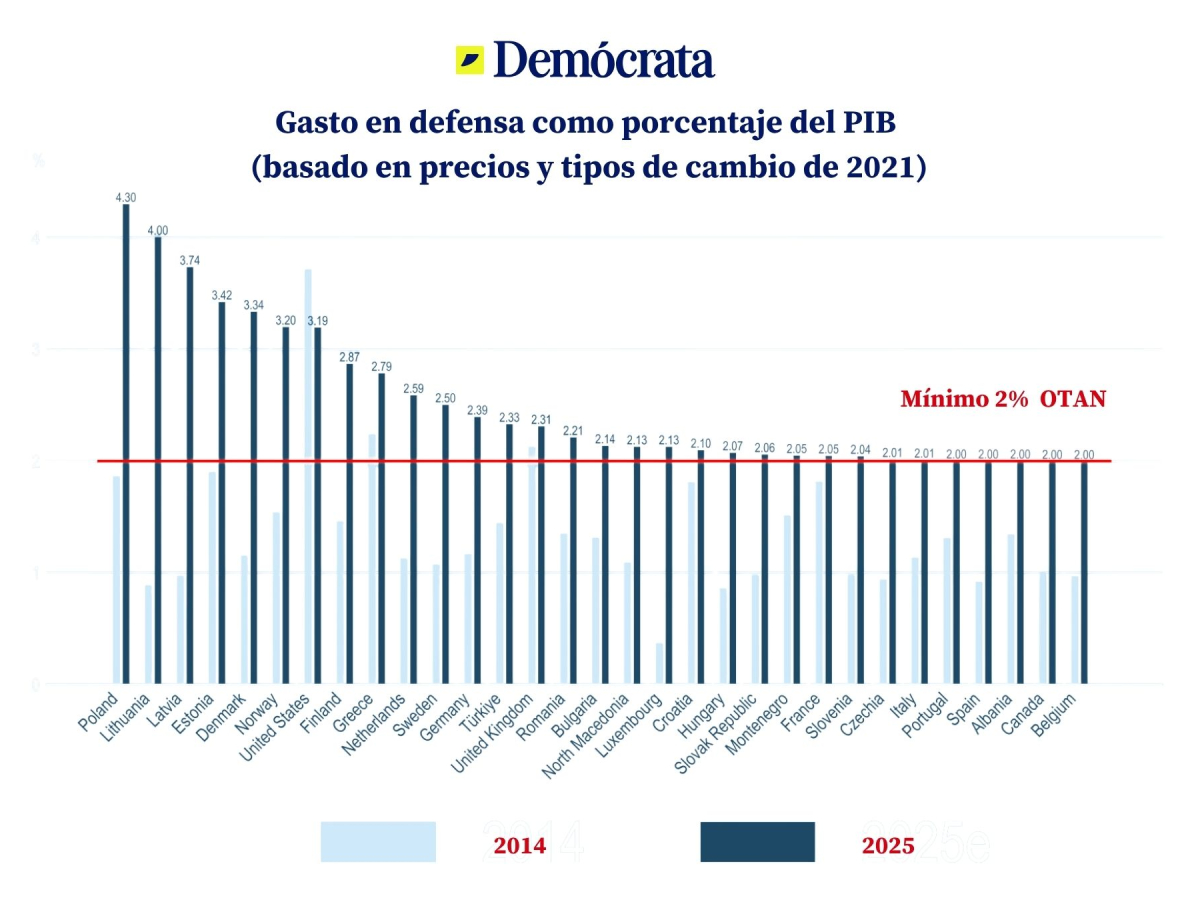
The key metric used by the Alliance to measure modernization is the percentage of the defense budget dedicated to equipment, which specifically includes research and development linked to large systems. From this analysis, Spain emerges with a record figure.
It allocates almost half of its total spending, 44.17%, to equipment and innovation. This figure allows it to widely exceed the minimum guideline of 20% set by the allies at their last summit.
It is enough to take a look at the investments of the other partners to configure a map of priorities in terms of security. Spain is ahead of other major allied powers in proportional terms. The United States invests 29.69% in innovation, the United Kingdom 35.98%, Germany 29.7% and France 30.04%. The final picture is still the result of a growing effort, as confirmed by the consulted sources. In 2023, Spanish investment was 27.39%, and in just two years it has made a leap of almost 17 percentage points.
A profound change in the structure of spending
To achieve this milestone, the composition of the national budget has been significantly transformed. Historically, Spain dedicated most of its funds to personnel expenditure, but the 2025 report shows a profound shift in these priorities.
In 2014, personnel expenditure accounted for 67.34%. Currently, it has decreased to 37.87%. This reduction of almost thirty points is what has allowed resources to be transferred towards modernization and technology. The result is clear: more operational capacity for each euro invested.
This change does not necessarily imply a reduction in the weight of the Armed Forces, but a strategic reorientation towards a more efficient model adapted to current challenges, where technology plays a central role.
Brand Spain in strategic projects of the Alliance
The Spanish commitment, as they point out in Brussels, is not only appreciated in the investment figures, but also in its involvement in some of NATO's most advanced projects.
Spain is one of the sixteen allies committed to the Allied Software for Cloud Services program, an initiative whose objective is to integrate artificial intelligence and advanced data analysis to facilitate real-time decision-making on the battlefield.
In addition, it is part of a select group of twelve countries that are driving the Allied Submarine Battle Space Mission Network. This project seeks to create an underwater communications architecture to connect drones, sensors, and submarines, protecting critical infrastructure such as data cables.
Added to this is its contribution to NATO's innovation fund, endowed with one billion euros, considered the first multinational sovereign venture capital fund of its kind. Its objective is to invest in deep tech start-ups that respond to security and resilience needs.
DIANA and the technological acceleration
During the last summit of the Alliance held in The Hague, the allies adopted the Rapid Action Plan, designed to introduce technological innovations in the armed forces at an unprecedented speed.
In this context, Spain actively participates in the DIANA accelerator, a platform that connects civilian and military innovators to develop solutions in areas such as biotechnology, quantum computing, and autonomous systems. This approach reinforces the importance of dual technology, that is, technology that has both civilian and military applications.
High-end capabilities with international projection
Thanks to all these investments, Spain contributes technological capabilities in high-demand missions within NATO. Among them stand out its participation in aircraft carrier strike groups, ballistic missile defense missions and advanced space surveillance operations from Germany.
These contributions consolidate the country's role as a relevant partner within the Euro-Atlantic security system and demonstrate the real impact of the modernization undertaken in recent years.
The European impetus of the AGILE program
Now, however, the challenge of innovation in defense does not concern solely NATO. The European Commission also wants to play a relevant role and this very week has presented its new AGILE program, endowed with 115 million euros, with the objective of accelerating the development of technologies in this field.
It is a pilot program that seeks to shorten the timelines that separate research from its practical application. To do this, it will focus on disruptive technologies such as artificial intelligence, quantum computing or drones, and will place special emphasis on the role of small and medium-sized enterprises, including startups and growth-stage companies.
The objective is to integrate these actors, traditionally distant from the defense sector, into an ecosystem that demands rapid, flexible, and low-cost solutions.
A more agile model to accelerate innovation
One of the most innovative elements of the plan is its administrative design. AGILE promises to reduce the time for granting aid to barely four months, an unprecedented figure in European programs. In addition, it is expected that the funded technologies can reach the armed forces within a period of between one and three years.
The instrument will finance between 20 and 30 projects, covering up to 100% of the eligible costs. It also incorporates a retroactive clause that will allow companies to recover expenses incurred before the closing of the call.
All of this is structured into two main lines, on the one hand the development of products oriented towards specific missions and on the other the commercialization of these solutions to facilitate their arrival to the market, always aligned with the most urgent needs of the Member States.
Throughout this entire process, the sector raises a key issue, that investments remain within the national scope. This was expressed by the president of Indra, Ángel Escribano, in a recent conversation.
According to him, the most important thing is that defense investment stays at home, allowing the development of the national industry's capabilities, generating quality employment, and consolidating competitive companies in the country itself.
A change of model underway
Spain has gone in a few years from being below NATO's investment standards to becoming one of the countries that lead the technological modernization within the Alliance.
The increase in spending has been relevant, but what has been truly decisive has been the change in its orientation. Less weight of structural spending and more commitment to innovation. In an international context marked by uncertainty and technological acceleration, this shift not only reinforces Spain's position, but also opens a broader debate about the future of European defense, strategic autonomy, and the role of national industry.
The challenge now will be to consolidate this transformation and ensure that it translates into real and sustainable long-term capabilities.